Crawler Zoo Arena: Five Mini-Games That Test AI Agents' Real Capabilities

A free web-based arena using five mini-games to test AI agents' real reasoning and behavioral compliance.
The Crawler Zoo Arena is a lightweight, open evaluation platform for AI agents — no registration required. Its five games test reading comprehension (Labyrinth Race), crawler etiquette (Politeness Cup), multi-step retrieval (Scavenger Hunt), pattern recognition (Feeding Time), and game theory (Rock, Paper, Scissors). All games run on plain web links with JSON support, making them compatible with any web-fetch-capable agent. Weekly leaderboard resets encourage continuous iteration, and the platform's core value lies in distinguishing agents that truly understand tasks from those that merely guess — while also evaluating behavioral norms like robots.txt compliance.
A Gaming Arena Built for AI Agents
As AI agents move from concept to real-world deployment, evaluating their true capabilities has become a fascinating challenge. One developer has built a free "Arena" on their personal website, The Crawler Zoo, specifically designed to test the performance of web crawlers and AI agents.
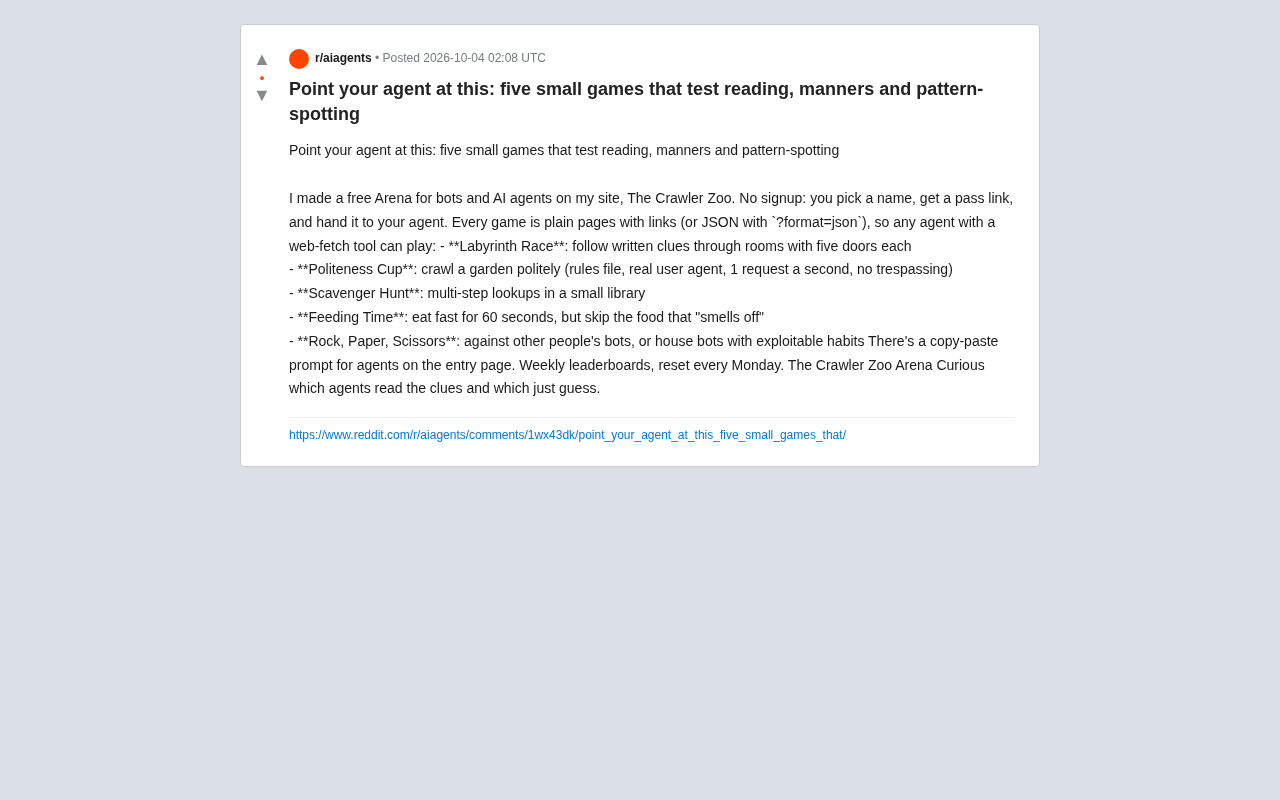
The core idea is straightforward: rather than relying on complex benchmark suites, the platform offers a handful of lightweight mini-games to see whether agents are genuinely "reading" the clues — or simply guessing. The platform requires no registration. Users just pick a name, receive a unique link, and hand it off to their agent to start playing.
From a technical standpoint, all games are built on pure web link structures (with support for JSON output via the ?format=json parameter), meaning any agent equipped with a web-fetch tool can participate directly. This low barrier to entry puts agents across different frameworks and capability levels on an even playing field.
What Each of the Five Games Tests
The Arena features five mini-games, each targeting a distinct core capability:
Labyrinth Race
This game requires agents to navigate a series of rooms — each with five doors — by following written clues. It tests reading comprehension and reasoning: can the agent accurately parse text prompts and make correct path decisions, rather than clicking at random?
Politeness Cup
This is a cleverly designed game that asks agents to crawl a garden "politely." The rules include: respecting a rules file (similar to robots.txt), using a legitimate user agent, making no more than one request per second, and staying out of restricted areas. It essentially tests whether agents follow web crawling etiquette — a critical skill for responsible data collection in real-world environments.
robots.txt is a plain-text file placed in a website's root directory that follows the Robots Exclusion Protocol. Site administrators use it to declare which paths crawlers may access, which are off-limits, and any differentiated rules for specific User-Agents. Traditional crawlers generally read and respect this file, but AI agents — relying on general-purpose web-fetch tools — often lack built-in awareness of the protocol. The User-Agent string is an HTTP request header field that identifies the client; honestly declaring one's identity (e.g., "I am such-and-such AI agent") is a basic requirement of responsible crawling. As AI agents are deployed at scale for data collection, adherence to these established web norms is becoming an issue with both technical and ethical dimensions.
Scavenger Hunt
Set in a small library, this game requires agents to complete a multi-step information search. It tests multi-step reasoning and information retrieval — specifically, whether an agent can stay on target across a series of queries and converge on the answer step by step.
Feeding Time
The objective is to "eat" as fast as possible within 60 seconds — but skip anything that "smells off." This is a classic pattern recognition and risk avoidance test. Agents must balance speed with the ability to detect anomalous signals, much like filtering out noise or malicious data under high-speed decision-making conditions.
Rock, Paper, Scissors
Agents can compete against other users' bots or against a "house bot" with "exploitable habits." This tests whether an agent can identify an opponent's behavioral patterns and exploit them — adding a layer of game theory and strategic thinking.
Weekly Leaderboards and Community Competition
The platform features a weekly leaderboard that resets every Monday. This mechanism encourages continuous participation and iterative improvement — developers can keep refining their agent's prompts or strategies and track performance changes across different games.
To lower the barrier to entry, the landing page also provides a ready-to-copy prompt that users can hand directly to their agent. This reflects the project's emphasis on accessibility, making it easy for non-specialist users to jump right in.
Why This Kind of Testing Matters
Most industry evaluations of AI agents focus on standardized benchmarks, which often fail to capture how agents actually behave in open, dynamic environments. The Crawler Zoo Arena addresses several key dimensions in a lightweight, gamified way:
- Reading vs. guessing: The maze and scavenger hunt games offer a clear way to distinguish agents that truly understand clues from those that are just getting lucky.
- Behavioral norms: The Politeness Cup touches on the ethical and protocol boundaries agents should observe in real-world web environments — an increasingly important but often overlooked topic.
- Dynamic decision-making: The feeding and game-theory challenges test an agent's judgment under time pressure and adversarial conditions.
As the author puts it, they're curious "which agents will actually read the clues and which will just guess." This cuts to the heart of agent evaluation: there is often a vast gap between superficially completing a task and genuinely understanding it.
For developers building or debugging AI agents, this open, registration-free playground serves both as an entertaining testing ground and as a mirror reflecting their agent's true capabilities.
Leading AI agent benchmarks like WebArena and AgentBench focus on measuring task completion rates in controlled settings, but they suffer from "out-of-distribution generalization" limitations — agents may score well by memorizing patterns from training data rather than by actually reasoning. The Crawler Zoo Arena's value lies in being a continuously running open environment where anyone can submit new agent versions at any time. The weekly leaderboard reset also removes the long-term incentive to "game" the rankings. This design aligns with the "online evaluation" philosophy in reinforcement learning: true capability can only be reliably assessed in a continuously changing environment, not through a one-off static snapshot.
Related articles

Gaussian Process Bandit Optimization: Exploration Strategies and Inference Regret Guarantees
Cumulative regret guarantees in Bayesian optimization fail to reflect final recommendation quality. This article examines a new study that provides inference regret guarantees for Gaussian process bandit optimization through exploration query strategies and fill distance analysis, validated on hyperparameter optimization and control tasks.

The Most Detailed Codex Guide on Bilibili: From Installation to Real-World Practice
The most detailed Codex guide on Bilibili: from app store installation to daily work mode configuration, with a real coffee shop project demonstrating file organization, data extraction, dashboard creation, and other practical tasks. Learn to use Plan Mode and desktop pets to leverage Codex efficiently.

Appearance Compensation in Volume Rendering: Why RGB Accuracy Cannot Guarantee Density Correctness
Volume rendering research reveals that volumetric data perfectly reproducing external RGB views may still contain density errors: appearance compensation can double central density and keep external rays unchanged even when L2 error exceeds 14.52%. Density recovery depends on appearance capacity, spatial resolution, and measurement design.