CreatorHat: A Safari YouTube SEO Tool Powered by Apple Intelligence
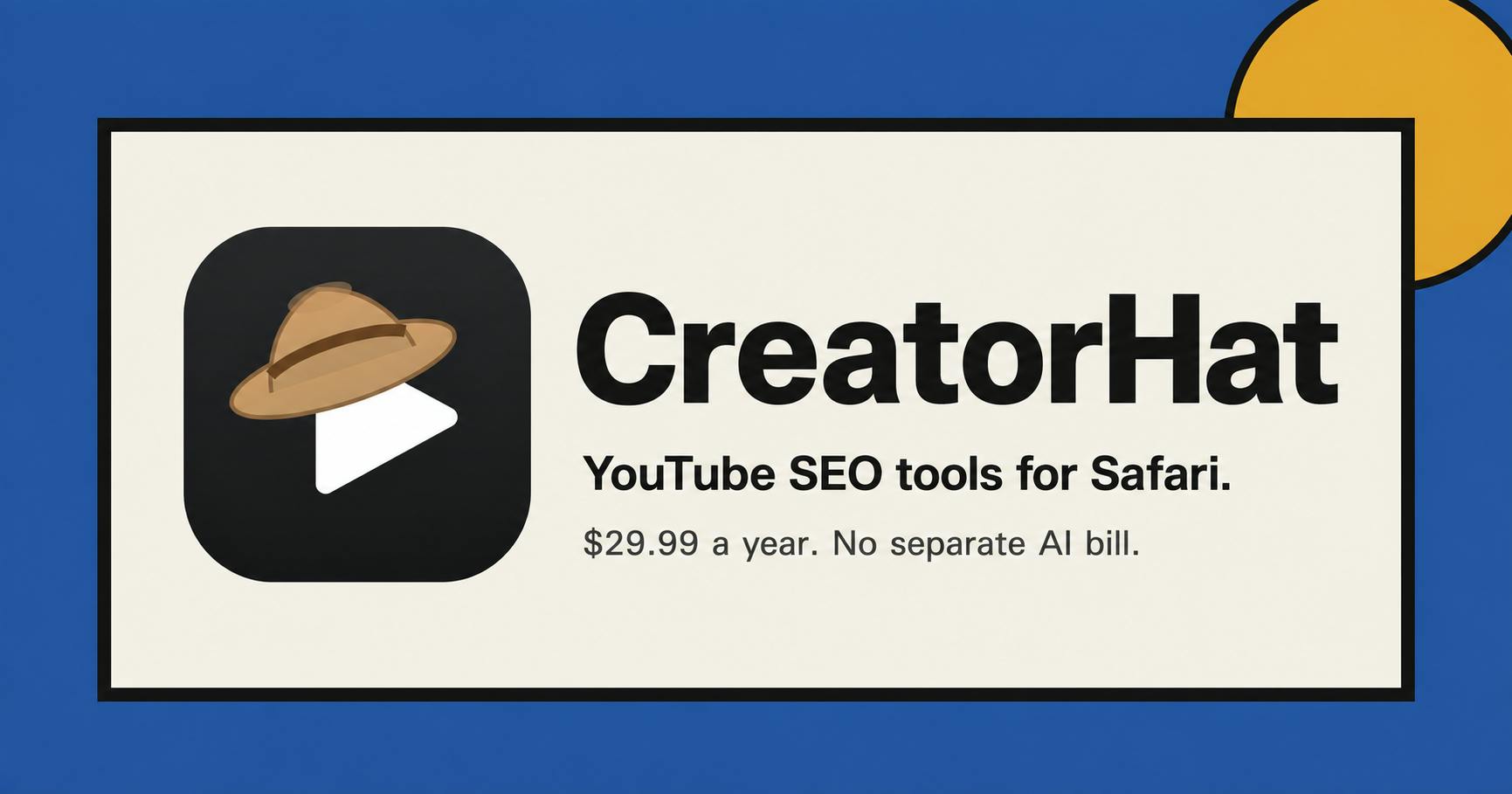
A Safari-based YouTube SEO tool that uses Apple Intelligence for private, on-device AI writing assistance.
CreatorHat is a Safari browser extension built by an indie developer, offering YouTube creators SEO features like keyword research, breakout video discovery, and rank tracking. Its key differentiator is deep Apple Intelligence integration: videos are transcribed locally on Mac and AI-generated title/description suggestions never leave the device, with no separate AI subscription costs. Priced at $29.99/year, it's affordable for its category — but requires macOS 26 and a newer Apple Intelligence-capable Mac, effectively limiting its audience to higher-end Apple users.
For creators who rely on YouTube for their livelihood, SEO optimization and writing content metadata can be a time-consuming and tedious chore. CreatorHat, which recently launched on Product Hunt, aims to solve this problem without ever leaving Safari — and brings Apple Intelligence into creators' everyday workflows. The product currently ranks 12th on Product Hunt, with 76 upvotes and 3 comments. While it hasn't gone viral, the technical approach it takes is well worth discussing.
A YouTube SEO Tool That Lives Inside Safari
CreatorHat's core identity is a YouTube SEO toolkit, but it exists as a Safari browser extension rather than a standalone app or web service. This means creators can conduct keyword research, track rankings, and more — all while browsing YouTube — without having to juggle multiple tabs and tools.
According to its official description, CreatorHat offers three main capabilities: identifying videos that "outperform the channel average" to help creators spot potential breakout topics; conducting YouTube keyword research to inform titles and tags; and tracking how a video's ranking changes in search results. Together, these features form a fairly complete SEO loop — from topic discovery and optimization to performance monitoring.
Embedding these features directly into Safari reduces the friction of switching between tools. For small-to-mid-size creators who deal with large volumes of video data every day, this "work in place" experience clearly addresses a real pain point.
An On-Device Experiment with Apple Intelligence
What truly sets CreatorHat apart from similar SEO tools is its deep integration with Apple Intelligence. When a creator uploads a video, CreatorHat transcribes it locally on the Mac, then uses Apple Intelligence to suggest titles and descriptions directly inside the YouTube Studio interface.
The most critical aspect of this workflow is its privacy promise: all transcripts and AI-generated text stay entirely on the user's Mac and are never uploaded to third-party servers. In an era when many AI tools rely on cloud-based large language models and routinely require users to upload their data, this on-device approach is a clear and meaningful differentiator.
It also delivers another practical benefit — "no separate AI bill." Many creator tools charge extra for calling cloud models like GPT, or place usage caps on AI features. By leveraging the processing power and system-level AI capabilities built into Apple devices, CreatorHat absorbs these costs locally. Users don't pay anything extra for AI features.
Apple Intelligence is Apple's system-level AI framework, introduced in 2024 and integrated into iOS 18, iPadOS 18, and macOS Sequoia (15) and later. It's powered by small language models running on-device and handles tasks like text generation, summarization, and rewriting. For more complex requests, it routes queries through Apple's own "Private Cloud Compute" servers — which Apple claims do not retain user data. Unlike tools that call OpenAI or Anthropic APIs directly, Apple Intelligence inference runs on the Neural Engine inside Apple Silicon (A17 Pro and M-series chips). This is the hardware foundation that enables CreatorHat's promise of "no uploads, no extra charges" — and it explains why the product has strict device requirements. Only newer Macs with specific chips have the on-device compute needed to run local models.
Pricing and Requirements: The Trade-Offs of $29.99/Year
CreatorHat uses a subscription model priced at $29.99 per year, with a 7-day free trial. Compared to many creator tools that charge monthly and bill AI features separately, this pricing is quite restrained — especially given that AI capabilities are included at no extra cost.
That said, the requirements are clear. CreatorHat requires macOS 26 or later, and its AI features depend on Apple Intelligence. This means only users with a newer Mac that supports Apple Intelligence, running the latest OS, can access the full value of the product. In practice, this limits the audience to a relatively premium segment within the Apple ecosystem.
Who Is CreatorHat For?
From a product design perspective, CreatorHat's target user is well-defined: YouTube creators who use Mac and Safari, care about data privacy, and want to reduce their tool subscription costs. For this group, integrating SEO research and AI-assisted writing into a familiar browser environment can genuinely save time.
But for creators who work cross-platform, use Windows or Chrome, or have devices that don't support Apple Intelligence, CreatorHat simply isn't an option right now. This is both a deliberate positioning choice and the product's most significant current limitation.
macOS 26 is the next-generation desktop OS version number announced at Apple's 2025 developer conference (WWDC25). Its official consumer name has not yet been finalized (historically, Apple names macOS releases after California landmarks). At the time of writing, the system is still in developer beta — meaning users need not only supported hardware, but must also proactively install an unreleased beta OS to access CreatorHat's full AI features. This raises the barrier to entry considerably, and partly explains why the product has seen relatively modest traction on Product Hunt.
A Product Direction Worth Watching
CreatorHat was built by indie developer Nathan Kontny, and is fundamentally an experiment in combining system-level AI capabilities with a focused vertical workflow. Rather than building a sprawling cloud platform, it chose to go deep within the Apple ecosystem — trading cloud infrastructure for privacy and cost advantages through local AI.
As system-level AI capabilities like Apple Intelligence continue to mature, we may see more lightweight tools like this emerge — ones that don't depend on expensive cloud API calls, but instead turn the device itself into an AI workstation. Whether CreatorHat can carve out a durable position in the competitive creator tools market remains to be seen, but the "local AI-first" philosophy it represents is worth watching — and worth learning from.
Related articles
AI Agent Fundamentals: The Three Core Components — Brain, Memory, and Tools
A beginner's guide to AI Agents: covering the three core components (brain, memory, tools), four stages of LLM deployment, and why Agents matter for real business use cases.
Boycotting Software That Doesn't Support Linux: One Developer's Philosophy of Choice
A Linux-only developer shares his philosophy of boycotting non-Linux software — without sacrificing productivity — and explains how coding agents like Claude Code are closing the gap with commercial tools.
Why Do All AI-Generated Projects Look the Same? The Aesthetic Homogenization Problem in Vibe Coding
Why do vibe coding projects all use purple gradients and dark glassmorphism? We break down the technical roots of AI aesthetic homogenization and how to escape it.