Cresta AI Hands-On Review: Can Real-Time Guidance Really Boost Team Performance?

Cresta AI amplifies employee performance through real-time guidance, but effectiveness depends on scenario standardization and organizational execution.
The article explores a Reddit user's question about whether Cresta AI can improve team performance, analyzing its "analytics layer + execution layer" approach: extracting behavioral patterns from high-performing employees' conversations and pushing prompts during live dialogues. It notes that real-time guidance has higher hit rates in standardized scenarios but may interfere with judgment in complex consultative sales. Reddit feedback is divided—managers value conversation analytics more than frontline prompts, and some employees ignore pop-ups due to imprecise prompts. The article emphasizes that tool effectiveness strongly depends on historical data quality and whether supervisors translate insights into continuous coaching. Cresta is a human-AI collaborative performance tool worth watching, but its ceiling depends on scenario fit and organizational execution.
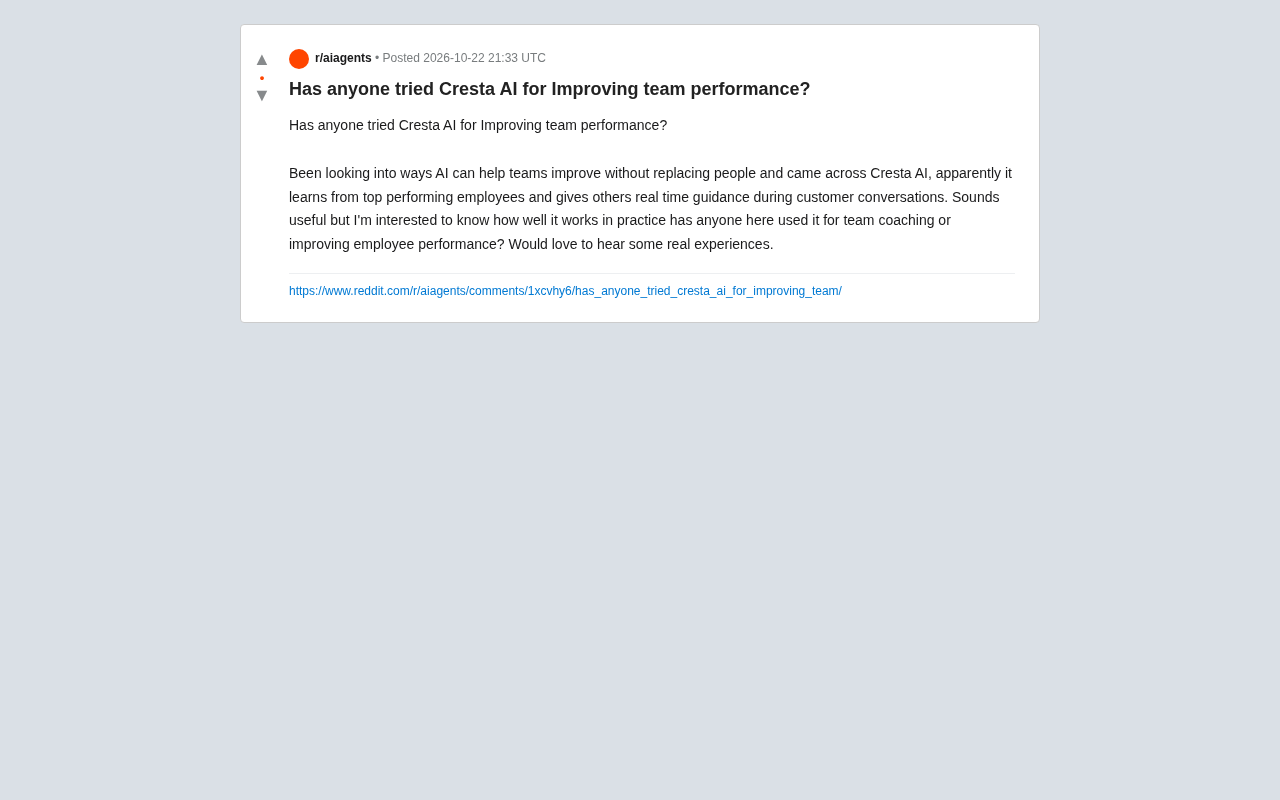
A Reddit user recently posted asking whether Cresta AI can genuinely improve team performance without replacing employees. They mentioned Cresta's core mechanism: learning from top performers' behavior and providing real-time guidance to others during customer conversations. The description sounds compelling, but there's often a gulf between "sounds useful" and "actually works."
What Cresta AI Actually Does
Cresta positions itself not as a replacement for agents, but as a "performance amplifier." Its technical approach can be broken into two layers: an analytics layer that identifies high-performing employees' behavioral patterns from historical conversation data—which scripts led to conversions, which follow-up questions resolved objections, which pacing controlled call duration—and an execution layer that pushes these patterns to current employees as prompts during live conversations.
The cleverness of this design lies in extracting "best practices" from training manuals and turning them into real-time feedback during conversations. Traditional agent training has strong lag: new hires finish courses, memorize scripts, but when they actually go live, they face wildly varied customers, and knowledge retrieval often can't keep up. Cresta attempts to fill this gap at the moment the conversation happens.
Technical Background: Behavior Pattern Mining and Real-Time Recommendation
The key technologies behind tools like Cresta typically involve two components in conversational AI: "best practice mining" and "real-time recommendation." In the analytics layer, the system performs speech-to-text, intent recognition, sentiment analysis, and conversation flow modeling on historical dialogues, then uses statistical or machine learning methods to identify high-frequency behavioral features of high-performing employees at specific moments (e.g., objection handling, closing deals). In the execution layer, the system needs to assess the current conversation state within hundreds of milliseconds and retrieve the most matching prompt from a candidate script library—typically relying on low-latency streaming inference and a hybrid architecture of rule engines and models.
It's worth noting that such systems don't truly "understand" the deep semantics of conversations; they rely on pattern matching and probabilistic recommendation. Therefore, when customers express needs outside the training distribution, the relevance of prompts drops significantly. This is why scenario standardization becomes a key variable determining effectiveness.
The Real Value and Boundaries of Real-Time Guidance
Based on public information and user discussions, the benefits most frequently cited for Cresta in sales and customer service scenarios center on several aspects: shortening new employees' ramp-up time, providing script prompts at key conversation moments (such as price objections or cancellation retention), and giving team supervisors quantifiable coaching evidence rather than subjective impressions from listening to recordings after the fact.
But it's important to view this calmly: the value of real-time guidance is highly dependent on scenario standardization. In renewal, collections, and basic customer service scenarios where scripts are relatively fixed, prompt hit rates will be higher; in complex consultative sales where customer demands are highly non-standard, the system's "standard answers" may actually interfere with employees' on-the-spot judgment. This is also a common challenge facing most AI sales tools in real-world deployment.
Voices from Real Users
In the Reddit thread's discussion, feedback showed clear divergence. According to the original poster and some respondents, those in favor believe Cresta's conversation analytics genuinely expose behavioral differences within teams, transforming coaching from "feeling who's not good" to "seeing where they drop off"—the value to managers may exceed the real-time prompts to frontline employees. Skeptics point out that real-time pop-up prompts are easily ignored in fast-paced conversations, and if prompts aren't precise enough, employees will gradually develop a habit of "turning it off."
A frequently mentioned prerequisite for deployment is that Cresta's effectiveness is strongly correlated with data quality and team cooperation. If historical conversation data itself has insufficient samples or uneven quality, the learned "best practices" will be distorted; if supervisors don't translate system insights into continuous coaching actions, the tool itself won't automatically bring performance improvements.
The "Alarm Fatigue" Phenomenon of Real-Time Prompts
The "employees gradually turning off prompts" mentioned in the Reddit discussion is not an isolated case—in human-computer interaction, this is called "alarm fatigue" or "prompt fatigue." When system prompts appear frequently but lack accuracy, users will actively ignore or even disable the prompt channel, rendering the tool useless. In customer service and sales scenarios, this phenomenon is particularly prominent because conversation pace is fast and employee cognitive load is high—any low-value pop-up is perceived as interference.
Common approaches to mitigate this include: raising the trigger threshold for prompts, tiered delivery based on employee proficiency, and allowing employees to provide feedback on prompts to iterate the model. But all these approaches depend on continuous data回流 and operational investment—they can't be solved with one-time deployment.
Things Worth Thinking Through Before Purchasing
For teams evaluating Cresta, the decision can be broken into several questions. First, is your business scenario standardized enough for real-time prompts to have stable utility? Second, does the team have sufficient historical conversation data for the system to learn from, and is data governance in place? Third, are managers willing to incorporate system-generated insights into daily coaching workflows, rather than treating it as a "install and it works" black box?
Cresta represents a rising category of "human-AI collaborative performance tools": AI doesn't replace people but makes an organization's tacit knowledge explicit and real-time. The direction is worth taking seriously, but its ceiling depends on scenario fit and organizational execution, not on how smart the model itself is. To the original poster's question, the honest answer is: it can help in the right scenarios, but it won't do your team management for you.
One-line Summary
Cresta AI amplifies employee performance through real-time guidance, but effectiveness depends on scenario standardization and organizational execution.
Paragraph Summary
The article explores a Reddit user's question about whether Cresta AI can improve team performance, analyzing its "analytics layer + execution layer" technical approach: extracting behavioral patterns from high-performing employees' conversations and pushing prompts during live dialogues. The article notes that real-time guidance has higher hit rates in standardized scenarios (such as renewals and basic customer service), while in complex consultative sales it may interfere with employee judgment. Reddit discussion feedback is divided—managers see greater value in conversation analytics than frontline prompts, and some employees ignore pop-ups due to imprecise prompts. The article emphasizes that tool effectiveness strongly depends on historical data quality and whether supervisors translate insights into continuous coaching. Cresta belongs to the human-AI collaborative performance tool category—the direction is worth watching, but its ceiling depends on scenario fit and organizational execution.
Related articles

Amphibious Transforming Drone: Beyond 100x Power Savings, What Are the Real Needs?
Is the amphibious transforming drone just a gimmick? Starting from the 100x power difference of the M4 Morphobot, explore real application scenarios and thesis topic ideas, analyzing boundary conditions where pure drones and pure ground robots both fail.

Warhound Raises $200 Million: Genetically Engineered "War Dogs" Paired with Anduril Gear
Warhound raises $200M, backed by Ben Lamm and Palmer Luckey, to genetically engineer dogs for military and law enforcement use and equip them with Anduril gear. This article analyzes its technology direction, funding logic, and ethical controversy.

Claude API Comes to Google Cloud: IAM Integration and SDK Access Guide
Anthropic hosts the full Claude API on Google Cloud with IAM-controlled permissions and unified billing. This guide covers the Vertex AI and Anthropic-hosted entry points, IAM role configuration, and SDK access.