CrewCode: An Open-Source Desktop Tool for Parallel Scheduling of Multiple AI Coding Agents

CrewCode is an open-source desktop tool for running and orchestrating multiple AI coding agents in parallel.
CrewCode is a free, open-source Electron-based desktop application that enables developers to run multiple AI coding agents simultaneously through Git Worktree isolation. Supporting major tools like Claude Code, Codex, and OpenCode, it offers crew orchestration, delegated threads, context handoff summaries, and a local plugin platform with MCP protocol support, consolidating multi-agent workflows into a single interface.
When AI Coding Agents Start "Working as a Team"
With the rise of AI coding assistants like Claude Code, Codex, and OpenCode, more and more developers are accustomed to having AI agents directly intervene in codebases to make modifications. But a practical problem follows: when you want to run multiple agents simultaneously handling different tasks, you often need to switch back and forth between multiple terminal windows, git worktrees, PR pages, and each agent's independent interface, fragmenting your workflow into pieces.
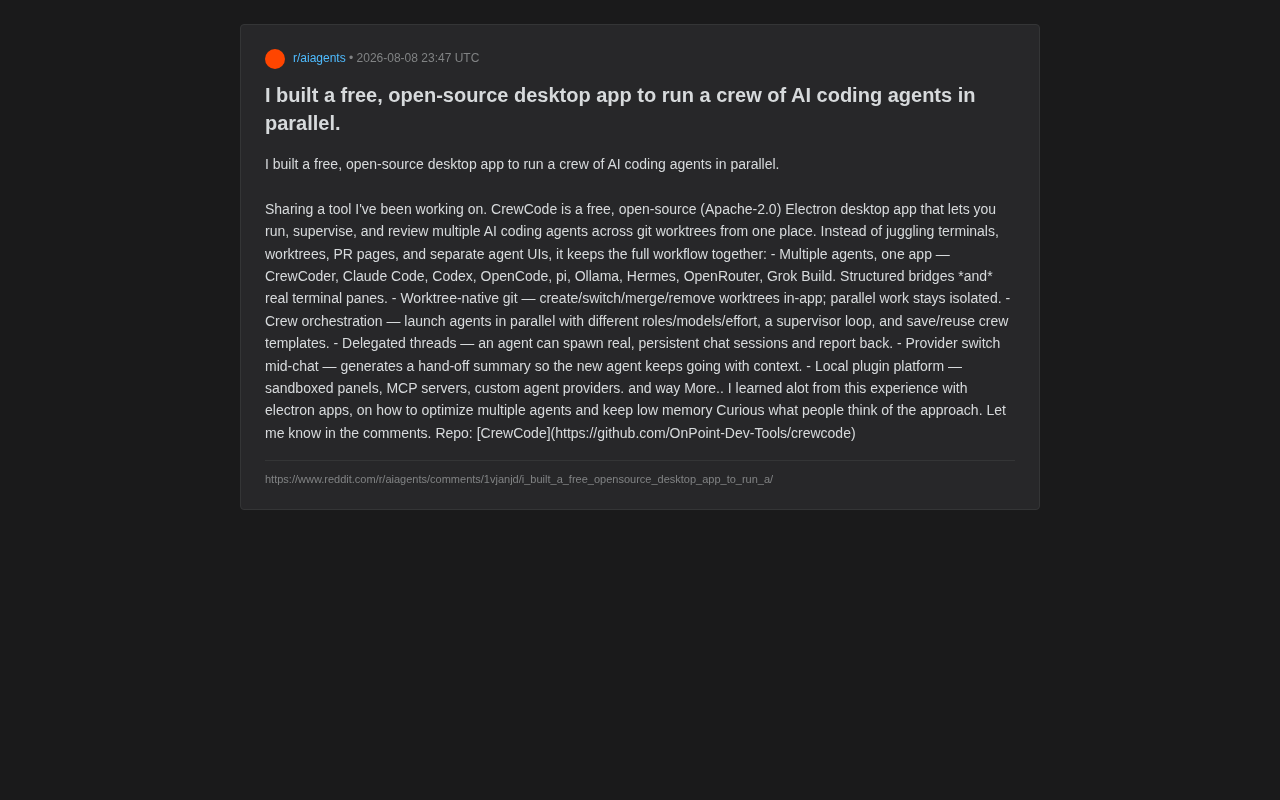
Recently, a developer shared his open-source project CrewCode on Reddit — a free Electron-based desktop application (under the Apache-2.0 license) designed to consolidate the entire process of "running, supervising, and reviewing multiple AI coding agents" into a single interface. The project is open-sourced on GitHub, and the author candidly states this was an attempt where he "learned a lot" through practice, especially regarding how to optimize multi-agent execution and control memory usage.
Core Design: An Isolation Architecture Centered on Git Worktree
CrewCode's most noteworthy design philosophy is its worktree-native architecture. For those unfamiliar, git worktree allows checking out multiple branches into different directories within the same repository, enabling truly parallel development without interference.
From a technical perspective, Git worktree is a feature introduced in Git 2.5 (2015) that lets developers check out multiple working directories from the same repository simultaneously, each corresponding to a different branch. Traditionally, if you wanted to work on two branches at once, you'd either frequently stash/checkout or clone the entire repository. The elegance of worktree lies in this: all working directories share the same .git directory (i.e., the object database), so they consume virtually no additional disk space, while each directory maintains its own independent working area and index. In multi-agent scenarios, this means each agent can operate in a physically isolated filesystem path, eliminating file lock conflicts and real-time merge conflicts — differences between branches only need to be handled during the final merge phase.
CrewCode builds this capability directly into the application: users can create, switch, merge, and delete worktrees within the app. This means when you dispatch multiple AI agents to work simultaneously, each agent's changes are isolated in an independent worktree, avoiding the chaos of "multiple agents modifying the same code at once." This worktree-based isolation mechanism is the key prerequisite for ensuring safety when running multiple agents in parallel.
Compatible with Major AI Coding Agents and Real Terminals
In terms of agent support, CrewCode takes a "cast a wide net" approach, supporting multiple agents and model sources including CrewCoder, Claude Code, Codex, OpenCode, pi, Ollama, Hermes, OpenRouter, and Grok Build.
Notably, it not only provides structured "bridge" interfaces but also retains real terminal panes. This dual-track design is quite pragmatic — structured bridging facilitates programmatic scheduling and supervision, while real terminals preserve flexibility, allowing developers to directly intervene with command-line operations when needed, without being "locked in" by the tool.
Crew Orchestration: Letting Multiple AI Agents Each Play Their Role
The "Crew" in CrewCode's name reveals its core ambition: Crew orchestration.
Multi-Agent Orchestration is one of the core trends in AI engineering for 2024-2025. Its theoretical foundation traces back to task scheduling in distributed systems and microservice orchestration patterns. In the AI domain, representative frameworks include Microsoft's AutoGen, CrewAI (Python library), LangGraph, and others. The core idea is to decompose complex tasks into multiple subtasks, assign them to agents with different "roles" or "specializations," and coordinate completion through defined communication protocols and supervision mechanisms. Key challenges include: effective utilization of context windows, information transfer loss between agents, error propagation control, and the design of human supervision intervention points. CrewCode's practice in the programming domain essentially instantiates this general paradigm into software development workflows.
Users can launch multiple agents in parallel and assign them different roles, models, and "effort" levels, coordinated by a supervisor loop. Furthermore, these crew configurations can be saved as templates for reuse. This effectively treats an "AI agent team" as a configurable, reproducible engineering asset rather than something manually assembled ad hoc each time.
Delegated Threads and Context Handoff
Two additional features reflect the author's thinking about real collaboration scenarios:
- Delegated threads: One agent can spawn real, persistent chat sessions to handle subtasks and report results upon completion. This is similar to the human team pattern of "a manager delegates tasks to subordinates, who report back when done."
- Provider switch mid-chat: When you want to switch agents or models mid-conversation, CrewCode automatically generates a hand-off summary, allowing the new agent to continue working with context rather than starting from scratch.
These two designs directly address pain points in multi-agent collaboration — how context is transferred between different agents and tasks without being lost. At the technical level, each large language model has context window limitations (e.g., Claude's 200K tokens, GPT-4o's 128K tokens), and as conversations grow, the model's "attention" to earlier information attenuates. Delegated threads avoid polluting the main thread's context with subtask details by spawning independent sessions; through structured reporting mechanisms, only key conclusions from subtasks are passed back, achieving information compression. The hand-off summary during "mid-chat provider switching" is essentially a form of context distillation — compressing the current conversation state into a briefing that a new agent can quickly understand, similar to work handover documents in human teams. In practice, this design can significantly reduce token consumption and improve the new agent's startup efficiency.
Extensibility: Local Plugin Platform and MCP Protocol Support
CrewCode also provides a local plugin platform supporting sandboxed panels, MCP (Model Context Protocol) servers, and custom agent providers. This means it doesn't try to be a closed finished product but leaves extension interfaces open, allowing developers to integrate their own toolchains or private agents.
MCP support is particularly noteworthy. MCP (Model Context Protocol) is an open protocol standard introduced by Anthropic in late 2024, designed to provide AI models with a unified way to connect to external data sources and tools. It adopts a client-server architecture: AI applications act as MCP clients making requests, while various tools (such as database queries, filesystem access, API calls) serve as MCP servers providing capabilities. The core value of MCP lies in decoupling — developers only need to implement an MCP server once, and it can be called by any AI application that supports MCP, avoiding the N×M problem of developing separate integrations for each AI tool. Currently, mainstream tools like Claude Desktop, Cursor, and Windsurf already support MCP, and it's becoming the "USB-C port" of the AI tool ecosystem. CrewCode's MCP integration enables it to connect with the broader tool ecosystem, while sandboxed panels balance extensibility with security.
Engineering Insights: Performance Challenges of Multi-Agent Parallelism
The author specifically mentioned that this development taught him a great deal about building Electron applications, with a focus on "how to optimize multi-agent execution while maintaining low memory usage."
It's worth elaborating on the technical characteristics of the Electron framework here. Electron is a cross-platform desktop application framework developed by GitHub, built on the Chromium browser engine and Node.js runtime. Well-known applications like VS Code, Slack, and Discord all use Electron. However, Electron has long been criticized for high memory usage — each Electron application essentially runs a complete Chromium instance. In CrewCode's scenario, this problem is further amplified: each AI agent may require an independent rendering process or worker thread to maintain session state, handle streaming responses, and manage terminal emulators. The optimization work the author mentioned likely involves strategies such as process pooling, lazy loading of inactive agent panels, and shared WebSocket connections.
This is actually the key to whether such tools can truly be production-ready — running multiple AI agents simultaneously, each potentially consuming significant compute and memory resources, and figuring out how to achieve parallelism without dragging down the developer's machine is a tough engineering challenge.
From an overall design perspective, CrewCode represents a clear evolutionary direction for AI coding tools: from "single assistant" to "multi-agent collaborative orchestration." Once individual agents can handle local tasks competently, how to organize multiple agents for parallel execution, isolation, collaboration, and handoff is becoming the core challenge of the next phase.
Summary
CrewCode is still in its early stages, and the author is actively soliciting feedback from the community, hoping to hear thoughts on this approach. As a free open-source project, its value lies not only in the tool itself but also in how it makes the still-exploratory workflow of "AI agent crews" tangible.
For developers who are already heavy users of Claude Code, Codex, and similar tools, if you're frustrated by the constant switching between multiple windows, branches, and agents, CrewCode offers an integration approach worth trying. Of course, its actual stability, performance, and reliability of multi-agent collaboration still await validation from more users in real projects.
Project link: CrewCode on GitHub (Apache-2.0 license)
Related articles

Gaussian Process Bandit Optimization: Exploration Strategies and Inference Regret Guarantees
Cumulative regret guarantees in Bayesian optimization fail to reflect final recommendation quality. This article examines a new study that provides inference regret guarantees for Gaussian process bandit optimization through exploration query strategies and fill distance analysis, validated on hyperparameter optimization and control tasks.

The Most Detailed Codex Guide on Bilibili: From Installation to Real-World Practice
The most detailed Codex guide on Bilibili: from app store installation to daily work mode configuration, with a real coffee shop project demonstrating file organization, data extraction, dashboard creation, and other practical tasks. Learn to use Plan Mode and desktop pets to leverage Codex efficiently.

Appearance Compensation in Volume Rendering: Why RGB Accuracy Cannot Guarantee Density Correctness
Volume rendering research reveals that volumetric data perfectly reproducing external RGB views may still contain density errors: appearance compensation can double central density and keep external rays unchanged even when L2 error exceeds 14.52%. Density recovery depends on appearance capacity, spatial resolution, and measurement design.