Cross-Session, Cross-User RAG: The Next Bottleneck and Breakthrough for AI Memory

Cross-user shared RAG caches could transform AI efficiency, but face privacy, freshness, and governance hurdles.
Starting from a Reddit user's observation about wasted AI retrieval work, this article explores the concept of cross-session, cross-user RAG—a shared knowledge cache layer that could dramatically reduce costs, improve response speed, and create a knowledge flywheel effect. It examines the technical architecture behind current session isolation, explains why shared RAG caching is valuable, and analyzes the core challenges of privacy, data freshness, and governance that must be solved for real-world implementation.
An Observation from Real-World Usage
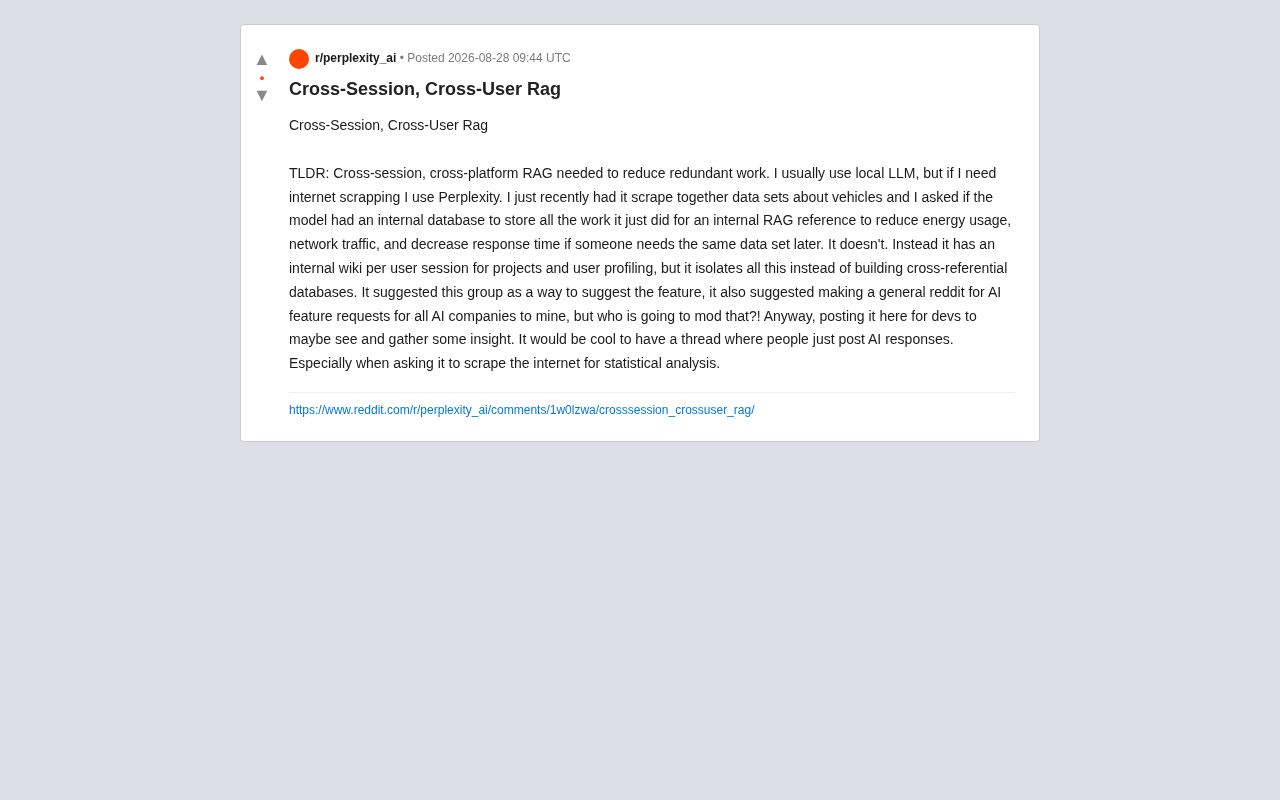
Recently, a Reddit user working on a data scraping task with AI tools raised a question that seems simple but cuts right to the heart of the matter: After an AI helps you compile an entire dataset from the internet, where does all that work go?
This user primarily works with local large language models (Local LLMs) but switches to tools like Perplexity—which have real-time retrieval capabilities—when they need to pull information from the web. Local LLMs refer to language models deployed and run on users' own hardware, typically open-source models like Llama or Mistral running through tools such as Ollama or LM Studio. Their core advantage is that data never leaves the local environment, providing strong privacy protection with no per-call fees. However, local models' knowledge is limited to their training data and they can't access real-time information. Perplexity represents a different product paradigm—it deeply integrates a large language model with a real-time web search engine, proactively searching the internet, pulling the latest information, and synthesizing it when answering questions. The fact that users toggle between these two types of tools reflects the real-world tension between "privacy" and "information freshness" in today's AI tool ecosystem.
After a session where the model compiled a vehicle-related dataset, the user asked the model: Is there an internal database that could store the work just completed as an internal RAG (Retrieval-Augmented Generation) reference, so that the next time someone needs the same data, it would reduce energy consumption, network traffic, and response time?
The answer was no.
The Status Quo: Isolated Session-Based Memory
According to this user's feedback, current mainstream AI products do have some degree of "memory"—they maintain an internal wiki for each user session, used for project management and user profiling. But the key issue is: this information is siloed.
This session isolation isn't simply a product decision—it's deeply embedded across multiple layers of technical architecture. At the base level, each session typically corresponds to an independent context window, with its length constrained by model architecture (e.g., GPT-4 Turbo's 128K token window). Once a session ends, that context is released at the computational level. Some products (such as ChatGPT's Memory feature and Claude's Project Knowledge) have introduced persistent memory layers, but these memories are strictly tied to individual user accounts, stored with encryption and excluded from model training. This design follows privacy engineering principles like "least privilege" and "data minimization," while also proactively complying with global data protection regulations such as GDPR and CCPA.
In other words, the AI remembers "what you did in this session," not "what reusable knowledge all users on the platform have collectively accumulated." This means:
- User A spends significant compute resources scraping and organizing a vehicle dataset;
- An hour later, User B makes a nearly identical request;
- The system starts from scratch—re-scraping, re-organizing, re-generating.
From a privacy isolation perspective, this design makes sense. But from a resource efficiency perspective, it's enormously wasteful. Every redundant web retrieval means additional energy consumption, bandwidth usage, and longer wait times.
The Fundamental Difference Between Session-Based RAG and Cross-User RAG
To understand the technical depth of this issue, we first need to clarify how RAG (Retrieval-Augmented Generation) works. RAG is an architectural paradigm proposed by Meta AI's research team in 2020. Its core idea is that before the language model generates an answer, it first retrieves relevant document fragments from an external knowledge base and injects these fragments as context into the prompt, allowing the model's response to be grounded in specific factual evidence rather than relying solely on parametric memory. A complete RAG pipeline typically involves three stages: the indexing stage (chunking documents and converting them into vectors via embedding models, then storing them in vector databases like Pinecone, Weaviate, or ChromaDB), the retrieval stage (vectorizing the user query and finding the most semantically relevant document fragments via approximate nearest neighbor search), and the generation stage (concatenating the retrieved fragments with the original question and feeding them into the LLM to produce the final answer). RAG's value lies in enabling models to "cite" rather than "fabricate," significantly reducing hallucination rates while allowing the knowledge base to be updated independently of model training.
Currently, the vast majority of RAG systems are designed with single-session or single-user boundaries. The system retrieves, augments, and generates within a session, and once the session ends, these temporarily constructed contexts are typically discarded or sealed in private storage.
What the user envisions as "cross-session, cross-user RAG" is fundamentally about building a shared knowledge asset layer—capturing the high-quality, reusable retrieval results generated during AI service delivery and consolidating them into a platform-level, cross-referenceable database. This is closer to the concept of "collective memory" or "shared cache."
The Triple Value of Cross-User Shared RAG Cache
From both technical and business perspectives, a cross-user shared RAG cache offers at least three layers of value:
First, significantly reduced costs and energy consumption. Web retrieval and large-scale data scraping are among the most expensive operations in AI services. A typical RAG-augmented query involves a computational chain that includes: query rewriting, web crawler invocation, HTML parsing and cleaning, text embedding computation, vector similarity search, and final LLM inference generation. According to estimates from organizations like Semianalysis, the comprehensive cost of running a complex web retrieval query in 2024 can be 5–10x that of pure text generation. From an energy perspective, the International Energy Agency (IEA) reported in 2024 that a single AI search query consumes roughly 10x the electricity of a traditional search. If identical or similar query results can be reused, platforms can dramatically cut redundant computation and network overhead. This is especially important given today's high AI compute costs. Some companies have already begun exploring semantic caching technology—by assessing the semantic similarity between a new query and historical queries, the system can return cached results directly when conditions are met, thereby avoiding redundant computation.
Second, improved response speed. For high-frequency datasets that have already been retrieved and organized, the system can serve cache hits directly, compressing what would otherwise be a scraping process taking tens of seconds or longer into near-instantaneous responses.
Third, a knowledge flywheel effect. The concept of the knowledge flywheel draws from Jim Collins's "flywheel model" in Good to Great, reinterpreted for the AI domain. Traditional internet platforms derive network effects primarily from user volume (e.g., Metcalfe's Law for social networks), whereas AI platforms generate a more nuanced "data network effect": each user's activity not only consumes the service but feeds back into system intelligence. In the context of shared RAG, the flywheel logic works as follows: more user queries → a richer cached knowledge base → faster, more accurate responses → higher user satisfaction and retention → more user queries. This parallels Waze's crowdsourced mapping model—every driver is both an information consumer and an information contributor. But the key difference is that judging the quality of AI retrieval results is far more complex than assessing traffic conditions, which raises the governance bar for starting and sustaining the flywheel.
Core Challenges to Implementation
However, as appealing as this idea is, real-world implementation faces significant obstacles.
Privacy and Data Sovereignty
The current session isolation design is no accident—it's a deliberate choice for privacy protection. User inputs during sessions may contain sensitive information, and hastily sharing retrieval results with other users could easily trigger privacy breaches and compliance risks. From a system architecture perspective, cross-user sharing means building a multi-tenant knowledge management system, where the complexity of access control, data classification, and audit trails grows exponentially. To implement cross-user RAG, a clear boundary must be drawn between "public knowledge" and "private data"—only retrieval results that contain no personal information and have universal value should be eligible for the shared layer.
Data Freshness and Accuracy
Internet data is constantly changing. A vehicle sales report scraped today might be outdated in a few weeks. A shared RAG cache must solve the "cache invalidation" problem—and cache invalidation was famously called "one of the two hardest things in computer science" by Phil Karlton. In traditional web caching, systems manage cache validity through mechanisms like TTL (Time-to-Live), ETag, and Last-Modified headers. But in AI retrieval caching scenarios, the problem is more complex: data "expiration" isn't just a temporal dimension—it also involves a semantic dimension. The "freshness" requirements for the same data may differ completely across different query contexts. For example, historical vehicle technical specifications can be cached long-term, but vehicle sale prices might change daily. This requires a "semantics-aware cache policy" that dynamically determines cache validity based on data type, source reliability, and query intent. Currently, some researchers are exploring using LLMs themselves to judge whether cached content is still valid—using AI to manage AI's cache—which is itself a delightfully recursive technical challenge. Systems need to determine which data can be reused long-term and which must be refreshed in real time; otherwise, reusing stale data would actually degrade answer quality.
Governance and Quality Control Mechanisms
The user also raised an interesting idea: creating a universal Reddit community where people could post AI retrieval responses for all AI companies to mine and reference. But they immediately recognized the problem themselves—"Who's going to moderate it?"
This half-joking remark hits squarely on the core challenge of shared knowledge systems: governance. Who reviews data quality? Who judges content authenticity? How do you prevent misinformation or malicious data poisoning from entering the shared repository?
Data poisoning is one of the core threats in machine learning security. In a shared RAG cache scenario, attackers could inject erroneous or biased content into the shared knowledge base through carefully crafted queries and feedback, subsequently affecting all downstream users' query results. These attacks are particularly insidious because the poisoned content may appear entirely reasonable on the surface. In 2023, the academic community demonstrated multiple attack vectors against RAG systems, including "knowledge conflict attacks" (planting documents that contradict factual knowledge in the retrieval store) and "backdoor trigger attacks" (specific keywords triggering malicious outputs). Defense mechanisms would likely require multi-layered review, including source credibility scoring, multi-source cross-validation, anomaly detection models, and blockchain-like provenance audit mechanisms. A shared RAG without effective governance could easily become an amplifier for misinformation. This makes "who's going to moderate it" not just a community governance question, but a serious information security engineering problem.
Implications for Developers and Product Teams
Although this was merely an idea that occurred to an ordinary user during actual use, it touches on a real gap in current AI product design. For developers and product teams, it may be worth thinking from the following angles:
- Layered memory architecture: On top of private session memory, build a public knowledge cache layer that has been de-identified and quality-filtered, enabling high-value general retrieval results to be reused. This design draws inspiration from the classic memory hierarchy model in computer systems—from CPU registers to L1/L2/L3 cache, RAM, SSD, and cold storage, each layer makes different tradeoffs between speed, capacity, and cost. Mapped to the AI knowledge management domain, we can envision a four-layer architecture: the innermost layer is session context (fast, ephemeral, fully private); the second layer is user-level persistent memory (moderate speed, long-term, user-private); the third layer is organization/community-level knowledge base (moderate speed, curated shared knowledge); and the outermost layer is platform-level public cache (high-frequency reuse results for popular queries). Strict data flow rules are needed between each layer: "promotion" from private layers to public layers must go through automated de-identification (PII detection and removal), quality scoring, and governance approval.
- Smart caching strategies: Set differentiated freshness policies for different types of data, balancing reuse efficiency with accuracy.
- User incentive mechanisms: If users' retrieval results can contribute to a public knowledge base, corresponding incentives could be designed to encourage the accumulation of high-quality data.
Conclusion
This suggestion from Reddit, though born from an ordinary data scraping task, reveals a possible direction for the evolution of AI memory mechanisms. From isolated session memory to cross-session, cross-user shared knowledge assets, AI systems have enormous room for improvement in efficiency, cost, and intelligence.
Of course, the three hurdles of privacy, freshness, and governance are not easy to overcome. But as this user hoped, recording and conveying these real-world observations from frontline users to developers is itself a vital part of driving product evolution. Sometimes the most valuable product insights come from a user's spontaneous "why can't it just..."
Related articles

Cross-App Access for AI Agents: Three Identity Vendors Converge on the Same Architecture Pattern in 8 Days
Okta, Auth0, and Descope all shipped Cross App Access within 8 days. This article breaks down the two-layer access pattern behind AI Agent identity management.

Dense Models Too Slow to Run Locally? How MoE Architecture Breaks Through the Performance Bottleneck
Dense models are slow on local hardware due to memory bandwidth limits. Learn how MoE sparse activation architecture dramatically boosts local inference speed and the future of local AI deployment.

Storm Summoner: A MIDI Controller Built Specifically for Guitar Effects Pedals
A deep dive into the Storm Summoner open-source MIDI controller for guitar effects pedals—covering design philosophy, technical architecture, and how it compares to commercial solutions.