CrowdStrike Acquires Two AI Security Startups for Nearly $500M as Agent Security Market Heats Up

CrowdStrike buys two AI security companies for nearly $500M to seize the standalone agent security track.
CrowdStrike announced it will acquire Fiddler AI and Dreadnode, two AI security startups, for nearly $500 million. Fiddler AI provides AI agent observability software, while Dreadnode focuses on automated red teaming and vulnerability scanning. The two acquisitions address the two core needs of agent security: runtime transparency and continuous security validation. As enterprises deploy AI agents at scale, traditional security tools struggle to cover new risks like prompt injection and tool abuse, and agent security is evolving from an add-on feature into a standalone track.
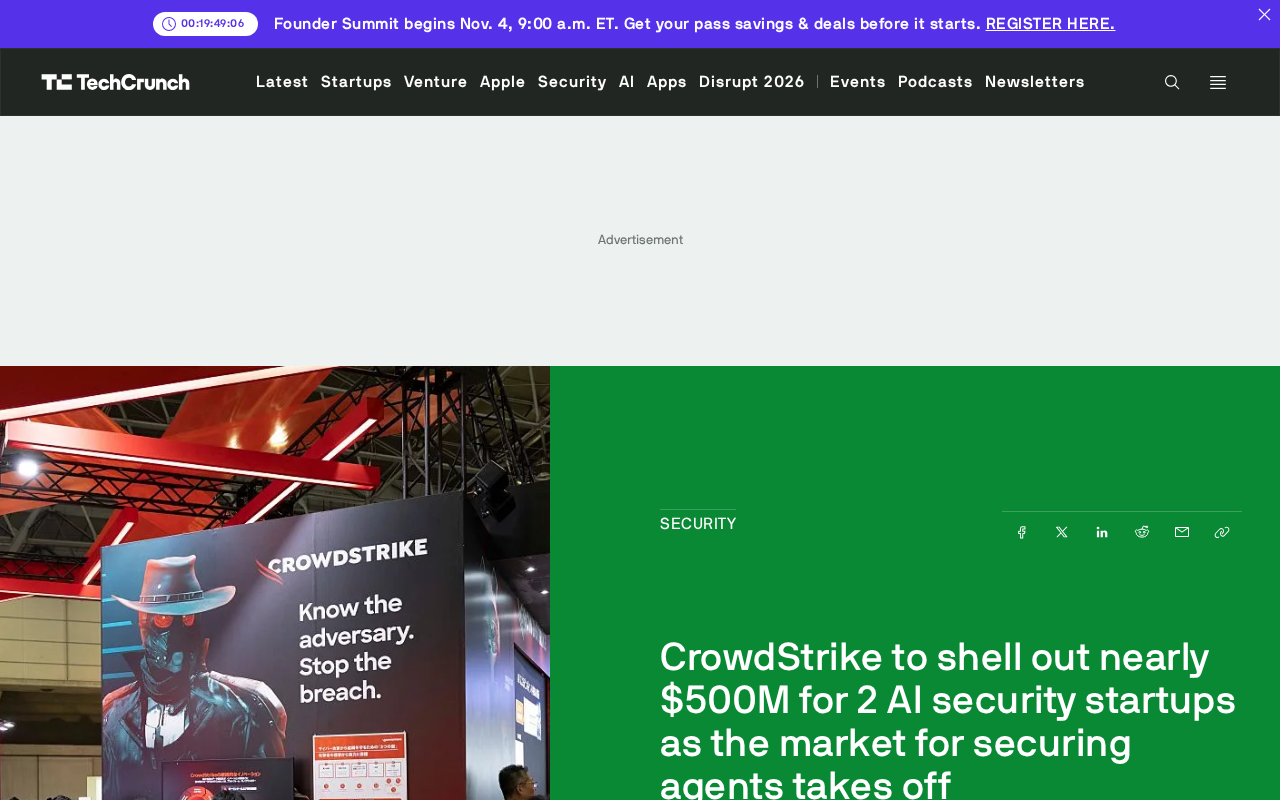
Security giant CrowdStrike has announced it will acquire two AI security startups, Fiddler AI and Dreadnode, for nearly $500 million. The deal underscores how, as AI agents are deployed at scale across enterprises, securing these agents themselves is becoming a standalone and rapidly growing market.
Two Acquisitions, Two Pieces of the Puzzle
According to information released by CrowdStrike, Fiddler AI focuses on AI agent observability software that helps enterprises monitor, understand, and debug the behavior of AI agents. Dreadnode, meanwhile, is dedicated to helping enterprises automate AI security testing, using continuous red teaming and vulnerability scanning to uncover risks in AI systems.
These two capabilities map precisely onto the two core needs of AI agent security: visibility and accurate testing. Fiddler AI addresses the transparency problem of agents at runtime—when an AI agent executes tasks autonomously, enterprises need to know what it did, why it did it, and whether it deviated from expectations. Dreadnode approaches from the attacker's perspective, automatically hunting for weaknesses in AI systems and transforming security testing from a one-off manual assessment into a continuous engineering process.
Why Now?
The heating up of the agent security market is no accident. As more and more enterprises put AI agents into production environments—letting them access internal data, call APIs, and execute business processes—the attack surface expands accordingly. Traditional application security tools cannot understand the decision logic of AI agents, nor can they easily cover new risks such as prompt injection, tool abuse, and data leakage. CrowdStrike's move at this moment is about seizing the entry point to this emerging security category.
Prompt Injection is a core attack method facing AI agents, in which an attacker crafts inputs (such as user messages, web content, or document text) to induce the model to ignore its original instructions or perform attacker-specified actions. For agents that can call tools and access data, prompt injection can lead to privilege escalation, data exfiltration, or tool abuse—for example, causing an agent to send internal database contents to an external address. Unlike traditional vulnerabilities, prompt injection often cannot be fully fixed with a patch, because it exploits the model's tendency to follow natural language instructions; it therefore requires layered defenses such as runtime monitoring, input/output filtering, and continuous red teaming.
Red Teaming, in the AI security context, refers to security experts or automated tools simulating attackers to systematically probe the weaknesses of AI systems, including inducing harmful outputs, bypassing safety guardrails, and extracting system prompts. For frequently iterated AI agents, one-off manual red teaming quickly becomes outdated, so companies like Dreadnode engineer it into a continuous, automated process that feeds discovered issues back into the development loop—a lineage consistent with traditional penetration testing, but targeting AI-specific attack surfaces.
Agent Security: From Add-On Feature to Standalone Track
For a long time, AI security was largely treated as an add-on feature of traditional security products. But the autonomy of agents has changed this landscape. For a system that can autonomously plan, call tools, and collaborate with other agents, its security boundary is far more complex than that of traditional software.
Fiddler AI's observability capabilities allow security teams to trace every decision chain of an agent, while Dreadnode's automated testing allows security validation to keep pace with the frequent iteration of AI systems. Combined, CrowdStrike is expected to build a closed-loop capability from monitoring to testing.
You may not have noticed, but this nearly $500 million investment also sends a signal to the market: protecting AI agents is shifting from a "nice to have" to a must-have in enterprise security architecture. For startups, this validates the commercial value of the AI security track; for enterprise buyers, it means they need to start incorporating agent security into their overall security budgets and processes.
AI Agent Observability borrows from the concept of observability in software engineering, but extends its object from services, metrics, and logs to the agent's decision-making process. It typically includes tracing the agent's reasoning chain (such as which tools were called, which context was read, and what intermediate results were generated), recording inputs and outputs, evaluating whether behavior meets expectations, and alerting on anomalies. Because large model decisions are probabilistic and opaque, traditional logs struggle to reconstruct "why it did this"; observability tools need to specifically capture chain-of-thought, tool-call parameters, and state changes to help security teams audit and debug. Fiddler AI builds its product around exactly this need, making the black-box behavior of agents traceable and explainable.
Implications for Enterprises
For enterprises deploying AI agents, CrowdStrike's acquisition offers a window into the landscape. Agent security cannot rely solely on model-level protection; it also requires a combination of observability, continuous testing, and runtime monitoring. When selecting products, enterprises should assess whether a product can cover the full lifecycle of agents—from testing during development to behavior monitoring and anomaly detection after launch.
At the same time, the deal hints at an industry consolidation trend. Large security platforms are filling out their AI security capabilities through acquisitions, and the window for independent AI security startups may be narrowing. For enterprise technology decision-makers, evaluating vendors means looking not only at current features but also at the platform integration capability and long-term roadmap behind them.
As agents move from experimentation to scaled deployment, security will become one of the key factors constraining their adoption. CrowdStrike's investment may be just the beginning of the race in the agent security market.
One-line Summary
CrowdStrike acquires two AI security companies for nearly $500 million to seize the standalone agent security track.
Paragraph Summary
CrowdStrike announced it will acquire two AI security startups, Fiddler AI and Dreadnode, for nearly $500 million. The former provides AI agent observability software, while the latter focuses on automated red teaming and vulnerability scanning. The two acquisitions correspond to the two core needs of agent security: runtime transparency and continuous security validation. The article notes that as enterprises deploy at scale AI agents capable of autonomous planning and tool calling, traditional security tools struggle to cover new risks such as prompt injection and tool abuse, and agent security is evolving from an add-on feature of traditional security into a standalone track. This signals to the market that protecting AI agents has become a must-have for enterprise security, and also foreshadows that large security platforms will integrate AI security capabilities through acquisitions, potentially narrowing the window for independent startups. Enterprises need to incorporate observability, security testing, and runtime monitoring into their overall security architecture.
Related articles

Deleted Reddit Post Sparks Debate Over AI Content Moderation
A Reddit post removed with only a 'Removed by Reddit' notice highlights AI content moderation's transparency gaps, misjudgment risks, and appeal challenges for platforms and creators.

DSH + Ollama Local LLM Deployment in Practice: Free Chat with Da Fei Yu
Bilibili creator tests DSH + Ollama local LLM deployment end to end: Ollama install, Xunlei-accelerated downloads, ModelScope GGUF model import, DSH custom API address setup, and a comparison of Qwen 3.5 4B, 8B, Gemma, and other models on 8GB VRAM, with advice on choosing local deployment vs. API calls.

Tested: A $899 Mac Mini vs. a $200/Month AI Subscription
Real-world test of whether an M4 Mac mini can replace a $200 AI subscription: 16GB can't fit large models, and both speed and quality fall short—but privacy, no caps, and near-zero running costs make it an ideal host for an always-on agent. Includes buying advice per configuration and money-saving strategies.