Curriculum Learning in Self-Play Environments: How to Prevent Policy Collapse?

Annealing environment parameters in self-play breaks opponent pools — domain randomization is a more robust fix.
This article analyzes a common failure mode when curriculum learning is introduced into self-play training: unidirectional annealing of environment parameters (such as network latency) causes early models in the opponent pool to collapse on out-of-distribution inputs, stalling the promotion pipeline. The root cause is that curriculum changes break self-play's core assumption — that opponents should behave reasonably under the current environment distribution. Four mitigation strategies are proposed: applying a unified curriculum across the opponent pool, replacing unidirectional annealing with domain randomization, adaptively pacing the curriculum based on performance metrics, and maintaining diverse cross-stage model snapshots. Switching to full-range domain randomization is considered the lowest-cost, highest-impact adjustment.
In reinforcement learning, self-play is one of the core techniques for training competitive agents — from AlphaGo to OpenAI Five, both rely on this mechanism. But when researchers try to introduce curriculum learning into self-play, they often run into a tricky problem: agents suddenly collapse during training and fail to pass promotion checkpoints. A recent Reddit discussion captured this dilemma precisely.
The Core Problem: Progressive Changes in Environment Parameters
The original poster attempted to anneal a competitive bot's ping (latency) parameter during training — gradually increasing ping from 0 to 100 (with values randomly sampled), while allowing the bot to observe its current ping during matches. This is a classic curriculum learning design: transitioning from easy conditions (low latency) to hard conditions (high latency), letting the agent progressively adapt to more complex environments.
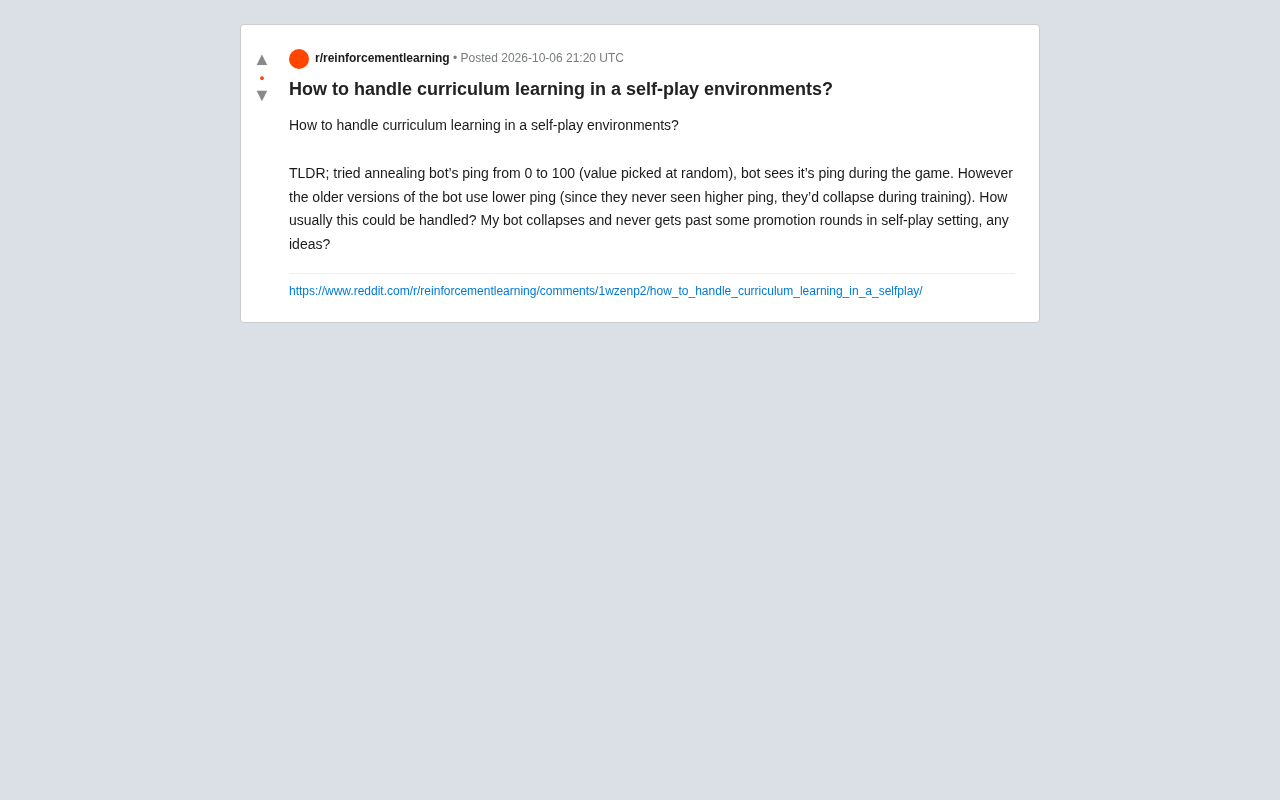
The problem quickly emerged. The author found that older bot versions in the historical opponent pool had only ever experienced low ping values and had never seen high-ping scenarios. When the new version trained under high-latency conditions, those older opponents encountered situations they had never seen before and simply "collapsed," causing the entire self-play promotion pipeline to stall at certain stages and unable to advance.
Why Does Collapse Happen?
Understanding this problem requires unpacking the inherent tension when self-play and curriculum learning are combined.
Distribution Shift in the Opponent Pool
Self-play training typically maintains an opponent pool composed of historical models, and new models must defeat past versions to advance. This mechanism assumes that models in the opponent pool can produce reasonable behavior under the current environment distribution. But once environment parameters that change over time are introduced (such as ping annealing), the training distribution of early models diverges from the current one. Strategies learned in a low-ping environment encounter out-of-distribution inputs when facing high ping — and their behavior naturally breaks down.
Distribution shift is a classic challenge in machine learning: a model performs well on its training distribution but degrades sharply when it encounters inputs from a different distribution at test or deployment time. In self-play, this problem is amplified — every historical model is essentially a snapshot frozen under the environment distribution of a particular "time slice." As curriculum parameters continuously evolve, the opponent pool effectively becomes a collection of "outdated snapshots," each corresponding to a different valid input range. This closely resembles covariate shift in transfer learning: the marginal distribution P(x) of inputs has changed, but the model's conditional distribution P(y|x) remains parameterized on the old distribution. For competitive self-play, this means the promotion threshold itself loses validity — you're asking the new model to beat an opponent that is "disabled" under current conditions, which neither guarantees the new model is genuinely improving nor provides a stable basis for advancing training.
Mismatch Between Observation Space and Generalization Ability
The author had the bot observe its own ping, which is reasonable in principle — letting the agent perceive environmental conditions is fundamental to adapting to change. But if early models were trained with that observation always sitting in a narrow range (near 0), their policy networks never learned how to respond to high-ping observations. This isn't a matter of the agent being "unwilling" to adapt — it simply has no effective mapping in parameter space for those inputs.
Common Approaches
Reinforcement learning practice has accumulated several strategies for dealing with this type of problem.
Apply a Unified Curriculum Across All Training
The most direct solution is to avoid applying curriculum changes only to new models. Instead, ensure that models in the opponent pool are also evaluated or fine-tuned under the same parameter distribution. If old models can't handle high ping, they shouldn't serve as valid promotion thresholds for the current stage — or they need to be retrained or adapted accordingly.
Domain Randomization Instead of Unidirectional Annealing
Rather than doing a one-way anneal from 0 to 100, consider using domain randomization: randomly sample ping from the full range during early training, rather than progressively raising the upper limit. This way, every version of the model is exposed to all latency conditions from the start, avoiding the collapse risk of encountering an unfamiliar distribution later. While this increases early training difficulty, it significantly improves policy robustness.
Domain randomization was originally proposed by robotics researchers at OpenAI and Berkeley to bridge the gap between simulation (sim) and the real world (real) — by randomizing physical parameters, textures, lighting, and other factors in simulation, it forces the policy network to learn representations that are robust to those variables. The core logic is: if the model has seen a sufficiently broad input distribution, real-world inputs are no longer unfamiliar out-of-distribution samples. Applying this idea to curriculum learning means abandoning the linear assumption of "learn easy first, then learn hard," and instead exposing the model to the full parameter range from day one. The trade-off is noisier training signals and slower convergence early on, but in return the policy generalizes uniformly across the entire parameter space. For self-play training that requires maintaining a long-term opponent pool, this property is especially valuable — every historical model retains the ability to handle the full range of inputs, keeping the opponent pool effective throughout.
Smooth Out the Curriculum Pacing
If you insist on an annealing-style curriculum, the key is controlling the pace of progression. Moving the curriculum too fast leaves models no time to adapt, while too slow wastes efficiency. One approach is to adaptively adjust curriculum progress based on performance metrics — only expanding the parameter range after the model achieves stable performance at the current difficulty level.
Adaptive curriculum is a class of methods that contrasts with predefined fixed-schedule curricula. The core idea is to use the agent's current performance as a feedback signal to drive curriculum progress, rather than relying on fixed training steps or time schedules. Common implementations include: threshold-based advancement (e.g., only expanding the parameter range when win rate consistently exceeds 60%), difficulty adjustment based on policy gradient signals (monitoring policy entropy or value function variance), and using learning progress as a proxy metric for curriculum advancement. The latter is grounded in intrinsic motivation research: agents explore most efficiently in difficulty ranges where they can make rapid progress. For scenarios coupling self-play with curriculum learning, adaptive curriculum must also account for the adaptation state of historical models in the opponent pool — avoiding situations where the curriculum difficulty races ahead before the opponent pool has "caught up."
Maintain a Diverse Opponent Pool
Opponent pool management is also worth optimizing. Consider retaining model snapshots from different curriculum stages and sampling opponents across all stages, rather than only having new models face the most recent versions. This helps prevent training from getting trapped in narrow strategy cycles.
Advice for Practitioners
This discussion reveals an underappreciated engineering detail: curriculum learning and self-play are each mature techniques on their own, but combining them can produce unexpected interaction effects. Dynamic changes in environment parameters break the assumption that underlies self-play — that opponent behavior is predictable.
For developers facing similar issues, the recommended first step is to replace unidirectional annealing with full-range domain randomization. This is typically the lowest-cost, highest-impact adjustment. If problems persist, further examine the composition of the opponent pool and the design of the observation space, confirming that models have effective policy representations across the full parameter range.
It's worth noting that the original discussion comes from a community question and has not produced a definitive best practice. The approaches described above are largely inferences based on general reinforcement learning experience, and their effectiveness still needs to be validated against specific tasks.
Related articles

Gaussian Process Bandit Optimization: Exploration Strategies and Inference Regret Guarantees
Cumulative regret guarantees in Bayesian optimization fail to reflect final recommendation quality. This article examines a new study that provides inference regret guarantees for Gaussian process bandit optimization through exploration query strategies and fill distance analysis, validated on hyperparameter optimization and control tasks.

The Most Detailed Codex Guide on Bilibili: From Installation to Real-World Practice
The most detailed Codex guide on Bilibili: from app store installation to daily work mode configuration, with a real coffee shop project demonstrating file organization, data extraction, dashboard creation, and other practical tasks. Learn to use Plan Mode and desktop pets to leverage Codex efficiently.

Appearance Compensation in Volume Rendering: Why RGB Accuracy Cannot Guarantee Density Correctness
Volume rendering research reveals that volumetric data perfectly reproducing external RGB views may still contain density errors: appearance compensation can double central density and keep external rays unchanged even when L2 error exceeds 14.52%. Density recovery depends on appearance capacity, spatial resolution, and measurement design.