Cursor Acquired: The Full Story Behind Musk's $60 Billion Takeover of the AI Coding Unicorn

SpaceX acquires Cursor for $60B, completing Musk's vertically integrated AI empire from compute to code editor.
SpaceX acquired AI coding tool Cursor for $60 billion in an all-stock deal, making its four MIT founders billionaires. The acquisition completes Musk's vertical AI integration strategy—from Colossus supercomputing to Grok models to developer tools—while weaponizing compute access against competitors like Anthropic. The Cursor brand will disappear, replaced by Grok Bot, signaling the end of model-neutral development environments.
A Single Tweet Ends an Era of Independence
On the evening of August 14, 2026, Cursor's official account posted a single-sentence tweet: "Cursor is now part of SpaceX." SpaceX immediately confirmed that the $60 billion acquisition had officially closed. From that moment on, Cursor—the AI coding tool built by four young MIT students in their dorm room that went on to dominate the global AI programming frontier—ceased to exist as an independent company.
$60 billion, all-stock transaction, arguably the largest startup acquisition in history. But what's more worth examining than the price tag is the industrial chain closing behind it—compute, models, data, and the developer entry point are all being squeezed into a single hand by a single person.

The acquisition catapulted all four founders' net worth, with each holding shares worth at least $1.3 billion—making them all billionaires. CEO Michael Truell is only 25 years old. Starting from a VS Code fork, he turned a dorm room project into a global phenomenon in just four years.
A Long-Planned Acquisition: From Partnership Agreement to Full Takeover
This deal didn't come out of nowhere. In April of this year, SpaceX and Cursor signed a partnership agreement that included an option clause: SpaceX could either pay $10 billion to continue the partnership and borrow compute, or acquire Cursor outright for $60 billion.
On June 16, just four days after SpaceX went public, the company filed documents with the SEC announcing it would exercise the acquisition option. On August 14, the deal was sealed.
According to regulatory filings, Cursor shareholders received approximately 389 million shares of SpaceX Class A common stock, representing an implied equity value of $60 billion. The entire transaction used newly issued SpaceX stock as the primary consideration—SpaceX didn't spend a single dollar in cash.
In other words, Musk used his inflated post-IPO stock price as currency to pocket Cursor. For a company of this scale, the greatest value of an IPO isn't fundraising—it's obtaining what amounts to an unlimited M&A checkbook. The Nasdaq gave him a money printer, and he immediately used it to buy the last major independent player in the AI coding space.
The Capital Logic of "Maskonomy"
This isn't Musk's first all-stock acquisition. In March 2025, XAI acquired X in an all-stock deal, valuing the combined entity at $113 billion. In February 2026, SpaceX acquired XAI outright; by May, Musk announced the complete dissolution of XAI, transferring all AI products to SpaceX; then in June, SpaceX went public.
Capital, technology, and talent constantly circulate between Musk's companies. Investors have even coined a dedicated term—Maskonomy—to describe this self-contained capital operation system.
Why Cursor Chose to Be Swallowed: From Growth Myth to Survival Crisis
Cursor is fundamentally an AI code editor. It doesn't train large models or develop new algorithms—it embeds the capabilities of models like Claude and GPT directly into developers' coding environments. It sits precisely between large models and developers: connecting to model capabilities upstream and real development workflows downstream.
The company's growth was staggering: annual revenue crossed $100 million in January 2025, hit $1 billion by November, doubled to $2 billion by February 2026, and reached nearly $4 billion in annualized revenue by June, with 67% of Fortune 500 companies using the product.
But the prodigy fairy tale didn't continue uninterrupted. Early on, Cursor relied entirely on calling Anthropic's Claude, contributing nearly half of Anthropic's revenue as a single customer. Then Anthropic launched the competing product Claude Code in 2025, and the two companies went from partners to direct competitors overnight. By early 2026, Claude Code's revenue had surpassed Cursor's, while Cursor's market share slid from 41% to 26%.
After this battle, Cursor recognized the fundamental problem: being just an application layer means no future. Survival required acquiring model capabilities and the compute to support them—two extraordinarily expensive things it simply didn't have.
These two things happen to be Musk's most abundant resources. SpaceX's Memphis supercomputing center, Colossus, commands the equivalent of a million H100s in compute power, but XAI's 11 co-founders had all departed, and Grok was being left far behind by Claude and GPT in coding. Put the two sides together, and you get a complete pipeline from chips to models to product.
The Cursor Brand Disappears: A Complete Absorption, Not a Partnership
The Information reported that this was not a warm acquisition preserving independence, but a complete absorption. At the all-hands meeting, Cursor's management admitted the company would be entirely dismantled—assets once valued at tens of billions, cash, intellectual property, employees, 50,000 enterprise customer contracts, and even tens of millions of lines of real coding data flows would all be absorbed into SpaceX AI's territory.
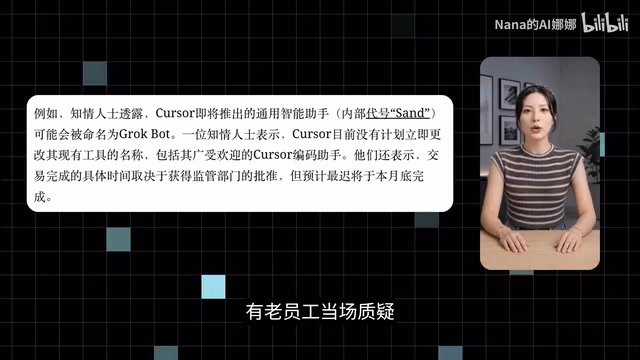
More symbolically, the Cursor name will also disappear. Its internal codename "Sand Agent" will likely ship under the Grok Bot brand. A veteran employee reportedly challenged the decision on the spot: "Why can't it still be called Cursor?"
A name carries identity. For countless developers worldwide, Cursor represented speed, an obsessive user experience, and reverence for code. But now it must make way for the Grok super-brand. From an independent player at the table, Cursor has finally been reduced to a gear on a giant's war machine.
Grok Bot: The First AI Product After Cursor's Integration
On August 11, SpaceX AI released Grok Bot. Each Bot has its own cloud virtual machine, can log into users' tools and applications, operate like a real person, and autonomously execute multi-step real tasks around the clock—continuing to work even when you close your computer. It supports multiple Bots collaborating in parallel, passing tasks and sharing context with each other.
Users who tested it reported that the biggest surprise was the multi-agent collaboration—assigning one Bot a "chief of staff" task, placing the rest in a thread where they pass work to each other, and only escalating items that need approval.
Grok Bot's download, installation, login, billing, and most documentation run through the Cursor system. This combination essentially bundles persistent cloud computers, multi-agent collaboration, top-tier coding capability, and massive compute together. Long-term, it's poised to become SpaceX AI's core product in the enterprise AI agent market, directly competing with enterprise versions of Claude and ChatGPT.
Weaponizing Compute: Selling Compute With One Hand, Cutting Off Competitors' Supply With the Other
Musk has another card up his sleeve, aimed squarely at old rival Anthropic. Days before the acquisition closed, SpaceX had just signed a compute lease with Anthropic: Anthropic pays $1.25 billion per month to rent 220,000 GPUs at the Memphis supercomputing center to run Claude.

Buried in the contract is one detail: either party can terminate with 90 days' notice. In other words, the power lies with Musk—he can choose to cut off the supply at any time. Additionally, SpaceX has signed compute lease agreements worth billions with Google.
The core of this strategy is Colossus—this supercomputer with a million H100-equivalent in compute is no longer just a training tool; it's a business in itself: selling compute to competitors for revenue on one side, while using that revenue to train its own models and acquire its own applications on the other.
Musk's Vertically Integrated AI Empire
Zooming out, Musk is assembling an unprecedented data closed loop: X provides text data, Tesla provides road and robot data, SpaceX provides engineering data and compute, and Cursor provides coding tools and real programming data flows. All this data is internalized, all fed to Grok, and then monetized through Cursor as the developer entry point.
Musk even predicted to employees that by September this year, AI business revenue will exceed the combined revenue of all other SpaceX businesses. In Q1 this year, Starlink revenue was $3.257 billion, space launch was $619 million, and the AI division was $818 million. If his prediction comes true, it means SpaceX has essentially transformed from an aerospace company into an AI company.

The End of the Model-Neutral Era
The deeper signal from this event is: the era of absolute neutrality in AI applications is over. Cursor was once a model-neutral platform where developers could freely switch between Claude, GPT, and other top models. But after the SpaceX acquisition, it will inevitably tilt toward Grok. In the future, at least within the Cursor ecosystem, the ideal development environment where you can freely switch between different models may become very scarce.
On the path to ASI, Musk's approach differs fundamentally from Anthropic's and OpenAI's: Anthropic takes a "model-first" route, OpenAI leverages Microsoft to balance between compute and applications, while Musk's core strategy is vertical integration of everything—a complete chain from chips to code editors, with data from every link circulating internally, never needing to be shared with anyone.
A Musk-Style Ending to a Fairy Tale: The Fate of AI Startups
Four years ago, four MIT students built Cursor in their dorm room. They proved something that excites every entrepreneur: in the large model era, you don't necessarily need your own model, nor do you need to burn tens of billions on compute. Just stand on the shoulders of giants, perfect the workflow, and you can still become a unicorn valued at tens of billions.
Yet today, this fairy tale has reached a Musk-style ending. Perhaps any sufficiently powerful AI application ultimately faces only two fates: either grow into a giant yourself, or be devoured.
Marked by Cursor's disappearance, the future AI landscape may increasingly enter an era of monopoly controlled by giants. In the winner-take-all endgame, there may be no more neutral ground—the entire AI map will become a battleground where a handful of super-oligarchs crush each other.
From today onward, Cursor no longer belongs to the world's developers. It belongs to the vast SpaceX AI empire, to a Musk who has sworn to seize the global AI throne.
Related articles

Cursor Can Now Control Your Computer: AI Agents Can Drive Desktop Apps for Testing
Cursor adds desktop control: AI agents can drive desktop apps like the iOS Simulator to test their own features. We analyze the impact on dev workflows, possible technical approaches, and reliability concerns.

Vibecoding a Custom Inference Engine: High Hopes, Harsh Reality
A Reddit developer shares the real experience of vibecoding a custom inference engine: running GGUF Q4 models in the browser with WebGL2 and GLSL, only to fall into tokenizer debugging hell. This article analyzes the engineering challenges of browser-side LLM inference and why cloning llama.cpp is the more rational choice.

How High Are Anthropic's Early Investor Paper Returns Ahead of IPO?
Anthropic's early investor paper returns draw attention ahead of IPO. This article analyzes sources of book gains, capital structure, pre-IPO games and risks, and implications for the AI startup ecosystem.