Cursor Cheap Renewal Traps Explained: How to Spot Account Risks

A breakdown of Cursor's gray-market renewal traps and how to evaluate the real risks before going cheap.
Based on a Bilibili commercial review, this article systematically analyzes three types of low-cost Cursor subscription services: shared accounts (unstable, frequently disconnected), time-limited plans (credits wiped on expiry), and cracked client tools (ban and device lockout risks). It highlights the most insidious trap — API proxy services that quietly downgrade model parameters or swap in cheaper models, degrading code output quality in ways users can't easily detect. While the pay-as-you-go billing model promoted in the source material does address credit waste, account compliance and long-term stability remain unverifiable gray areas. The core takeaway: official subscriptions are the safest bet for commercial developers, while casual users should prioritize checking for model degradation and device ban risks over price alone.
Introduction: When AI Coding Tools Meet Subscription Cost Anxiety
Cursor has rapidly emerged as one of the most popular AI coding tools in recent years, becoming a daily productivity staple for developers, professionals, and students alike. Its performance in code completion, bug fixing, project scaffolding, and even copywriting can genuinely reduce repetitive work. But there's an unavoidable reality: the official Pro subscription isn't exactly budget-friendly for individual users, and the long-term cost adds up.
This cost anxiety has fueled a murky gray market of "cheap renewal" services. Drawing on a Bilibili review video, this article breaks down the most common low-cost Cursor services and their potential risks, helping you build a solid framework for evaluating your options. Worth noting upfront: the source material is fundamentally a commercial promotion, so specific claims like "25% of official pricing" should be taken with a healthy dose of skepticism.
Three Common Tricks in the Cheap Renewal Market
Based on the review, low-cost Cursor services generally fall into three categories — each with its own fundamental flaws.
The first type is shared accounts and short-term Pro access. These services might only cost a few dozen yuan, but they're riddled with issues: frequent disconnections, expired permissions, and rate-limited API calls. The worst-case scenario hits when you're in the middle of a critical project or urgent code fix — the account suddenly dies and the Pro model becomes inaccessible. Whatever you saved simply doesn't compensate for the lost productivity.

The second type is the time-limited plan model. Sellers bulk-register large numbers of cheap throwaway accounts and sell monthly or quarterly cards by cycling through them. The core flaw is strict time limits: when the plan expires, all remaining credits are wiped regardless of how much you actually used. For users who don't use Cursor heavily every month, the majority of their credits go to waste — making the long-term value proposition surprisingly poor.
The third type carries the highest risk: cracked and modified client tools. These tools unlock permissions by tampering with the software's underlying data. Beyond crashes and lag, they can result in account bans, device lockouts, and data breaches. If your device gets flagged by the risk control system, your machine may be permanently unable to run Cursor — a consequence that far outweighs any subscription savings.
The "device lockout" risk in the third category deserves a closer look. Cursor's risk control system performs device fingerprinting on the client, collecting hardware IDs, network environment data, and behavioral patterns across multiple dimensions. Cracked versions typically bypass verification by hooking into the underlying authorization logic or forging tokens. Once the server detects an anomalous client, it may blacklist that device's hardware fingerprint — meaning even if you later purchase a legitimate subscription, that device may never activate properly. This is what's meant by a "permanent device ban." Unlike account bans, device bans can't be resolved by switching accounts, making the damage irreversible. Additionally, tampering with system-level files can conflict with security policies, potentially triggering EDR (Endpoint Detection and Response) alerts in corporate network environments — adding compliance risks on top of everything else.
The Hidden Trap of API Proxying: Degraded Model Performance
Of all the risks, the most subtle and most worth watching out for is degraded model output quality.
The review points out that many low-cost services are fundamentally API proxy + client-tampering setups. They appear to give you access to Pro models, but quietly compress parameters and reduce output quality on the backend. This degradation is extremely difficult for ordinary users to detect — you think you're calling a top-tier model, but what you're actually getting is code full of bugs, tangled logic, and thin, rough-edged outputs.
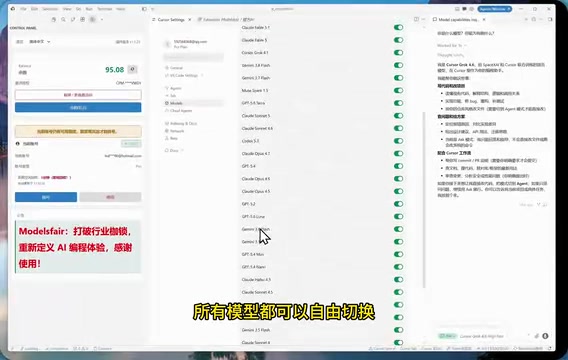
This is the critical quality differentiator: the price can be slashed, but whether the model call chain is intact and whether parameters have been tampered with directly determines the tool's actual value. For developers relying on AI for complex algorithm development or large-scale refactoring, a secretly downgraded model simply cannot produce code that meets production requirements.
API proxying refers to a third-party provider calling the official API and relaying requests to Cursor or its underlying large language models (such as Claude or GPT-4), then returning results to the user. On the surface, you're using Cursor — but your traffic is actually routing through an intermediary's servers. This creates two core problems. First, parameter tampering: the provider can reduce max_tokens (maximum output length), lower temperature settings, or silently swap in a cheaper, smaller model (e.g., replacing Claude 3.5 Sonnet with Claude Haiku) while the interface still displays the premium model name — giving you a significantly weaker reasoning engine. Second, data retention risk: all code, prompts, and outputs passing through the proxy server can theoretically be logged by the provider, creating potential exposure for commercially sensitive code or personal information. Since the Cursor client doesn't expose underlying API call details to users, there's virtually no way to tell the difference at the interface level.
Pay-as-You-Go vs. Time-Limited Plans: A Fundamental Difference in Billing
The service promoted in the source review centers its pitch on replacing time-limited plans with a "pay-as-you-go, credits never expire" model.

Logically, this model does address the credit-waste problem directly: after topping up, your balance has no expiration date — you use what you need and unused credits roll over indefinitely. Paired with claimed features like intelligent account rotation and consumption billing records, users can theoretically verify token usage and deduction details at any time.
That said, it's worth being objective: regardless of billing model, these third-party services are still unofficial channels. The source material emphasizes claims like "system automatically matches official legitimate independent Pro accounts" and "no modifications to the native underlying code" — language that sounds reassuring, but the provenance of the accounts, the compliance of the resource pool, and long-term stability remain gray areas that users cannot fully verify.

Thinking Critically About "25% of Official Price": The Hidden Costs Behind the Value Claim
The source material offers a tidy calculation: costs run roughly 10–25% of the official price, with a ¥100 top-up equating to ¥1,000 worth of official credits. These numbers are undeniably compelling in a promotional context — but a few things deserve clear-headed consideration.
First, any service priced significantly below official rates must be relying on some form of cost-shifting mechanism, typically bulk account procurement or resource arbitrage. The long-term sustainability of such models is inherently uncertain. Second, the reason official subscriptions cost more isn't just model inference costs — it also includes service guarantees, account security, and the right to compliant use. These intangible values are often the first things sacrificed by third-party services.
For teams and individuals who genuinely depend on Cursor for commercial development, the official subscription remains the safest choice. For budget-conscious students or casual users considering third-party options, the minimum due diligence should be checking whether the model has been downgraded and whether the account poses a device ban risk — not just comparing prices.
Conclusion: The Trade-off Between Cheap and Reliable
The subscription cost of AI tools like Cursor is a real pain point, and the gray market that's grown around it isn't going away anytime soon. The risks covered in this article — shared account instability, credit waste from time-limited plans, device ban risk from cracked tools, and output degradation from API proxying — represent the critical dimensions you need to evaluate before choosing any third-party service.
Ultimately, there's always a trade-off between saving money and staying reliable. Before being swayed by a "25% off" headline, ask yourself the harder questions: How intensively do I actually use this tool? Can I afford the worst-case outcome for my data and account security? Getting clear on those answers is what keeps you from falling into the classic trap of penny-wise, pound-foolish decisions.
Related articles

Automate Job Search with AI Agents and Residential Proxies for Precise Matching
Build an AI Agent with MCP and residential proxies to bypass recruitment site anti-scraping and geo-restrictions, scrape thousands of DevOps jobs, then have Claude score and rank each against your resume. Includes proxy comparison experiments, project structure, and cost analysis—filtering only, no auto-submission.

The AI Task Assistant That Knows When to Back Off: A Cure for Activation Struggles
One Small Step is an AI assistant for task initiation struggles, using agentic decisions for guilt-free reminders, timely retreat, and cross-platform task management. The developer shares real test results on 13 tasks and architectural trade-offs.

FastAPI: A High-Performance Python Framework and a Production-Ready API Development Powerhouse
FastAPI is a high-performance web framework based on Python type hints, supporting async and automatic OpenAPI docs. With over 100k GitHub stars, this article analyzes its core strengths, production readiness, and selection advice.