Cursor Launches Build Live Apps: AI Deploys Apps Directly

Cursor launches Build Live Apps, using a cloud Agent to take apps from description straight to live deployment.
Cursor launched Build Live Apps, extending AI-assisted development from code writing to app delivery. Users create a cloud Agent and describe requirements in natural language; the system automatically provisions Postgres, integrates login authentication, and deploys an accessible live link. Before publishing, it scans for exposed passwords and keys, making the app public only after checks pass and user confirmation. This marks AI coding tools shifting focus from code generation to the "last mile" of database, auth, deployment, and security.
AI coding tool Cursor recently launched a new feature called "Build Live Apps," extending AI-assisted development from code writing to the entire app deployment workflow. Users simply spin up a cloud agent and describe the app they want, and the system automatically handles database configuration, login integration, and live deployment. This move is seen as an important signal that AI coding tools are evolving from "writing code" to "delivering apps."
From description to launch: How Build Live Apps works
According to a demo on a YouTube channel, the Build Live Apps workflow is quite straightforward: users create a cloud Agent, describe the app requirements in natural language, and the Agent gets to work building it. If the app needs data storage, it automatically provisions a Postgres database; if it involves a user system, it completes login authentication integration; and finally, it deploys the app to an accessible live link.
The entire process requires no manual server operations or deployment scripts—the cloud Agent connects the three stages of database, authentication, and deployment in the background. For quickly validating ideas or building prototypes, this "one-sentence generation of a runnable app" experience greatly lowers the barrier from concept to launch.
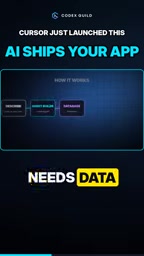
Postgres is an open-source relational database management system (RDBMS) known for its stability, scalability, and strong support for SQL standards, often used as backend data storage for web apps. It supports transactions, foreign keys, JSON fields, full-text search, and other rich features, and has mature managed cloud services (such as Supabase, Neon, Amazon RDS, etc.). In AI auto-configuration scenarios, the Agent typically calls the APIs of such managed services to create a usable database instance within seconds, and automatically generates connection strings, table creation statements, and access permission configurations—eliminating the need for developers to manually install, tune, and operate databases.
Authentication refers to the mechanism by which an app identifies users and manages sessions, with common approaches including email/password, OAuth third-party login (Google, GitHub, etc.), magic links, and SSO. A complete authentication implementation usually involves user table design, password hash storage, session or JWT token issuance, token refresh, and permission validation—all of which developers previously had to build item by item. AI Agent automated integration is generally based on ready-made authentication services or frameworks (such as Auth.js, Clerk, Supabase Auth), automatically completing SDK integration, callback URL configuration, and environment variable writing, so that generated apps have registration and login capabilities out of the box.
Security first: Automated checks before launch
Notably, Build Live Apps sets up a security gate before publishing. The system automatically runs security checks, scanning for exposed sensitive information such as passwords and keys. Only after checks pass and the user confirms will the app be officially published—the video emphasizes that "nothing will be made public unless you confirm it."
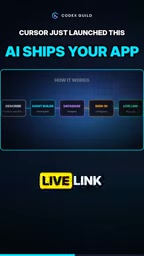
This design addresses a common security risk when AI automatically generates code: developers may inadvertently hardcode credentials into the code. Embedding security checks into the deployment pipeline is like adding a human-controllable buffer zone to the automated workflow.

Credential hardcoding refers to the practice of developers writing sensitive information such as API keys, database passwords, and private keys directly into source code or configuration files. Once such code is committed to a public repository or bundled into frontend artifacts, credentials can be scraped en masse by crawlers and attackers, causing data leaks or theft of cloud resources. The industry-standard response is to use environment variables or dedicated secret management services (such as Vault, cloud providers' Secret Manager), combined with static code scanning tools (such as GitGuardian, TruffleHog) to automatically detect leaks during commit and deployment stages. AI-generated code is especially prone to "conveniently" writing connection strings into code, making pre-deployment secret scanning a necessary line of defense.
After "writing code became cheap," delivery became cheap too
The video has a rather incisive summary: writing code has long been inexpensive, and this week, delivering apps to production became cheap too. This statement highlights the shift in competitive focus among AI coding tools—over the past two years, tools like Cursor and GitHub Copilot have mainly addressed code generation efficiency; now, competition is turning to the "last mile": databases, authentication, deployment, and security—stages that previously required specialized configuration.
For indie developers and small teams, the value of Build Live Apps lies in compressing multiple cloud service configuration tasks into a single conversation. However, this highly automated approach also brings new considerations: whether automatically generated database and authentication configurations meet production environment standards, whether security check coverage is sufficient, and where the boundaries of the cloud Agent's control over complex apps lie—all of which remain to be tested through more practice.
Industry impact: AI coding tools enter the full-stack delivery stage
The emergence of Build Live Apps means AI coding assistants are evolving from a "pair programming" role to a "full-stack delivery platform." When describing requirements can yield an accessible live app, the prototype validation cycle may shrink from days to tens of minutes. This could change the way early-stage product validation works and give non-professional developers a more direct path to implementation.
But it's important to see clearly that automated deployment solves the "0 to 1" rapid launch problem, not the "1 to 100" engineering challenges. Capabilities required for production-grade apps—monitoring, scalability, data governance—still depend on developers' judgment and investment. Build Live Apps is more like a key that opens the door to rapid delivery, not a universal tool that replaces a complete engineering system.
Related articles

Former Inmate Reveals Psychopath Ratio in Prison: About 200 Out of Every 880
Former inmate Larry Lawton shares on Lex Fridman's podcast that about 200 of 880 life-sentence inmates are psychopaths—a 23% ratio. He explores the blurred line between good and evil, social dynamics in prison, and wisdom from dark experiences.

Getting Started with Local AI: A Practical Guide to Inkling, Qwen, and Unsloth
A beginner's guide to local AI, explaining the roles of Inkling, Qwen, and Unsloth in local LLM deployment and fine-tuning, covering model selection, quantized inference, lightweight fine-tuning workflows, and trade-offs between local and cloud solutions.
Open Social Web Alliance Launched: A New Starting Point for Decentralized Social
The Open Social Web Alliance has emerged, sparking heated discussion on Hacker News. This article outlines its positioning, the core disagreements in community discussion, and the real-world challenges facing the open social web in interoperability, content governance, and identity migration.