Open Social Web Alliance Launched: A New Starting Point for Decentralized Social
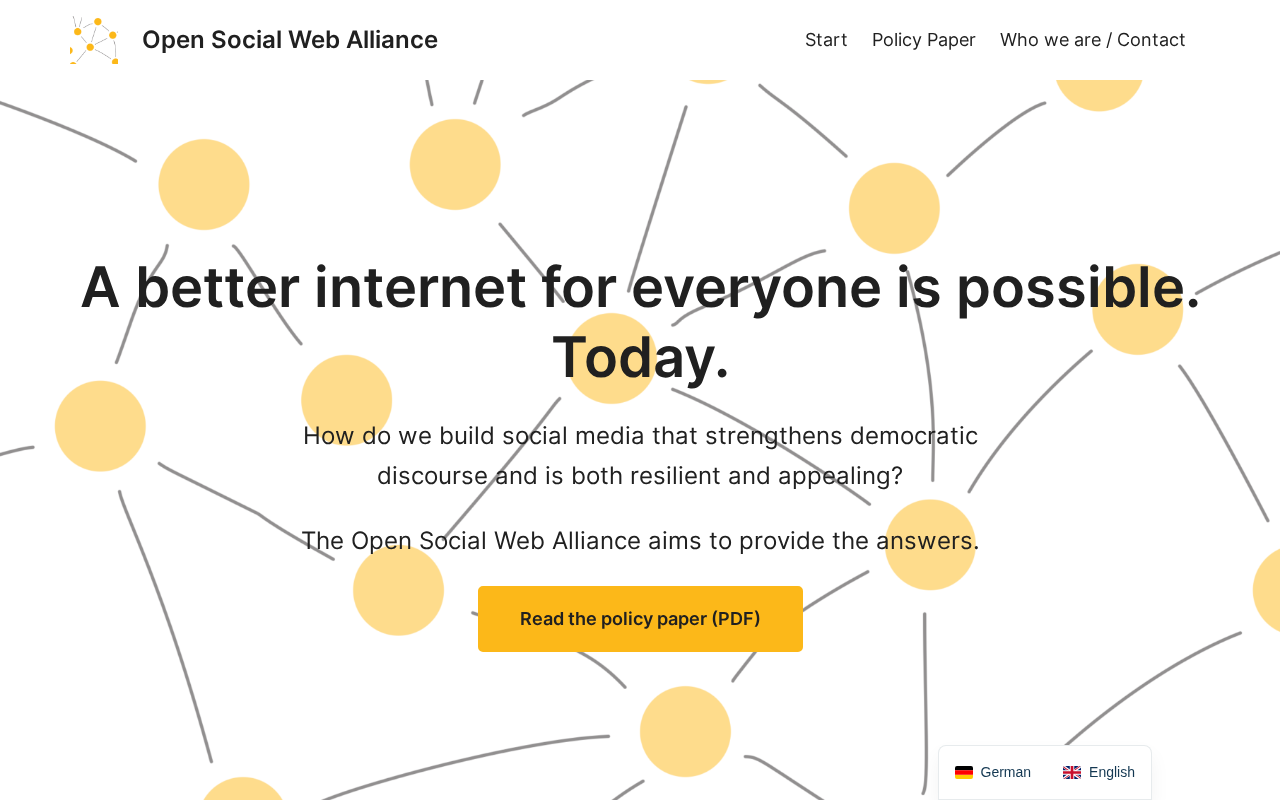
The Open Social Web Alliance has emerged, promoting social network interoperability and portable identity.
The Open Social Web Alliance has launched its official website, positioning itself as an organization promoting the open social web ecosystem, though specific members and action plans remain unclear. The article outlines the problem it aims to solve: centralized platforms lock in user relationship graphs and data, while the open social web uses decentralized protocols to enable interoperability and identity portability. The topic received 180 points and 183 comments on Hacker News, with high discussion heat and clear disagreement, focusing on the user experience of decentralized protocols, content moderation under federated architectures, and whether the alliance will become a new center of power. The article also analyzes the real-world challenges of the open social web in ecosystem coordination, identity migration, and cross-instance governance, noting that for developers it means clearer compatibility expectations, while for users it represents long-term choice.
The open social web space has a notable new development. According to a discussion on Hacker News and information from the Open Social Web Alliance website, an organization called the Open Social Web Alliance has emerged. Although public information is currently limited, its name and positioning point to an issue that has been gaining momentum in recent years: how to move social networks from closed platforms toward an open, interoperable ecosystem.
What problem the alliance aims to solve
Centralized social platforms have long controlled the entry points to user relationship graphs, content distribution, and identity verification. Users' data and social graphs are locked into a single platform, and the cost of cross-platform migration is extremely high. The core idea of the Open Social Web is to use decentralized protocols and open standards to enable different services to interoperate, allowing users to choose different providers while retaining control over their own identity and data.
Alliances of this kind typically take on several types of work: promoting the adoption of open protocols, coordinating compatibility across different implementations, providing reference specifications for developers, and explaining the value of open social networking to the public and policymakers. The content currently disclosed on the official website is still fairly preliminary, and the specific membership composition and action plans have not yet been fully laid out. However, judging from the attention on the official website and in community discussions, this topic already has a substantial real-world foundation.
The open social web and federated protocols
The technical foundation of the open social web is usually built on federated protocols, which allow multiple independently operated servers (often called instances or nodes) to communicate with one another, thereby forming a logically unified social network. Representative protocols include ActivityPub (standardized by the W3C and used by Mastodon, Misskey, and others), AT Protocol (developed by Bluesky), and Nostr, among others. Unlike centralized platforms, federated architectures do not have a single operator controlling all data; each instance can set its own rules while exchanging content and identity information with other instances through protocols. The key advantages of this architecture are resistance to single points of failure and portability, while the cost is that cross-instance content moderation, spam governance, and feature consistency all require additional coordination—precisely the coordination challenge that alliance-type organizations are trying to solve.
Community reaction on Hacker News
This link received 180 points and 183 comments on Hacker News. The discussion heat was almost on par with the points, indicating that this is a topic that sparks widespread debate rather than one-sided agreement. In discussions about the open social web, common disagreements tend to focus on several aspects: whether decentralized protocols can match centralized platforms in user experience; how content moderation can be implemented under federated architectures; and whether the alliance itself will become a new center of power, thereby departing from its original open intentions.
You may not have noticed that these discussions are often more intense than the technical details. Supporters value portability and resistance to censorship, while skeptics worry that fragmentation will create barriers to use and deter ordinary users. Whether the alliance can offer actionable answers amid these tensions will determine whether it is just another manifesto or whether it can truly drive the ecosystem forward.
How Hacker News discussions work
Hacker News is a technology and startup community operated by Y Combinator, and its content ranking is based on a combined algorithm of points and comment counts. Points reflect the level of attention a post receives, while comment counts often indicate controversy—when the two are close (as with this article's 180 points and 183 comments), it usually means the topic has triggered opposing views rather than consensus. The divide commonly seen in community discussions between technical optimists and pragmatic skeptics is useful for understanding issues like the open social web, but note that participants are mainly developers and technical practitioners and do not represent the perspective of ordinary users.
Real-world challenges for the open social web
From a technical perspective, there are already many implementations of the federated protocols on which the open social web depends, and cross-instance interoperability is already usable in some scenarios. The real difficulty lies not in the protocols themselves but in ecosystem coordination: feature differences across implementations, the completeness of identity migration, and cross-instance governance of spam and abusive behavior.
From an organizational perspective, the alliance needs to answer a fundamental question—whom does it represent? If its members are mainly protocol implementers and developers, then it is closer to a technical standards organization; if it brings in platform operators and content governance bodies, then it needs to balance commercial interests with open principles. The information currently available on the official website is insufficient to determine its composition, and this is a key point that warrants continued observation.
The technical meaning of identity migration and portability
Identity portability refers to users being able to migrate their identity identifiers, social relationship graphs, and published content from one platform to another service without having to start from scratch. Under federated architectures, this involves several layers: whether identity identifiers are controlled by users (for example, through domain names or decentralized identifiers, DID), whether social graphs can be fully exported and recognized by other parties, and whether historical content remains accessible after migration. At present, interoperability in most federated protocols is concentrated at the content distribution layer, and full identity migration remains difficult because different implementations differ in their designs for identity, signatures, and permission models. This capability directly determines the real cost to users of leaving a platform and is also at the core of the open social web's value proposition.
What it means for developers and users
For developers, the emergence of the alliance may mean clearer compatibility expectations and more stable reference specifications, reducing the cost of cross-platform integration. For ordinary users, short-term changes will not be very obvious; the value of the open social web is more about long-term choice: when identity and social relationships can be carried across platforms, the cost of leaving a platform will decline, which in turn will affect platform product decisions.
If you follow decentralized social networking, content portability, or open protocols, this alliance is worth adding to your watchlist. Its official website is the main channel for first-hand information, while community discussions such as Hacker News can provide different critical perspectives; combining the two helps form a more complete judgment.
Frequently asked questions
What is the Open Social Web Alliance?
An organization focused on the open social web. Specific information can be found on its official website, osw-alliance.net.
What is its relationship with existing open social protocols?
Based on public information, the alliance's positioning leans toward coordinating and promoting the open social web. Whether it is deeply tied to any specific protocol is currently unclear.
What can ordinary users gain from it?
In the long run, the goal of the open social web is to make user identity and social relationships portable across platforms and reduce dependence on any single platform.
One-line Summary
Open Social Web Alliance emerges, promoting social network interoperability and portable identity.
Paragraph Summary
The Open Social Web Alliance has launched its official website, positioning itself as an organization promoting the open social web ecosystem, though its specific members and action plans remain unclear. The article outlines the problem the alliance aims to solve: centralized platforms lock in user relationship graphs and data, while the open social web uses decentralized protocols to enable interoperability and identity portability. The topic received 180 points and 183 comments on Hacker News, showing high discussion heat and clear disagreement, with focus on the user experience of decentralized protocols, content moderation under federated architectures, and whether the alliance will become a new center of power. The article also analyzes the real-world challenges of the open social web in ecosystem coordination, identity migration, and cross-instance governance, and notes that for developers it means clearer compatibility expectations, while for users it represents long-term choice.
Related articles
Gemini 4 Neon Hands-On: Can It Challenge Opus 5.5?
Google released 4 Gemini 4 models in 49 days. We test whether Neon can challenge Opus 5.5 across benchmarks, real video tasks, and subscription costs.

Former Inmate Reveals Psychopath Ratio in Prison: About 200 Out of Every 880
Former inmate Larry Lawton shares on Lex Fridman's podcast that about 200 of 880 life-sentence inmates are psychopaths—a 23% ratio. He explores the blurred line between good and evil, social dynamics in prison, and wisdom from dark experiences.

Getting Started with Local AI: A Practical Guide to Inkling, Qwen, and Unsloth
A beginner's guide to local AI, explaining the roles of Inkling, Qwen, and Unsloth in local LLM deployment and fine-tuning, covering model selection, quantized inference, lightweight fine-tuning workflows, and trade-offs between local and cloud solutions.