Cursor Launches Projects: Reimagining AI Coding Workflows with a Coordinator Agent
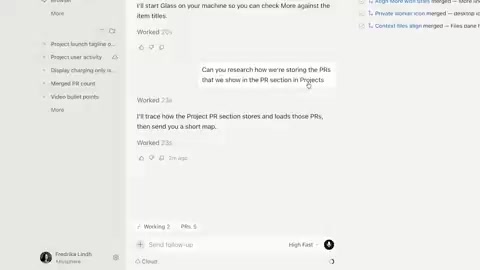
Cursor's Projects replaces fragmented chats with a persistent coordinator agent that autonomously dispatches subagents.
Cursor has launched Projects, replacing the traditional one-task-one-chat model with a persistent single thread powered by a coordinator agent. The agent is always on, proactively dispatches multiple subagents for parallel execution, and improves over time. This layered multi-agent architecture lets the coordinator act as a tech lead while subagents handle specific tasks — freeing developers to focus on intent and direction. The feature reflects AI coding tools' broader shift toward autonomous collaboration, though questions around context bloat, controllability, and transparency remain to be tested in real-world use.
AI coding tool Cursor has announced a new feature called Projects, aiming to fundamentally change how developers collaborate with AI. In the past, you might have needed to open a separate conversation window for each task — leaving context fragmented and hard to carry forward. Projects takes a different approach: it lets you work continuously with a "coordinator agent" within a single, persistent thread.



From "One Task, One Chat" to Continuous Collaboration
Traditional AI coding assistants tend to operate in a fragmented way — every new feature or bug fix means starting a fresh conversation, re-explaining context, pasting code, and restating goals. This works fine for simple, one-off tasks, but in long-running, complex projects, constantly losing context creates a real drag on productivity.
Cursor's official announcement speaks directly to this pain point: "Instead of creating a chat for each task, you'll collaborate with a coordinator agent in a persistent, single thread." This shifts the developer's focus from "managing a pile of conversations" to "maintaining a continuously evolving collaborative relationship." The project's overall context, past decisions, and progress all accumulate in one place, and the agent's understanding of the project deepens over time.
The Coordinator Agent: Always On, Proactively in Charge
At the heart of Projects is the "coordinator agent" role. According to Cursor's description, it has three defining characteristics:
Always On
Unlike traditional modes where the user must actively send commands, the coordinator agent runs continuously. Rather than passively waiting for each message, it maintains ongoing awareness of the project's state — a prerequisite for proactively stepping in when needed.
Proactively Manages Work via Subagents
Cursor emphasizes that the agent will "proactively manage work and dispatch subagents." This is a classic multi-agent architecture — the coordinator handles the big picture, breaks down tasks, and delegates execution to multiple subagents working in parallel. For complex development work involving multiple steps and modules, this division of labor theoretically delivers higher parallelism and execution efficiency.
Background: Multi-Agent Architecture Multi-Agent Architecture is not a new concept in AI, but it has only recently begun to take hold in engineering tooling as large language models have grown more capable. The core idea is to decompose a complex task into subtasks, each handled by a different "agent" — agents can run in parallel, communicate with each other, and report results back to a coordination layer. This is loosely analogous to microservices in traditional software engineering: a monolithic application broken into independent services, each focused on a specific responsibility. In an AI coding context, one subagent might handle code generation, another writes test cases, a third updates documentation, and the coordinator acts as the orchestration engine. OpenAI, Anthropic, and others are exploring similar patterns in their own agent frameworks, and this architecture is quickly becoming the go-to approach for complex AI applications.
Improves Over Time
Cursor likens the coordinator to their own @bot and notes that the agent "improves over time." This implies some form of learning or adaptation based on historical interactions — experience accumulated within a project thread feeds back into optimizing future behavior.
Multi-Agent Architecture as the New Direction for AI Coding
The launch of Projects reflects a broader industry shift: AI coding tools are evolving from "single-point Q&A assistants" to "autonomous collaborative systems." A single conversational assistant excels at answering clear, well-scoped questions — but real software development is a long-running, iterative process where context is deeply intertwined.
Introducing a layered coordinator-and-subagent structure essentially brings "project management" — a critical function in software engineering — into the scope of AI capabilities. The coordinator plays a role similar to a tech lead, responsible for planning and task scheduling; subagents function like individual contributors, focused on concrete implementation. If this model works well, it could allow developers to concentrate more on expressing intent and setting direction, rather than issuing granular instructions.
Questions Worth Watching
As a newly launched feature, Projects' real-world performance remains to be seen. Persistent threads may solve the context-loss problem, but they could also introduce new challenges — context bloat and noise accumulation. As a single thread carries more and more historical information, ensuring the agent accurately focuses on what's currently relevant is a genuine technical challenge.
Beyond that, the controllability of multi-agent collaboration, the transparency of subagent behavior, and whether "proactive management" leads to unwanted interference in practice are all things developers will need to keep an eye on. The phrase "improves over time" is also fairly vague for now — the specific learning mechanism and its practical limits remain unclear.
Overall, Cursor Projects represents a meaningful attempt to rethink AI coding workflows. It shifts the interaction paradigm from fragmented conversations toward continuous collaboration, and leverages a multi-agent architecture to take on more complex development tasks. Whether this direction genuinely improves developer productivity is something that real-world usage will ultimately determine.
Background: Context Window "Context window" is a key concept for understanding the potential bottleneck of persistent threads. Large language models can only process a limited amount of input text during each inference pass — this limit is called the context window, typically measured in tokens. Even though leading models today support context windows of hundreds of thousands or even millions of tokens, managing weeks or months of accumulated interactions, code snippets, and decision history in a project thread remains an engineering challenge. Common strategies include sliding window truncation, vector retrieval-based memory systems (RAG), and summarization compression of historical content. The long-term viability of Cursor Projects will depend heavily on how well it handles long-context management — and that's an important dimension to watch when assessing the feature's maturity.
Related articles

AI Agent Earns $10K in One Week: 3 Key Upgrades Explained
A blogger shares how he earned $10K in a week with an AI Agent — not by adding more skills, but through verification, approval gates, and subagents to raise trust and enable true automation.
Getting Started with OpenClaw: Multi-Channel AI Agent Gateway and Automated Workflow Guide
OpenClaw is an open-source multi-channel AI agent gateway. This guide covers its three core components — gateway, agents, and channels — plus tool integration and memory mechanisms.

Grist Removes SSO from Community Edition: The 'SSO Tax' Debate Resurfaces
Grist v1.7.18 removed SSO from its Community Edition, locking it behind a paid tier and reigniting the 'SSO Tax' debate. We analyze the incident, open-source monetization tensions, and what it means for self-hosted users.