Cursor Low-Price Subscription Traps Exposed: The Real Risks of Shared Accounts and Cracked Versions

Exposing the real risks behind cheap Cursor subscriptions: shared accounts, API proxies, and cracked versions.
This article dissects common traps in low-price Cursor AI programming tool subscriptions, including time-limited quota wipes, shared account ban risks with permanent device fingerprint blocking, API proxy services that secretly degrade output quality, and cracked versions that tamper with underlying code. It analyzes a pay-per-use alternative while warning that official direct payment remains the safest choice for code security and data privacy.
Cursor Becomes Essential, and Payment Pain Points Follow
As one of the hottest AI programming tools today, Cursor has permeated the daily workflows of programmers, professionals, and even students. Cursor is a deeply customized AI programming IDE built on the VS Code open-source code editor, developed by Anysphere. It deeply integrates large language models (such as GPT-4, Claude, etc.) into the code editing workflow, providing intelligent completion (Tab completion), multi-file editing (Composer), code chat (Chat), and other core features. Unlike competitors such as GitHub Copilot, Cursor's differentiation lies in its ability to understand the entire project context — it can read your entire codebase, understand inter-file dependencies, and provide more precise suggestions. Whether writing code, fixing bugs, scaffolding projects, drafting documents, or organizing ideas, Cursor's intelligent completion and conversational capabilities significantly boost productivity.
However, as the user base grows, two major payment pain points have become increasingly apparent: first, the official Pro membership is priced at $20/month (Business plan at $40/person/month), making long-term renewal costs substantial; second, the market is flooded with low-price renewal schemes, cracked plugins, and shared accounts of dubious quality and stability. This article will objectively dissect the operational logic of these third-party "efficiency services" based on promotional material from Bilibili, and provide rational usage recommendations.
Important note: This article does not endorse any third-party service. Claims such as "75% off" and "official legitimate accounts" are solely from the promoter's advertising, and readers should exercise careful judgment.
Common Traps in Low-Price Cursor Accounts
The promotional material lists traps that users commonly encounter when seeking low-price solutions — this information has universal reference value.
Time Limits and Quota Wipes
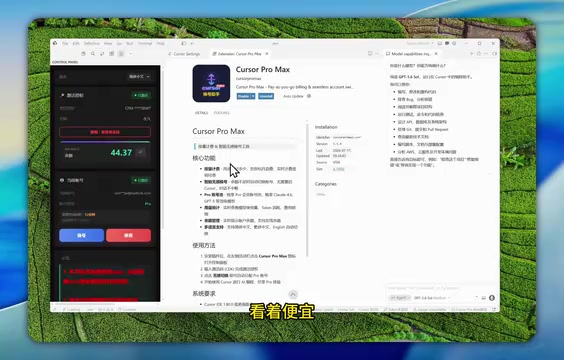
Most renewal tools on the market use time-limited package models like "monthly cards" and "quarterly cards." Vendors bulk-register cheap accounts and provide services through automatic account rotation. The biggest problem with this model is strict time limits — remaining quota is completely wiped upon expiration. Users with lighter usage often waste most of their monthly quota, making the cost-effectiveness extremely poor over the long term.
Stability and Account Ban Risks
Low-price shared accounts commonly suffer from frequent disconnections, model quality degradation, and rate limiting. When your account suddenly fails at critical moments — while rushing a project or fixing code — it doesn't save money at all and severely hampers your work progress. More seriously, these accounts carry extremely high risk-control exposure, easily triggering device locks and account bans. Cursor's risk-control system collects device fingerprints to identify violating users. Device fingerprints include a hash combination of multi-dimensional information such as hardware serial numbers, MAC addresses, OS versions, disk UUIDs, CPU models, and more. Once a device is flagged as violating, even switching accounts, reinstalling the software, or even reinstalling the OS won't help — as long as the hardware fingerprint remains unchanged, the ban remains effective. This means a banned device will be permanently unable to use Cursor normally, with losses far exceeding any money saved.
The True Nature of Cracked Cursor Versions and API Proxies
Many low-price services are essentially API proxy + frontend tampering crack schemes — something all users should be wary of.
Parameter Compression and Output Quality Degradation
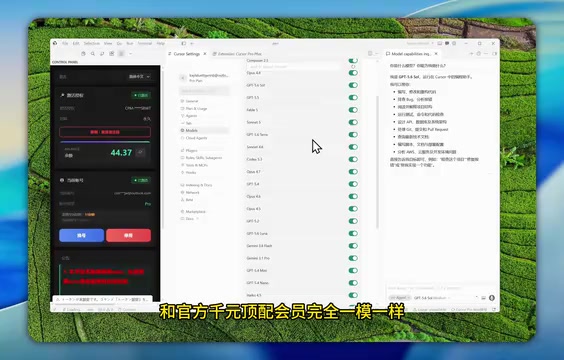
So-called API proxying means a third-party service provider sets up an intermediary proxy layer between the user and the official AI model API. User requests are first sent to the proxy server, which then forwards them to official APIs like OpenAI or Anthropic. During this process, the proxy can modify request parameters (such as lowering max_tokens, reducing temperature), substitute model versions (using cheap models while claiming premium ones), compress context windows, and perform other operations to reduce their own costs.
These cracked services appear to give you access to Pro models, but secretly compress parameters and degrade output quality behind the scenes. The resulting code has more defects and confused logic, while written content becomes shallow and hollow. The problem is that most ordinary users can hardly detect that the output has been degraded — since LLM outputs have inherent randomness, users can barely determine from a single conversation whether they're using a genuine premium model. They just feel the AI is "not very smart" without realizing the root cause is corner-cutting on the server side.
Security Risks of Underlying Code Tampering
Cracked versions typically modify Cursor's native underlying code to achieve "free full functionality," bringing multiple risks: crashes, freezing, frequent errors, account bans and device locks, and even personal information leakage. From a technical security perspective, any approach that tampers with the client's underlying code should raise serious red flags.
Analyzing the "Pay-Per-Use" Model Claims
The service promoted in this material has a core selling point that differentiates it from traditional time-limited packages: pay-per-use billing with permanently valid balances.
Billing Transparency
Before understanding this model, you need to understand the Token billing mechanism: Tokens are the basic units that LLMs use to process text. For English, approximately 4 characters equal 1 Token; for Chinese, 1 character typically consumes 1.5-2 Tokens. API call costs are determined by both input Tokens (Prompt) and output Tokens (Completion), with output Token pricing typically 3-4 times that of input Tokens. Taking Claude 3.5 Sonnet as an example, the input price is $3 per million Tokens and the output price is $15 per million Tokens — a single moderately complex code generation request might consume 2,000-5,000 Tokens.
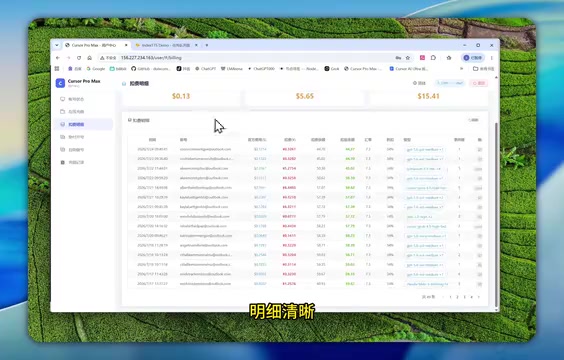
The promoter claims to use pure pay-per-use billing, charging only for what you use. Every model computation, conversation, and code completion generates a complete billing record that can be verified at any time for Token consumption, official pricing, and deducted amounts. In theory, this model does address the pain point of "wasted expired quotas."
Claimed Price Advantage
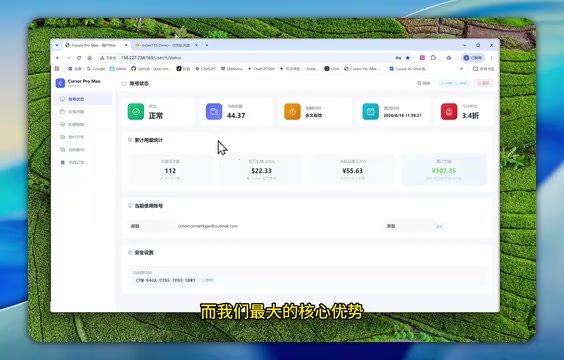
The promoter quotes prices at "approximately 25% of official pricing," even mentioning "recharging 100 RMB equates to 1,000 RMB of official quota" (approximately $137 in real consumption). They also emphasize that the plugin retains only two functions — "intelligent account rotation" and "consumption billing records" — preserving Cursor's native interface and allowing one-click upgrades with official updates.
A Rational Perspective: These Issues Demand Vigilance
While the above marketing sounds quite attractive, as technology professionals, we must maintain clear judgment:
First, "official legitimate independent Pro accounts" are questionable. If these truly are official accounts yet can be offered at 25% or even 10% of the price, the account sourcing and compliance are worth questioning. Bulk-purchased accounts may still face official ban risks.
Second, account rotation is still essentially sharing. "Intelligent account rotation" means the service relies on account pool scheduling, which has no fundamental difference from the "shared accounts" criticized in the same material — it's simply more automated.
Third, compliance and data security risks. Any solution requiring installation of third-party plugins in Cursor or binding to third-party account systems carries potential risks of code leakage and sensitive information exposure — especially dangerous for enterprise developers. For enterprise users, using third-party proxy services means all code requests pass through unofficial servers. These requests often contain core business logic, database structures, API keys, internal system architecture, and other sensitive information. Even if the proxy claims not to store data, the possibility of traffic being recorded, analyzed, or leaked cannot be ruled out. At the compliance level, this may violate enterprise information security policies, data protection regulations like GDPR, and non-disclosure agreements (NDAs) signed with clients. Should a data breach occur, the legal liability and commercial losses the enterprise faces would far exceed any savings on subscription fees.
Conclusion: Beyond Saving Money, Calculate the Long-Term Costs
The value of this promotional material lies in its fairly complete revelation of common schemes in the Cursor third-party renewal market — time-limited quota wipes, API proxy quality degradation, and underlying code tampering leading to bans. These are indeed real traps that users should avoid.
However, for the promoter's own service, claims like "official legitimate" and "permanently valid" lack third-party verification, and readers should not take them at face value. For individual developers on a tight budget, Cursor itself offers free quotas to try; for enterprises and commercial projects, official direct payment remains the most reliable and compliant choice. Saving money matters, but the value of code security, account stability, and data privacy is often far greater than the subscription price difference.
In an era where AI programming tools are increasingly becoming the core of productivity, choosing a legitimate and sustainable usage path is the true "best value for money."
Related articles
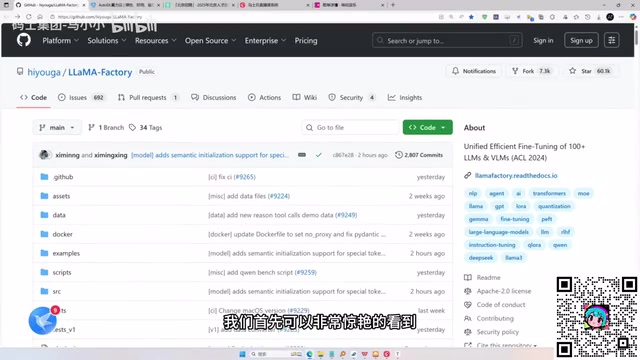
LLaMA-Factory in Practice: A Complete No-Code Guide to Fine-Tuning Large Models
An introduction to LLaMA-Factory, the open-source fine-tuning tool: its 60.1K-star background, supported models and algorithms, local vs. cloud deployment, and CUDA setup steps.

Zeng Ming's Deep Retrospective: Why OpenAI May Not Be the Ultimate Winner — and Why the Corporate System Will Disappear
Zeng Ming's deep retrospective on the AI endgame: model companies are just infrastructure, OpenAI and Anthropic won't be the final winners; the next battle is the Agent entry point standard; the corporate system will disappear as AI restructures collaboration, and only mission-driven companies can survive the cycle.
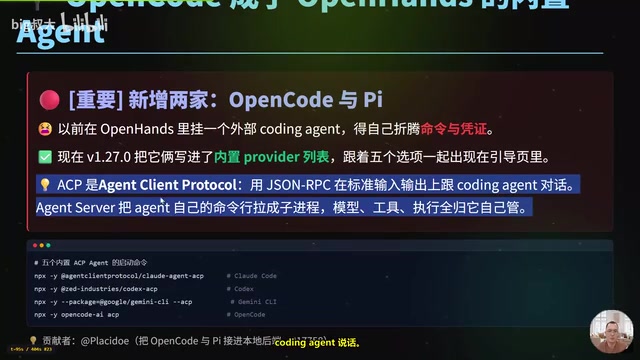
OpenHands v1.28.0: OpenCode and PI Added as Built-in Agents, API Keys Requestable In-Conversation
OpenHands ships 5 releases in 21 days: v1.27.0 adds OpenCode and PI as built-in agents, v1.28.0 enables in-chat key requests. ACP integration, credential reuse, model list changes, and upgrade advice.