Cursor Pro vs SuperGrok: Which Is More Cost-Effective? A Deep Dive into Grok 4.5 Token Economics

Comparing Cursor Pro and SuperGrok's real token economics when using Grok 4.5 model.
This article analyzes whether Cursor Pro or SuperGrok delivers better token value for Grok 4.5 usage. It examines why direct comparison is difficult due to opaque platform metering, explains how Cursor's IDE context injection inflates hidden token costs versus SuperGrok's lighter conversation overhead, provides a DIY benchmarking framework, and argues that token efficiency—not raw token count—should drive the decision.
A Question That Keeps Coming Back
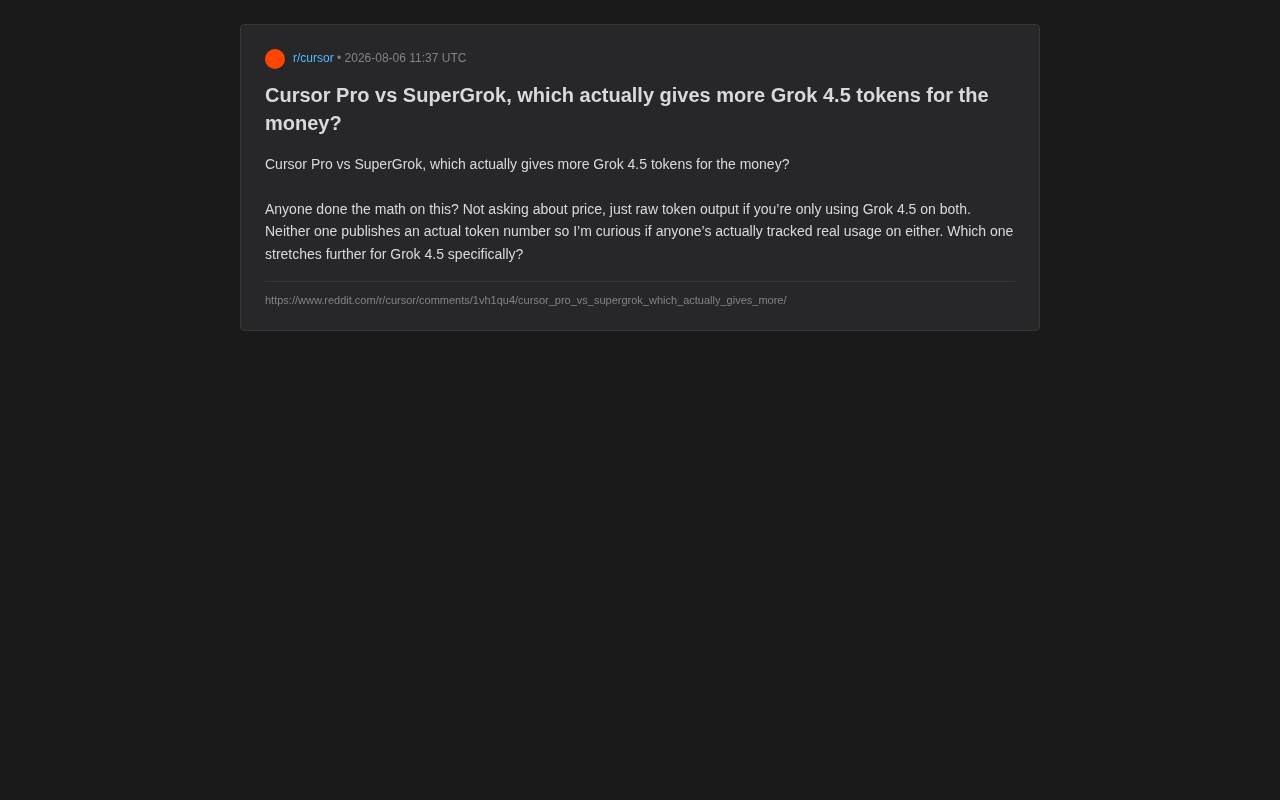
In Reddit's AI developer communities, a seemingly simple question with no definitive answer has resurfaced once again: if you only use the Grok 4.5 model, which subscription plan—Cursor Pro or SuperGrok—gives you more token output for the same money?
The original poster's approach is pragmatic—they explicitly state they don't care about the monthly fee itself, but rather want to figure out "how many raw Grok 4.5 tokens each dollar buys." Behind this question lies a widespread pain point in today's AI subscription market: virtually no platform is willing to publicly disclose their actual token quotas.
First, let's establish a fundamental concept: tokens are the basic unit of measurement for how large language models process text. For English text, one token corresponds to roughly 4 characters or 0.75 words; for Chinese, a single character typically consumes 1.5-2 tokens. More critically, model pricing usually charges separately for input tokens and output tokens, with output tokens often costing 2-4x more than input. This means that when a platform "stuffs" large amounts of context into each request, even if the model produces an identical-length response, the actual token consumption can differ by several multiples.
Why Comparing Tokens Between Cursor Pro and SuperGrok Is So Difficult
Deliberately Opaque Metering
Neither Cursor nor SuperGrok (xAI's premium subscription) publicly disclose hard numbers like "how many Grok 4.5 tokens you get per month." Instead, they offer vague language like "faster responses," "higher usage limits," and "priority access."
This approach is extremely common across the AI SaaS industry. Here's why:
- Cost structures fluctuate with underlying model pricing, so platforms don't want to lock themselves into specific numbers;
- Usage distributions are highly uneven—the gap between heavy and light users is enormous, and publishing fixed quotas would only invite controversy;
- Competitive considerations—explicit token numbers enable easy cross-platform price comparisons, so platforms prefer to obscure competition through experience differentiation.
Same Grok 4.5 Model, Different Packaging
Grok 4.5 is the flagship large language model from xAI (the AI company founded by Elon Musk in 2023), considered to be in the same tier as GPT-4o and Claude 3.5 Sonnet in terms of reasoning capability, code generation, and long-context processing. xAI provides model access through both the SuperGrok consumer subscription and enterprise API channels—and it's precisely this dual-track distribution model that gives rise to the price comparison discussed in this article.
Although the underlying model is the same, the way Grok 4.5 is "fed" in Cursor versus SuperGrok is completely different. Cursor is an AI-native code editor built on a VS Code fork (developed by Anysphere), and its core differentiator is deeply embedding large language models into the programming workflow. With every code completion or chat request, Cursor automatically sends the current file content, related dependency files, project structure index, cursor position context, and carefully crafted system prompts to the model. This "RAG + IDE" architecture means that a seemingly simple Tab completion might consume thousands of input tokens building the context window behind the scenes—hidden costs that simply don't exist in pure conversation scenarios.
SuperGrok, on the other hand, leans toward general conversation scenarios with relatively lighter context overhead per request. Therefore, even if both platforms give you the "same number" of tokens, in Cursor that might only cover a few dozen code completions, while in SuperGrok it could sustain over a hundred conversation turns. This is why the "raw token output" metric itself becomes distorted in cross-platform comparisons.
How to Benchmark Token Value Yourself
Since official numbers aren't provided, the more reliable community approach is to track real usage yourself. Here's an actionable framework:
Run Controlled Tests with Uniform Workloads
- Fix the input: Prepare a set of standardized prompts (e.g., identical code refactoring tasks or Q&A), ensuring consistent input token counts on both sides;
- Record consumption: Cursor shows usage statistics in its settings, and SuperGrok has a usage dashboard—record each session until you hit the limit;
- Calculate unit price: Divide "monthly fee ÷ total tokens measured" to get the actual cost per token—this is the only meaningful comparison.
Watch for Throttling and Downgrades
Many subscriptions don't cut you off entirely after reaching a threshold—instead, they quietly switch you to a slower queue or downgraded model.
Rate limiting and model downgrading are standard resource management strategies across AI platforms. Rate limiting typically manifests as hard caps on requests per minute (RPM) or daily token totals; downgrading is more insidious—platforms may silently route requests to smaller-parameter models (e.g., switching from Grok 4.5 to Grok 3) after users reach certain usage thresholds, or reduce inference sampling temperature and maximum output length. Users perceive symptoms like "responses getting shorter" or "quality declining," but the interface still shows the original model. This practice is technically difficult for ordinary users to detect and sits at the heart of the subscription "black box" problem.
When benchmarking, pay close attention to changes in response speed and output quality—if answers become noticeably more perfunctory or latency spikes after a certain point, the "quota" you thought you had may already be diluted.
The Deeper Decision Logic: Beyond Raw Token Counts
Don't Fixate on Total Token Volume
For most developers, obsessing over "who gives more tokens" actually misses the point. What truly determines value is token utilization efficiency:
- If your core use case is programming and codebase operations, Cursor's deep IDE integration, codebase understanding, and auto-completion capabilities make each token produce higher actual output—even if individual requests consume more;
- If you need general reasoning, writing, and everyday Q&A, SuperGrok's direct access approach is often more economical.
A Third Path Beyond Subscriptions: xAI API Pay-as-You-Go
It's worth noting that if your needs are highly predictable, calling xAI's Grok API directly with pay-as-you-go pricing might be more transparent and cost-effective than any fixed subscription.
xAI's API uses a pay-as-you-go model, typically priced per million tokens. Using industry benchmarks as reference, top-tier models (like GPT-4o, Claude 3.5 Sonnet) usually price API access at $2-15/million tokens for input and $8-75/million tokens for output. The biggest advantage of API billing is complete transparency—you can precisely calculate the cost of each request and actively control spending by optimizing prompt length and reducing unnecessary context. You get precision down to the cost per thousand tokens, completely bypassing the "black box quota" problem of subscription plans.
The tradeoff, of course, is that you need to handle authentication, request management, error retries, context construction, and other engineering work yourself, losing the out-of-the-box development experience that Cursor provides. For non-technical users, this path has a significant barrier to entry.
Conclusion: Transparency Is the Real Issue
The fact that this Reddit question still has no authoritative answer exposes a deep contradiction in the AI subscription market—users want comparable certainty, but platforms are selling fuzzy experiences.
Given this information asymmetry, the most rational strategy isn't waiting for official token numbers, but rather: run small-scale benchmarks based on your actual workload, and make decisions using "actual output per dollar" rather than "tokens per dollar." For heavy programming users, Cursor Pro's integration value is usually worth the price; for general users, SuperGrok or the API may save more money. The answer, ultimately, lies hidden in your own usage data.
Related articles

Amphibious Transforming Drone: Beyond 100x Power Savings, What Are the Real Needs?
Is the amphibious transforming drone just a gimmick? Starting from the 100x power difference of the M4 Morphobot, explore real application scenarios and thesis topic ideas, analyzing boundary conditions where pure drones and pure ground robots both fail.

Warhound Raises $200 Million: Genetically Engineered "War Dogs" Paired with Anduril Gear
Warhound raises $200M, backed by Ben Lamm and Palmer Luckey, to genetically engineer dogs for military and law enforcement use and equip them with Anduril gear. This article analyzes its technology direction, funding logic, and ethical controversy.

Claude API Comes to Google Cloud: IAM Integration and SDK Access Guide
Anthropic hosts the full Claude API on Google Cloud with IAM-controlled permissions and unified billing. This guide covers the Vertex AI and Anthropic-hosted entry points, IAM role configuration, and SDK access.