Cursor Projects Multiplayer Collaboration Launches: AI Programming Enters the Team Era
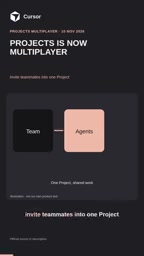
Cursor Projects supports multiplayer collaboration, making AI workflows a shared team object.
Cursor announced on November 10 that its Projects feature now officially supports multiplayer collaboration, available to all users in beta. Projects was initially launched in September with a "coordinator + agent cluster" architecture, where a coordinator breaks down tasks and dispatches multiple agents to execute in parallel. The multiplayer version extends this pipeline to the team level: teams share context, memory, and documents; a shared task board shows member分工, agent work content, and corresponding PRs; each member retains independent conversations, but decisions are visible to all agents in the project. Agents can also plan around each other's work in real time and unblock each other. This marks AI programming shifting from improving individual efficiency to making the AI workflow itself the object of team collaboration.
AI coding tool Cursor announced on November 10 that its Projects feature now officially supports multiplayer collaboration—a project can invite multiple team members to participate together. Projects was initially launched in September, with a core design where a coordinator directs a group of agents working in concert. Now, this group of agents can serve an entire team rather than a single individual. According to Cursor's official announcement, the feature is currently available to all users in beta.
From Solo Command to Team Sharing: The Evolution Logic of Projects
To understand the significance of this update, we first need to revisit the original design of Projects. Projects, launched in September, introduced a "coordinator + agent cluster" architecture: a coordinator breaks down tasks and dispatches multiple agents to execute in parallel, forming an automated development pipeline. This model solved the problem of limited individual capacity and high context-switching costs in complex projects.
The multiplayer version extends this pipeline to the team level. The agent cluster originally directed by a single coordinator can now be driven by multiple members together. According to official documentation, teams can share context, memory, and documents—meaning each member's agent is no longer an isolated execution unit but is built on the same project knowledge base.
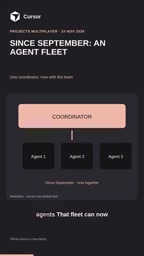
Coordinator-Agent Architecture: In AI agent systems, a coordinator is a control unit responsible for global planning and task dispatch. It typically does not directly execute specific operations itself; instead, it decomposes user goals into subtasks and then dispatches multiple agents to execute in parallel or in sequence. This pattern draws on the classic design of Multi-Agent Systems and, compared to single-agent sequential execution, can significantly reduce context pressure in complex tasks while allowing different agents to focus on different sub-domains. Cursor Projects productizes this architecture, enabling developers to obtain an automated development pipeline without building orchestration logic themselves.
Shared Task Board: Making AI Workflows Transparent
The most common problem in multiplayer collaboration is "not knowing what others are doing." Cursor's solution is a shared task board. According to official documentation, the task board shows who is responsible for what, which work each member's agent is advancing, and the pull request corresponding to each task.
The value of this design lies in exposing the working status of agents. In traditional development, code review relies on PRs and issue tracking; when agents participate in development, the execution process and output of tasks likewise need to be traceable. Linking PRs to tasks is equivalent to providing a reviewable landing point for each agent's output.
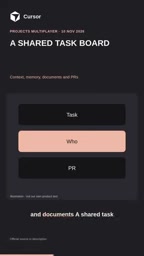
Traceability of Pull Requests and Agent Output: A pull request (PR) is the standard collaboration mechanism on code hosting platforms, used to propose changes, initiate code review, and record discussions. In traditional development, a PR is the review unit for human-submitted code changes. When agents participate in development, linking each task to its corresponding PR means agent output is no longer a black box—team members can review agent-generated code just as they review a human colleague's code, and the PR history also provides traceable audit clues for the task execution process. This is a key step in bringing AI workflows into existing engineering norms.
Separate Conversations, Unified Decisions: How Collaboration Stays Unchaotic
An intuitive question is: when multiple members converse with their respective coordinators simultaneously, will contradictory decisions arise? According to official documentation, each member retains their own independent conversation with the coordinator, but decisions made in one conversation are accessible to all agents in the project.
This is equivalent to layering "conversation" and "decision": conversation is the private working interface, while decision is the shared project state. A further mechanism is that members' agents can plan around each other's work in real time and unblock each other—just as human teammates do. This real-time coordination among agents is what distinguishes multiplayer AI programming from "each person using AI to write code separately."
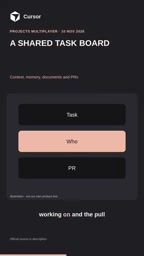
Shared Context and Memory: In AI coding tools, context refers to the information a model can reference when generating code, including project files, conversation history, and documents; memory refers to project knowledge persisted across sessions. The multiplayer version lets all members' agents share the same context and memory, avoiding the knowledge fragmentation caused by "each person training their own AI." This means a team's project conventions, architectural decisions, and domain knowledge can be沉淀 as project-level state rather than scattered across individual conversation histories, and newly joined members or their agents can quickly obtain consistent background information.
What This Means for Development Teams
The signal significance of this update outweighs the feature details. The mainstream narrative for AI coding tools has been "improving individual efficiency"—one person using AI to accomplish more work. Projects' multiplayer mode points in another direction: the AI workflow itself becomes the object of team collaboration. Shared memory and documents mean team knowledge can be沉淀 into the project rather than scattered across each person's conversation history; the shared task board makes the progress and quality of AI output manageable.
For teams already using Cursor, this beta opening lowers the barrier to trying it out; for teams still watching, what's worth关注 is how agents' "real-time unblocking" performs in actual projects. The official announcement did not disclose specific performance data or capacity limits, and the actual collaboration experience still needs to be tested with real projects.
One-line Summary
Cursor Projects supports multiplayer collaboration, making AI workflows a shared team object.
Paragraph Summary
Cursor announced on November 10 that its Projects feature now officially supports multiplayer collaboration, available to all users in beta. Projects was initially launched in September with a "coordinator + agent cluster" architecture, where a coordinator breaks down tasks and dispatches multiple agents to execute in parallel. The multiplayer version extends this pipeline to the team level: teams share context, memory, and documents; a shared task board shows member分工, agent work content, and corresponding PRs; each member retains independent conversations, but decisions are visible to all agents in the project. Agents can also plan around each other's work in real time and unblock each other. This marks AI programming shifting from improving individual efficiency to making the AI workflow itself the object of team collaboration.
Related articles

AI Writes Your Code—Do You Still Need to Learn Git? Five Reasons
AI coding agents handle Git operations automatically—is it still necessary to learn Git? Five reasons: team communication, reviewing agent PRs, monitoring code changes, fallback when AI goes down, and the joy of learning—plus how the focus of learning Git is shifting in the agent era.

Anthropic Reportedly Prices IPO at $83 Per Share, Valuing Company at $1.5 Trillion
Anthropic reportedly prices IPO at $83 per share, above the expected range, with a fully diluted valuation of $1.5 trillion. This article analyzes the signal significance of the pricing and its impact on the AI industry's financing environment.

Open-Source Code Hosting Platform Codeberg Suffers Outage, Sparking Debate in Developer Community
Open-source code hosting platform Codeberg.org suffered an outage, sparking Hacker News debate over nonprofit platform stability and open-source infrastructure dependency risks.