Cursor's Compole Event: The Developer Community Strategy Behind Custom Keyboards

Cursor's Compole event uses custom keyboards to build developer community and brand loyalty.
Cursor recently hosted "Compole," an in-person developer event featuring custom mechanical keyboard building. This creative community engagement reflects a broader trend in the AI coding tool space: as products from Cursor, GitHub Copilot, Windsurf, and others converge in features, developer culture and community belonging are becoming key differentiators. The event signals a new era of developer relations where brand identity and ecosystem building matter as much as technical capabilities.
Cursor Hosts Compole Event, Custom Keyboards Steal the Show
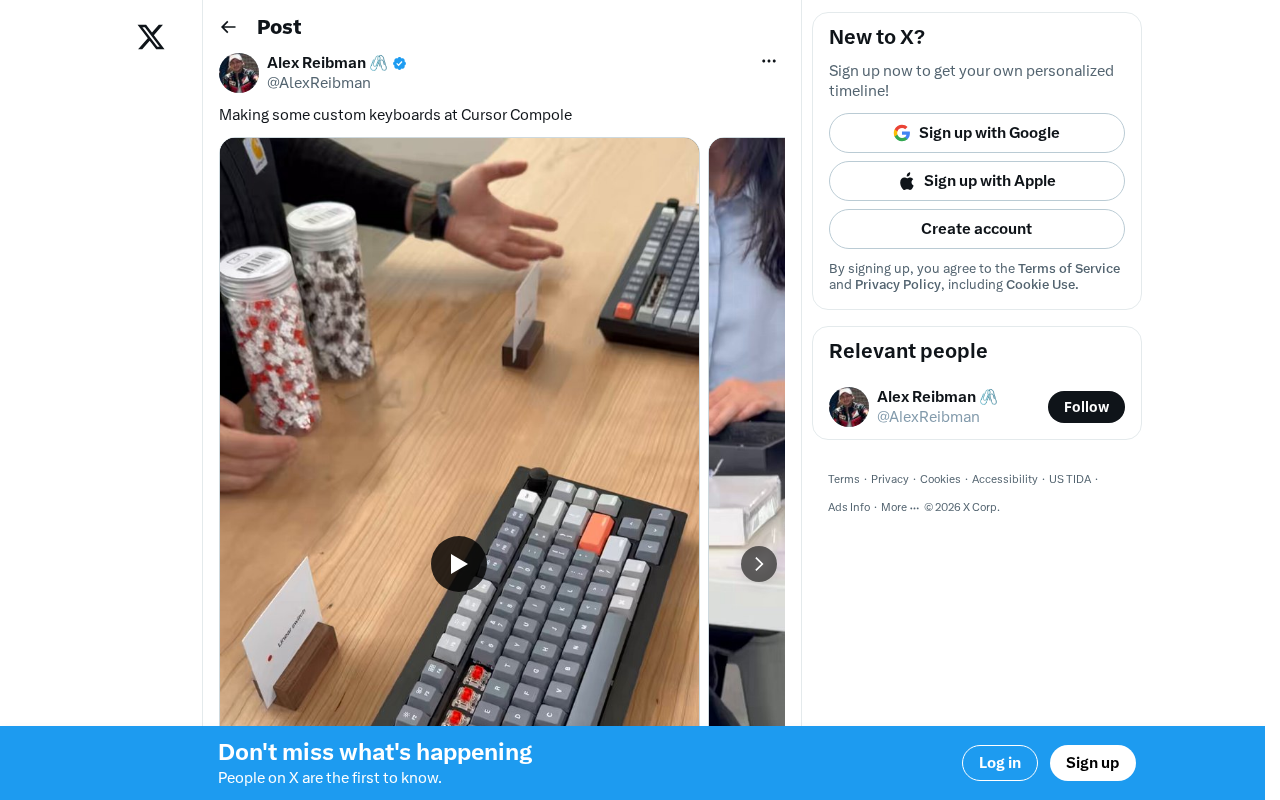
AI coding tool Cursor recently held an in-person event called "Compole," and one particular highlight caught the developer community's attention — attendees could build custom keyboards. While seemingly lighthearted, this detail reveals the thoughtful approach AI coding tool companies are taking toward community building and developer culture.
What Is the Cursor Compole Event?
As one of the most talked-about AI coding IDEs today, Cursor is rapidly building out its developer ecosystem. Developed by Anysphere, Cursor takes a fundamentally different approach from GitHub Copilot, which works as a plugin embedded in existing editors. Instead, Cursor deeply customizes the VS Code open-source codebase, integrating AI capabilities into the editor experience at the architectural level. It supports multi-line code generation, cross-file editing, natural language conversational programming, and more. Since 2024, Cursor has won over a massive developer following thanks to its outstanding Tab completion and Agent mode experiences, with its valuation rapidly climbing into the multi-billion dollar range.
"Compole" is Cursor's in-person developer meetup event. Based on information shared on social media, the event featured not only technical talks and product demos but also interactive activities steeped in geek culture — like the custom keyboard building station.
Custom mechanical keyboards have long been an important symbol in programmer culture. Unlike mass-produced keyboards, custom mechanical keyboards let users choose their own switches (such as Cherry MX, Gateron, etc.), keycap materials and colorways (like GMK or PBT keycaps), case materials (aluminum alloy, brass, polycarbonate, etc.), and may even require hand-soldering the PCB. This highly personalized process aligns perfectly with programmers' drive for efficiency and self-expression, making it an important identity marker in developer culture — Reddit's r/MechanicalKeyboards community boasts over a million members, a testament to the culture's massive influence.
By incorporating this element into the event, Cursor precisely targeted its user base's interests. For developers who spend countless hours at their keyboards every day, a well-crafted custom keyboard isn't just a productivity tool — it's an expression of personal technical taste.
The Competitive Landscape of AI Coding Tool Communities
From Product Competition to Ecosystem Competition
The AI coding tool space is fiercely competitive, with GitHub Copilot, Cursor, Windsurf, Augment Code, and others each bringing unique strengths. GitHub Copilot, launched through a collaboration between Microsoft's GitHub and OpenAI, leverages GitHub's massive code repository and GPT models to hold the largest market share among AI coding assistants. Windsurf (formerly Codeium) also takes the standalone IDE route, emphasizing enterprise-grade security and privacy. Augment Code focuses on understanding large codebases and enterprise collaboration scenarios. Other notable players include Google's Gemini Code Assist, Amazon's CodeWhisperer, and JetBrains' built-in AI Assistant.
As the underlying large language model capabilities converge and features increasingly overlap across these tools, developer community stickiness and brand identity are becoming key differentiators.
By hosting in-person events and creating developer culture symbols, Cursor is building a sense of community belonging that transcends the tool itself. This mirrors Apple's early strategy of building user loyalty through design aesthetics.
New Approaches to Developer Relations
Traditional Developer Relations (DevRel) efforts typically revolve around technical documentation, online webinars, and open-source contributions. DevRel is the function within tech companies dedicated to building and maintaining relationships with external developer communities. Core activities include writing technical documentation, maintaining SDKs and APIs, organizing hackathons, attending or sponsoring tech conferences, and managing developer forums. In recent years, with the rise of social media and content marketing, DevRel has expanded into more diverse formats including technical blogging, YouTube/Twitch tech livestreaming, Discord community management, and more. An effective DevRel strategy can significantly boost product adoption and developer loyalty.
Cursor's event signals that the new generation of AI tool companies is exploring more creative ways to engage their communities. An activity like custom keyboard building generates social media buzz while driving word-of-mouth within the developer community — a single tweet can spark widespread attention, making it a highly efficient community marketing practice.
The Broader Industry Trend
AI coding tools are transitioning from the "early adopter phase" to the "deep adoption phase." Looking at this evolution: the initial early adopter phase (2022–2023) was driven primarily by developer curiosity, with use cases limited mostly to simple code completion. The current deep adoption phase (2024–present) sees developers deeply integrating AI tools into their daily workflows, expanding from code generation to debugging, refactoring, documentation, test generation, and beyond. According to Gartner's Hype Cycle framework, AI coding tools are currently transitioning from the "Peak of Inflated Expectations" toward the practical productivity validation stage, where user retention rates and deep usage metrics matter more than new user acquisition.
At this stage, the factors determining which tool developers ultimately choose go beyond code completion accuracy or Agent capabilities. They also include:
- Community atmosphere: Whether there's an active user community with knowledge sharing
- Brand identity: Whether the team behind the tool truly understands developer culture
- Ecosystem maturity: Whether plugins, integrations, and workflows are well-developed
Through events like Compole, Cursor is advancing all three dimensions simultaneously. A custom keyboard bearing the Cursor logo might be more memorable to developers than any advertisement.
Takeaway
In the white-hot competition among AI coding tools, Cursor chose to deepen its connection with the developer community through an in-person event that blends technology and culture. A custom keyboard may seem like a small thing, but it represents a product philosophy of truly "getting" developers. As AI tools grow ever more powerful and increasingly similar, what ultimately wins developers' hearts and minds may be precisely these seemingly small yet genuinely thoughtful details.
Related articles

Transformer²: Achieving Co-Design of Robot Morphology and Control with a Unified Architecture
Deep dive into how Transformer² uses a unified Transformer architecture to integrate robot morphology design and motion control into one model, enabling task-driven end-to-end co-design for embodied AI.

Tutorial: Installing Tailscale on a Jailbroken Kindle to Create a Private Network Node
Learn how to deploy Tailscale on a jailbroken Kindle, turning an idle e-reader into a private network node. Covers cross-compilation, power optimization, and risk considerations.
Tutorial: Installing Tailscale on a Jailbroken Kindle to Create a Private Network Node
Learn how to deploy Tailscale on a jailbroken Kindle to turn an idle e-reader into a private network node. Covers cross-compilation, power optimization, and risk considerations.