Custom AI Interpretation Methods: Why Can't ChatGPT and Claude Learn Them?

A Reddit user tried to teach AI his custom interpretation method, exploring the limits of general large models and fine-tuning/customization paths.
A Reddit user developed a unique method for generating interpretations from materials, but ChatGPT and Claude could not fully understand and apply it. The article analyzes the limitations of general large models in following highly customized, multi-step reasoning rules, noting that models tend to deviate in details and lack internalization of the underlying logic. It discusses fine-tuning or building a dedicated chatbot as viable paths, emphasizing the need for large amounts of high-quality examples and clear rule encoding. At the same time, collaborating with AI can help developers identify ambiguities in the method and optimize the methodology. Finally, it suggests that teaching AI a personal method requires clear rules, positive and negative examples, and step decomposition, rather than relying only on prompts.
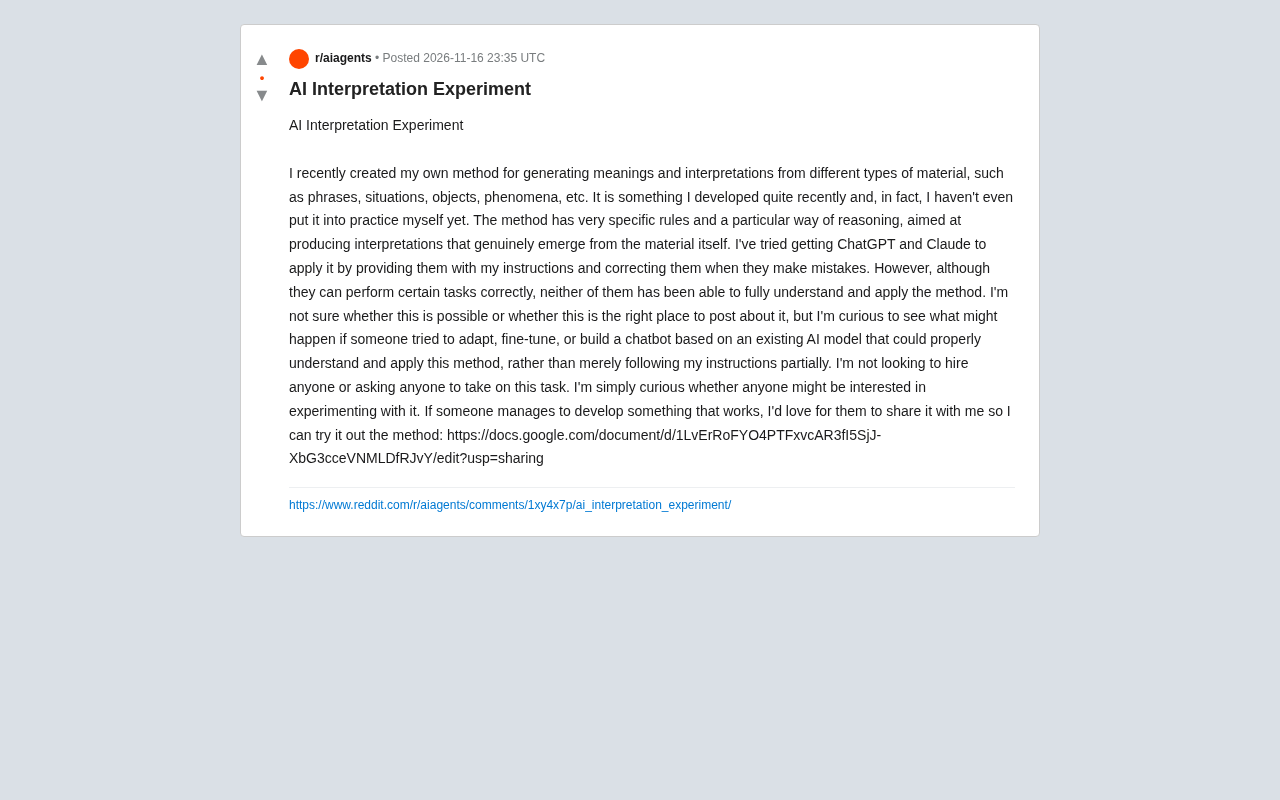
A Reddit user posted about developing a method for generating meaning and interpretation from materials such as phrases, situations, objects, and phenomena. The rules are very specific, and the reasoning approach is unique, aiming to make interpretation truly emerge from the material itself. He tried instructing ChatGPT and Claude to follow his instructions and corrected them when they made mistakes, but although the two could complete certain tasks, they were never able to fully understand and apply the method. He wondered: if existing AI models were adapted, fine-tuned, or used to build a chatbot, could AI truly master this method rather than only partially follow instructions?
Why Is It Difficult for General Large Models to Master Highly Customized Methodologies?
This user's experience reveals a common dilemma: when you have a highly personalized reasoning framework with clear rules, general large models often can only "imitate" the surface steps and cannot internalize the underlying logic. ChatGPT and Claude perform well at following instructions, but they lack a deep understanding of a user's specific methodology, especially when the method involves unique reasoning chains and material-driven interpretation. Models tend to rely on patterns common in pretraining rather than strictly following new rules.
This is not a lack of model capability, but a natural gap between general models and customized methods. The user's method may require structural adjustment, example guidance, or fine-tuning before the model can effectively master it.
Limitations of Instruction Following
Large models are good at executing clear, discrete tasks, but for methods that require multiple steps, are context-sensitive, and have interrelated rules, they tend to deviate in the details. The user mentioned that "they make mistakes when corrected," indicating that models still struggle to apply complex rules consistently during ongoing interaction.
The "instruction-following" capability of large models usually refers to the ability to execute tasks according to natural language instructions, and its training relies on reinforcement learning from human feedback (RLHF) and instruction fine-tuning. However, this capability has boundaries: when instructions involve multiple steps, long-range dependencies, or rules that differ greatly from the pretraining distribution, models are prone to "instruction drift"—appearing to follow while substantively deviating. In addition, context window limits can affect the model's ability to maintain consistency with complex rules, especially in multi-turn interactions.
Is Fine-Tuning or Building a Custom Chatbot a Viable Path?
The user wondered whether adapting, fine-tuning, or building a chatbot could enable AI to truly understand this method. From a technical perspective, fine-tuning can help a model learn patterns for a specific task, but it requires a large number of high-quality examples and clear rule encoding. Building a dedicated chatbot may constrain model behavior through system prompts, workflow design, or retrieval augmentation.
However, the user's method has not yet been tested in practice; even he has not actually used it yet. This means the method itself may still need iteration, and AI involvement may help reveal ambiguities in the rules.
The Value of the Experiment
Even if AI ultimately cannot perfectly apply the method, the experimental process can reveal the method's operability and clarity. The user said he was "just curious whether anyone would be interested in trying it," and this open attitude is commendable. If someone can develop a usable implementation, the user hopes to try it himself.
Fine-tuning refers to continuing to train a pretrained model on domain-specific data so that the model adapts to a new task. Common approaches include full-parameter fine-tuning and parameter-efficient fine-tuning (such as LoRA). Fine-tuning requires a large number of high-quality examples and may overfit; for highly customized methodologies, the coverage and consistency of examples are crucial. Another path is to build a chatbot and constrain model behavior through system prompts, workflow orchestration (such as LangChain), or retrieval-augmented generation (RAG). This approach is more flexible but depends on the quality of prompt engineering.
Implications for the Development of AI Interpretation Methods
This case reflects a trend in AI applications: more and more users want AI to carry their own unique methodologies rather than merely provide general answers. This requires AI systems to have stronger customizability and the ability to understand complex rules. At the same time, users also need to make tacit knowledge explicit so that AI can learn effectively.
For method developers, the process of collaborating with AI is itself a kind of stress test—which rules are necessary, which are ambiguous, and AI feedback can help optimize the methodology.
How to Help AI Better Learn Your Method
- Provide clear, structured rule descriptions and avoid ambiguity.
- Give positive and negative examples to help the model understand boundaries.
- Break the method down into executable steps to reduce cognitive load.
- Consider using fine-tuning or dedicated workflows rather than relying only on prompts.
Although this Reddit user's experiment has not yet produced results, it raises a question worth discussing: how can an effective bridge be built between general AI and personal methodologies? Perhaps more tools will emerge in the future that allow users to easily "teach" their reasoning frameworks to AI.
Making tacit knowledge explicit is key to enabling AI to learn personal methodologies. Tacit knowledge refers to experience and intuition that are difficult to put into words, while explicit knowledge is structured, codifiable rules. Method developers need to break reasoning steps into clear "if-then" rules and provide boundary cases. In addition, using "Chain-of-Thought" prompting or "Few-shot Learning" can guide the model to imitate the reasoning process, but attention must be paid to the diversity and representativeness of examples to prevent the model from learning only surface patterns.
One-line Summary
A Reddit user tried to teach AI his custom interpretation method, exploring the limits of general large models and fine-tuning/customization paths.
Paragraph Summary
A Reddit user developed a unique method for generating interpretations from materials, but ChatGPT and Claude could not fully understand and apply it. The article analyzes the limitations of general large models in following highly customized, multi-step reasoning rules, noting that models tend to deviate in details and lack internalization of the underlying logic. It discusses fine-tuning or building a dedicated chatbot as viable paths, emphasizing the need for large amounts of high-quality examples and clear rule encoding. At the same time, collaborating with AI can help developers identify ambiguities in the method and optimize the methodology. Finally, it suggests that teaching AI a personal method requires clear rules, positive and negative examples, and step decomposition, rather than relying only on prompts.
Related articles
Doha DECC New Year's Eve Fireworks on Camera: Crowds, Drones, and the Metro Station Scene
A Bilibili creator films the Doha DECC New Year's Eve fireworks—from the metro underground passage to the DECC viewing area—documenting crowd density, the drone show, and the real restrictions on filming in public spaces, with on-site screenshots and observations.

Three-Way All-In Showdown: A 43K Pot Collision in Texas Hold'em
In No Gamble, No Future, a three-way all-in creates a 43K pot. Wolfgang's KK, Marcus's 10-9 suited, and Randy's A-Q clash; running it twice splits the pot. Analysis of key decisions and player psychology.
B7R Round Table Air Combat: Virtual Battlefield Narratives in the Age of AI Video Generation
Starting from a Bilibili Ace Combat Zero B7R Round Table Air Combat video, this explores how AI video generation reconstructs game virtual battlefield narratives, analyzing multi-source memory perspective, text-to-image air combat aesthetics, and AI's boundaries in emotional logic and generational storytelling.