Three-Way All-In Showdown: A 43K Pot Collision in Texas Hold'em
Three-way all-in for 43K; running it twice lets KK and a flush draw each win half, showcasing poker's uncertainty.
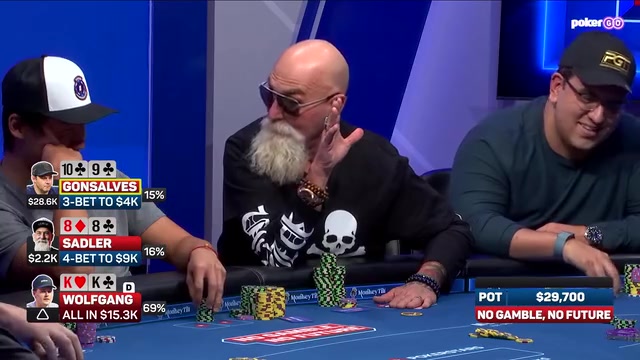
In No Gamble, No Future, Wolfgang raised to 9,000 with KK, Marcus called with 10-9 suited, and Randy shoved with A-Q, creating a 43K pot. Running it twice, Wolfgang won the first half with a full house, and Marcus hit a flush to take the second, splitting the pot. The article analyzes the all-in decisions: KK has about 70% preflop equity, but running it twice reduces variance and adds drama. Player interaction highlighted the aggressive style and psychological battle of high-stakes cash games, underscoring poker's core charm—even strong hands don't guarantee victory.
A Three-Way All-In Texas Hold'em Spectacle
At the table of No Gamble, No Future, three players demonstrated the most insane scenario in Texas Hold'em with a single hand: three-way all-in, with the pot soaring to 43K. This was not just a clash of chips, but a double gamble of psychology and luck. According to hand footage shared by a Bilibili content creator, Wolfgang, Marcus, and another player were involved in a "fireworks" showdown before the flop.
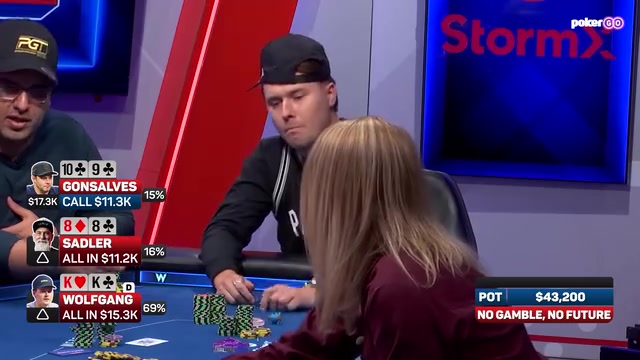
The hand began with Wolfgang showing respect for his opponents, raising to 9,000, while Marcus called with 10-9 suited. Then another player (possibly Randy) shoved all-in directly, and Wolfgang and Marcus both followed suit, instantly inflating the three-way pot to 43K. The commentator exclaimed: "This is a dream scenario!"
Key Decision Points: Respect and Traps
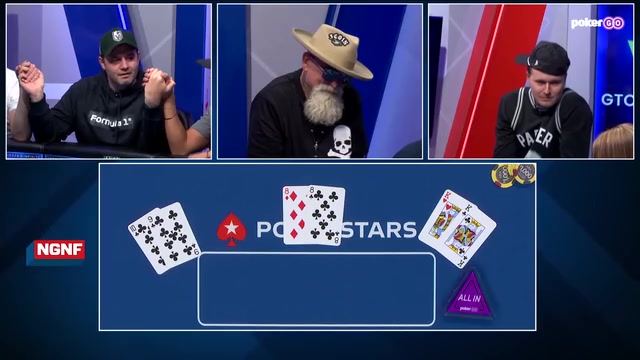
When raising, Wolfgang said: "I respect Mark (Marcus) a lot, so I raise to 9,000." But Marcus's call seemed to suggest he wasn't intimidated. When Randy shoved, Wolfgang had only 15,000 chips left and chose to call, while Marcus also shoved without hesitation. The commentator analyzed that Marcus might have thought Wolfgang was setting a trap, but ultimately the three players revealed their hands: Wolfgang held KK, Marcus had 10-9 suited, and Randy had A-Q.
Preflop Equity and All-In Decisions: In Texas Hold'em, the rationality of a preflop all-in is usually based on comparing pot odds with equity. Wolfgang's KK against A-Q and 10-9 suited has about 70% equity, but in a three-way pot, each additional opponent significantly reduces equity. Marcus called all-in with 10-9 suited primarily based on "implied odds"—suited connectors have high potential returns in multi-way pots. Even with only 30% current equity, the pot odds (he needed to call about 15K to win 43K) were close to 3:1, which just matched his equity. Randy's A-Q all-in was a pressure play, attempting to use his chip advantage to force folds, but was suppressed by Wolfgang's strong hand. This difference in decision-making reflects the balance between "value betting" and "semi-bluffing" in cash games.
Two Runs: From Heaven to Hell and Back
Due to "run it twice," the hand was split into two independent boards. On the first run, the flop came K-Q-7, giving Wolfgang top set, while Marcus had a straight draw and a backdoor flush draw. The turn was 8, the river 8, and Wolfgang's KK made a full house, winning the first half. But the second half took a dramatic turn.
On the second run, the flop again came K-Q-7, but the turn and river were consecutive diamonds, giving Marcus's 10-9 suited a flush, and Randy's A-Q also made a flush? Actually, according to the commentary, Marcus hit his flush on the turn, and the river brought another diamond, ultimately giving Marcus the second half. The commentator excitedly shouted: "Triple nines for Marcus Gonzalez! Ten of diamonds! How?" Although the exact board was somewhat confusing, it was clear that the two runs split the pot.
Player Psychology and Table Atmosphere
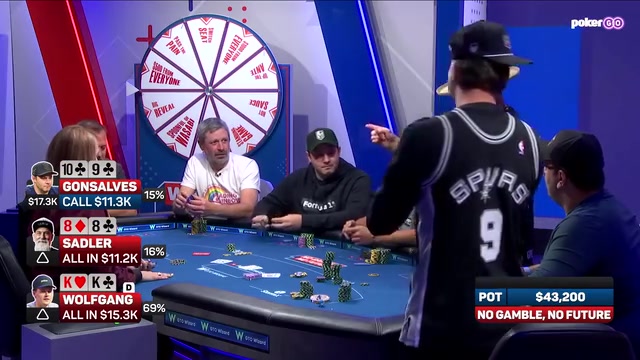
The hand was filled with lighthearted banter. Wolfgang was dubbed "the most elegant loser," while Marcus was called "the turn builder." When Randy shoved, he said: "Let's stay in Dallas." Someone even proposed betting 500 chips on who would win, and one player chose "the casino" (i.e., betting on the other players) to hedge. This interaction showcased the entertainment value of high-stakes tables.
Technical Analysis: Rationality of the All-In Decisions
From a strategic perspective, Wolfgang's KK is an absolute strong hand preflop, but facing two opponents' all-ins, his equity is not overwhelming. According to poker odds, KK against A-Q and 10-9 suited has about 70% equity (the commentary mentioned 70-30). Marcus's 10-9 suited, while behind, had about 30% equity, and Randy's A-Q was dominated. The all-in decision was standard for Wolfgang, but Marcus's call was more odds-driven.
Volatility of Running It Twice
"Run it twice" reduces variance but also makes the hand more dramatic. On the first run, Wolfgang won solidly; on the second, Marcus reversed it, and ultimately each won half the pot. This mechanism is common in high-stakes games, aimed at reducing the luck factor while increasing entertainment.
The Math Behind Run It Twice: Running it twice splits the original single board into two independent hands, dividing the pot. The core is to reduce variance, not change expected value. For example, Wolfgang's KK has 70% equity in a single run, but a 30% chance of losing the entire pot; after two runs, his probability of winning at least half rises to about 91% (1-0.3²), but his probability of winning it all drops to 49% (0.7²). Marcus's 10-9 suited's probability of winning it all drops from 30% to 9%, but his probability of winning half rises to 42% (2×0.3×0.7). This mechanism is common in high-stakes games because players focus more on long-term stable returns rather than single-instance luck. However, running it twice also lengthens the game and adds commentary and entertainment value.
Player Background and Show Features
No Gamble, No Future is a poker show known for high-stakes cash games, with aggressive players and constant verbal sparring. Wolfgang and Marcus are regulars in this hand, and Randy's addition made the game even more heated. The commentator used "Texas tornado" to describe this three-way all-in situation.
Pot Size and Game Stakes
Although the material did not specify the blind levels, the pot reaching 43K indicates high stakes. Players had varying chip depths—Wolfgang had only 15K left when he shoved, while Marcus and Randy likely had more. Such short-stack all-ins are common in tournaments, but in cash games they reflect the players' aggressive style.
Chip Depth Differences Between Cash Games and Tournaments: The article mentions Wolfgang had only 15K left when he shoved, which is a short stack in high-stakes cash games (typically 100-200 big blinds). Cash games allow players to reload at any time, so short-stack all-ins often represent "semi-bluffs" or "value shoves." In tournaments, short-stack all-ins are more common because rising blinds force action. In this hand, Wolfgang's 9,000 raise (assuming blinds of 200/400) showed he was trying to isolate opponents, but Randy's shove disrupted the plan. This aggressive style is exactly the hallmark of No Gamble, No Future—players often use chip depth to apply pressure rather than relying solely on hand strength.
Conclusion: The Charm of Poker Lies in Uncertainty
This three-way all-in showcased the core appeal of Texas Hold'em: even with KK, victory is not guaranteed. Running it twice made the result fairer but also more dramatic. As the commentator said: "That's poker—you never know what the next card will be." For viewers, such a hand is undoubtedly a feast for both the eyes and the mind.
One-line Summary
Three-way all-in for a 43K pot; running it twice lets KK and a flush draw each win half, showcasing poker's uncertainty and entertainment.
Paragraph Summary
In No Gamble, No Future, Wolfgang raised to 9,000 with KK, Marcus called with 10-9 suited, and Randy shoved with A-Q, creating a 43K three-way pot. Running it twice, Wolfgang won the first half with a full house, and Marcus hit a flush to take the second half, splitting the pot. The article analyzes the all-in decisions: KK has about 70% preflop equity, but running it twice reduces variance and adds drama. Frequent player interaction highlighted the aggressive style and psychological battle of high-stakes cash games, underscoring poker's core charm—even strong hands don't guarantee victory.
Related articles

Doha DECC New Year's Eve Fireworks on Camera: Crowds, Drones, and the Metro Station Scene
A Bilibili creator films the Doha DECC New Year's Eve fireworks—from the metro underground passage to the DECC viewing area—documenting crowd density, the drone show, and the real restrictions on filming in public spaces, with on-site screenshots and observations.
B7R Round Table Air Combat: Virtual Battlefield Narratives in the Age of AI Video Generation
Starting from a Bilibili Ace Combat Zero B7R Round Table Air Combat video, this explores how AI video generation reconstructs game virtual battlefield narratives, analyzing multi-source memory perspective, text-to-image air combat aesthetics, and AI's boundaries in emotional logic and generational storytelling.

Custom AI Interpretation Methods: Why Can't ChatGPT and Claude Learn Them?
A Reddit user shared an experiment with a custom AI interpretation method, trying to get ChatGPT and Claude to apply unique rules but failing, exploring the limits of general large models in learning highly customized methodologies and the possibility of fine-tuning.