Custom Connectors Launch: Connect Internal Systems Without Waiting for Official Integrations

Custom Connectors let admins connect REST APIs directly, bringing shadow IT integrations under governed control.
Custom Connectors address a common enterprise pain point: stalled projects caused by gaps in official connector coverage. Workspace admins can now configure publicly accessible HTTPS REST APIs with API-key auth to quickly integrate internal systems or niche services — no vendor roadmap required. The core value lies not just in expanded capability, but in pulling previously ungoverned "Shadow IT" integrations into a centralized, auditable framework. Current limitations include the public accessibility requirement (purely internal services need a gateway or proxy) and API-key-only auth, which is relatively simple in terms of permission granularity and key management.
What Problem Do Custom Connectors Solve?
When enterprises adopt AI tools or automation platforms, they're often constrained by the coverage of official connectors. A team wanting to connect an internal system or a niche professional service to their workflow may find that the platform hasn't yet provided a first-party connector — leaving them with no choice but to wait on the vendor's roadmap. That wait often means project delays, or teams resorting to ad-hoc, ungoverned workarounds.
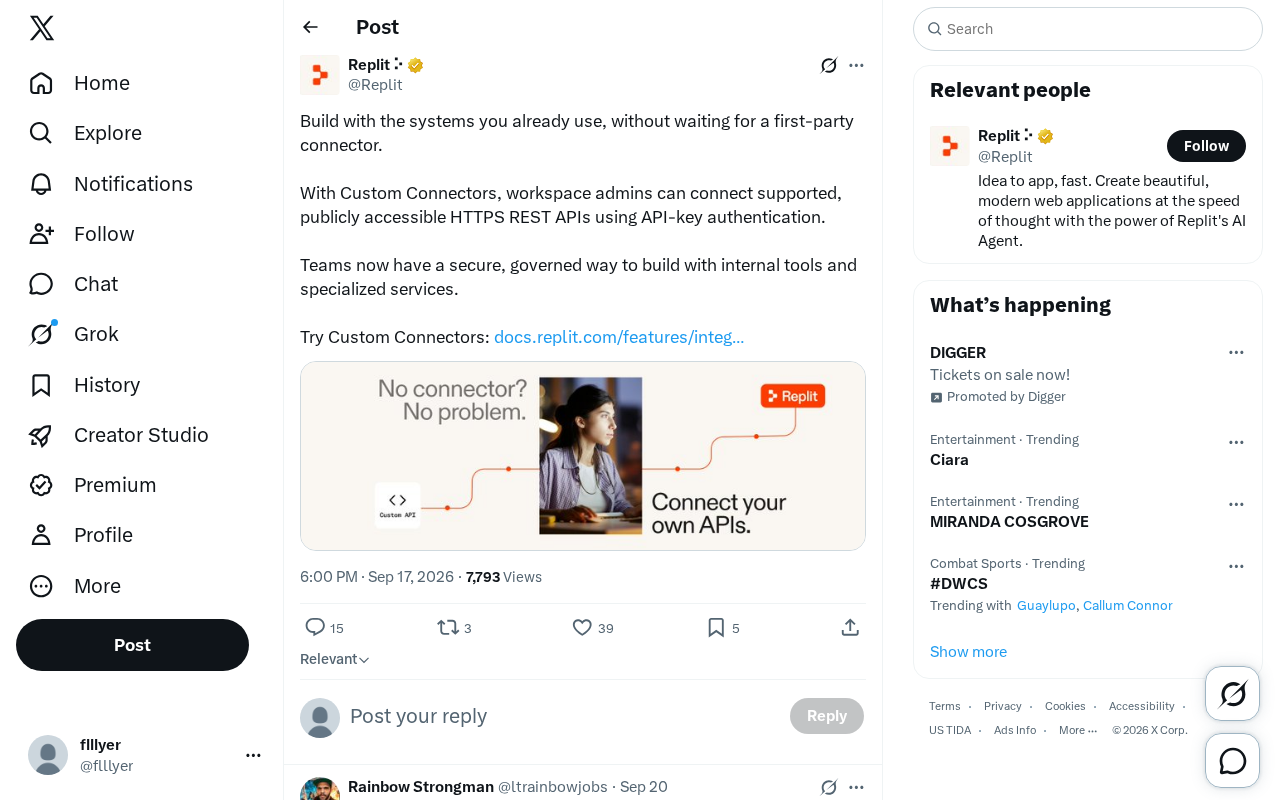
The newly launched Custom Connectors feature targets exactly this pain point. According to information published by the company on Twitter, workspace admins can now independently connect supported, publicly accessible HTTPS REST APIs — bypassing the dependency on official integrations and building workflows directly with the systems their teams already use.
Technical Details: Which APIs Are Supported?
Based on the published details, Custom Connectors have a few clear technical boundaries:
- Protocol requirement: Only REST APIs exposed over HTTPS are supported, ensuring transport-layer security.
- Accessibility: APIs must be publicly accessible, which means services entirely isolated within a private network — with no external endpoints — may not be directly supported at this time.
- Authentication: API-key authentication is currently the supported method. This is a common, low-overhead authentication mechanism that enables quick onboarding, though it does place demands on proper key management.
The design trade-offs are straightforward: lower the barrier to entry, cover the broadest range of general-purpose REST services, while maintaining baseline security constraints through HTTPS and API keys.
Background: REST API & HTTPS — REST (Representational State Transfer) is the dominant API style on the internet today. It uses HTTP methods (GET, POST, PUT, DELETE, etc.) to operate on resources and returns structured data (typically JSON). Compared to older protocols like SOAP, REST is simpler to implement and has a rich ecosystem of tooling, making it the default choice for SaaS products and enterprise services exposing external interfaces. HTTPS layers TLS encryption on top of HTTP, ensuring data cannot be intercepted or tampered with in transit — which is why the platform treats it as a hard requirement rather than an option. API-key authentication is one of the lightest-weight auth mechanisms available: a service provider issues a fixed string, and the caller includes it in request headers or parameters to prove identity. The advantage is extremely low onboarding cost, but a leaked key immediately creates abuse risk, and API keys typically lack fine-grained permission controls compared to delegated authorization protocols like OAuth 2.0.
Value for Teams
The company emphasizes that teams now have a "secure, governed" way to connect internal tools and specialized services. The key word here is governed.
For enterprises, employees quietly using unapproved third-party integrations — so-called "Shadow IT" — has long been a security concern. Placing connector creation under workspace admin control means integrations can be centrally managed, audited, and controlled, rather than scattered across ad-hoc scripts owned by individual teams. This is especially important in organizations with strict compliance requirements.
In other words, Custom Connectors aren't just a capability extension — they bring integration needs that might otherwise drift outside governance frameworks back into a controllable, auditable track.
Use Cases
- Connecting internally built business systems (provided their APIs meet the public accessibility and HTTPS requirements)
- Integrating niche vertical-industry services that don't yet have official connectors
- Rapidly validating an integration idea without waiting for the vendor to build it
Background: Shadow IT — "Shadow IT" refers to software, services, or data integrations introduced by employees or teams without approval from the IT department. This behavior is common under business pressure — teams often bypass approval processes, using personal accounts, unofficial scripts, or undocumented API calls to get integrations done quickly. The risks are real: data flows become opaque, compliance accountability is hard to trace, and keys and credentials lack centralized management. When a data breach or compliance audit occurs, organizations struggle to reconstruct the chain of responsibility. Centralizing connector creation under workspace admins and providing a unified configuration interface is fundamentally about finding a balance between business agility and IT governance — satisfying teams' need for fast integration while keeping every data flow visible and auditable.
Limitations Worth Noting
While the feature is practical, a few points from the currently disclosed information deserve attention.
First, the "publicly accessible" requirement rules out a large number of purely internal services. Enterprises looking to connect such systems may still need to rely on API gateway or proxy solutions. Second, API key authentication — as the only mentioned auth method — is comparatively simple in terms of permission granularity and key rotation when measured against mechanisms like OAuth. At scale, this requires a complementary key management strategy.
For teams looking to improve their automation capabilities without being held back by official integration timelines, Custom Connectors offer a pragmatic path forward. The core philosophy — "build with the systems you already have" — directly addresses one of the most common real-world challenges in enterprise integration.
Note: This article is based on limited information from the official Twitter announcement. For specific supported scope and configuration details, please refer to the official documentation.
Background: Addressing the "Publicly Accessible" Limitation — A common enterprise approach to this constraint is deploying an API Gateway or reverse proxy in front of internal services, exposing them to the public internet in a controlled manner while layering access control and traffic filtering policies at the gateway level. Another approach is using tunneling or Zero Trust Network Access (ZTNA) solutions, enabling restricted access to internal services without fully opening a public-facing entry point. Both approaches introduce additional architectural complexity and operational overhead, which teams should factor in when assessing integration feasibility. OAuth 2.0, the current mainstream standard for enterprise API authentication, supports token expiration and auto-refresh, fine-grained permission scopes, and avoids sharing raw credentials. If future versions of Custom Connectors expand to support such mechanisms, it would significantly improve their applicability in high-compliance scenarios.
Related articles

Amphibious Transforming Drone: Beyond 100x Power Savings, What Are the Real Needs?
Is the amphibious transforming drone just a gimmick? Starting from the 100x power difference of the M4 Morphobot, explore real application scenarios and thesis topic ideas, analyzing boundary conditions where pure drones and pure ground robots both fail.

Warhound Raises $200 Million: Genetically Engineered "War Dogs" Paired with Anduril Gear
Warhound raises $200M, backed by Ben Lamm and Palmer Luckey, to genetically engineer dogs for military and law enforcement use and equip them with Anduril gear. This article analyzes its technology direction, funding logic, and ethical controversy.

Claude API Comes to Google Cloud: IAM Integration and SDK Access Guide
Anthropic hosts the full Claude API on Google Cloud with IAM-controlled permissions and unified billing. This guide covers the Vertex AI and Anthropic-hosted entry points, IAM role configuration, and SDK access.