Cutting the Tether: A Lightweight Flying Robot Achieves Onboard Sensing and Computation
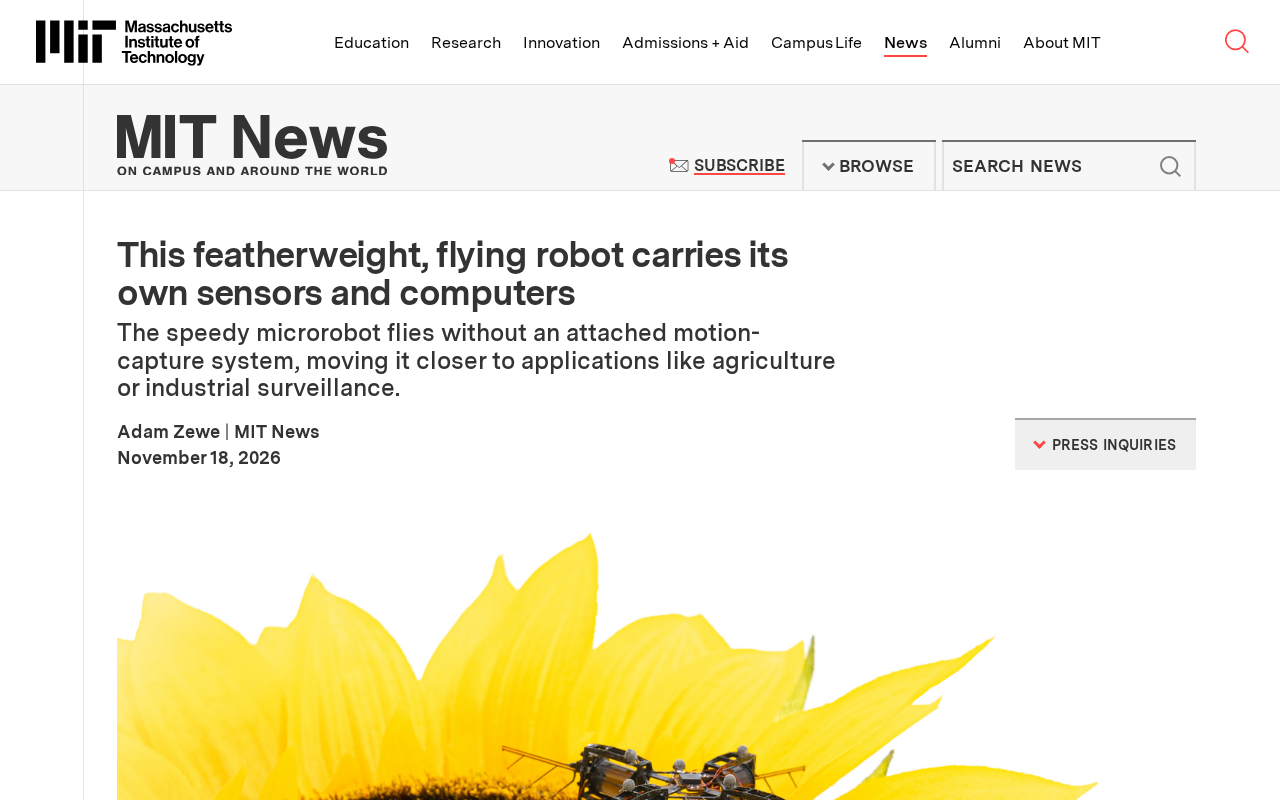
A lightweight flying robot integrates sensing and computation onboard, breaking free from external motion capture for autonomous flight.
The article introduces a lightweight flying robot that integrates sensors and a compute unit into its body. It no longer relies on lab motion capture systems for external localization, but estimates its pose and processes sensor data itself for closed-loop flight. The core difficulty is the triple constraint of payload, power, and compute, plus the need for robust onboard perception. Agriculture and industrial inspection are the main application directions, but endurance, real-time performance, cost, and maintainability remain obstacles to scaling.
Micro aerial robots have long been tethered by an invisible string — the motion capture system in the lab. Cameras, markers, and external compute form the precondition for their flight. Once they leave this carefully arranged environment, even the most agile flapping-wing or rotor designs can barely move. Recent progress on a lightweight flying robot is cutting that string: it carries its sensors and computer onboard, flying without relying on any external tracking system.
From "being watched while flying" to "watching itself fly"
Traditional micro-robot research generally relies on motion capture systems for centimeter-level localization. This approach works well in papers but stumbles in reality: agricultural greenhouses, factory corners, and warehouse aisles will not set up infrared camera arrays in advance for robots.
This robot integrates sensing and computation modules into its body, estimating its pose and processing sensor data on its own during flight. The report describes its weight class as "featherweight" and its flight performance as "speedy" — lightweight and high maneuverability hold at the same time, indicating that integration did not come at the cost of flight performance. What is truly valuable is not any single metric, but that the whole system can complete closed-loop control after detaching from external infrastructure.
Motion capture system refers to a class of external measurement devices that track reflective markers on a target using multiple infrared cameras and solve for its 3D position and orientation at millimeter-to-centimeter accuracy. In micro-robot research, it is often used as "ground truth": the onboard algorithm does not need to answer "where am I" itself; it only needs to align control commands with the externally provided pose. This approach outsources the hardest perception problem to lab infrastructure, so flight performance reported in papers often cannot be directly transferred to real environments. One of the key indicators of whether a micro robot is truly autonomous is whether it can complete pose estimation and closed-loop control without any external tracking and without pre-placed markers.
Why "carrying its own brain" is so hard
Moving computation onto the body runs into the hardest constraints in the micro-robot field: payload and power consumption.
Flight power itself already consumes most of the weight budget and battery capacity, leaving very little margin for sensors, processors, and batteries. A larger processor means a heavier body, a heavier body requires stronger propulsion, and stronger propulsion in turn drives up power consumption — this cycle easily spirals out of control at the micro scale.
Another difficulty lies in perception. External motion capture provides near-ground-truth pose, while onboard solutions can only rely on inertial measurement, vision, or other lightweight sensing to infer it themselves. Errors accumulate over time, placing much higher robustness demands on control algorithms. The fact that this robot can fly shows that the team made trade-offs and balanced payload allocation, compute selection, and state estimation.
The coupled constraint of payload and power is the fundamental bottleneck of micro aerial vehicles. Lift scales with wing area or rotor size, while battery energy density and processor power consumption do not shrink proportionally at the same scale, causing the payload fraction to drop sharply as size decreases. Common engineering solutions include: choosing low-power embedded vision processors or dedicated accelerator chips, replacing high-frame-rate images with sparse sensing such as event cameras, and offloading some computation to a ground station while retaining a minimal closed loop. Each of these approaches has costs — reduced compute affects state estimation accuracy, and sparse sensing weakens robustness. Therefore, "carrying its own brain" is not simply shrinking off-the-shelf modules, but redesigning the whole architecture across the trilemma of weight, power, and compute.
State estimation refers to the process by which a robot infers its own position, orientation, and velocity in real time from sensor data, and it is a core component of autonomous flight. External motion capture directly provides pose, whereas onboard solutions must fuse the high-frequency but drifting data of an inertial measurement unit (IMU) with the low-frequency but absolute information from vision or ranging sensors. Inertial integration errors accumulate over time, and vision tends to fail under drastic lighting changes, textureless scenes, or motion blur, so filtering or optimization frameworks are needed to weighted-fuse the two and robustly handle anomalous observations. On micro platforms with limited compute, state estimation must be compressed to millisecond-level completion, which further limits the usable algorithm complexity.
Application scenarios: landing first where "there is no infrastructure"
The two directions highlighted in the report are worth noting: agriculture and industrial inspection.
What they share is irregular space, dynamic environments, and the inability to pre-deploy localization infrastructure. In agricultural scenarios, crop canopies are dense and lighting varies sharply, and the robot needs to work up close in tight spaces; in industrial scenarios, equipment occlusion is heavy and metal structures cause strong interference, making GPS or external tracking unreliable. A robot with onboard sensing and computation fits precisely these needs of "infrastructure absence."
Another advantage of the micro scale is safety and reachability: even if a lightweight body collides, the risk is far lower than that of a large multirotor, giving it the potential to enter areas that large platforms cannot reach.
How far is it from practical use
Breaking away from motion capture systems is an important step, but there is still a gap between lab validation and large-scale deployment. Endurance is an unavoidable issue for onboard solutions — added payload inevitably cuts flight time, while agricultural and industrial inspection often require sustained operation. The balance between compute and real-time performance also needs repeated validation in real scenarios: stable flight in the lab may not be equally reliable in environments with airflow disturbances, dust, and vibration.
There is also cost and maintainability. Research prototypes can select components regardless of cost, but productization must consider sensor yield, assembly processes, and ease of repair.
Still, the direction is clear: the competitiveness of micro robots is shifting from "how well it flies" to "how well it can still fly outside the lab." When sensing and computation become part of the body, these robots can truly leave the room surrounded by cameras.
One-line Summary
A lightweight flying robot integrates sensing and computation onboard, breaking free from external motion capture systems to achieve autonomous flight.
Paragraph Summary
The article introduces a lightweight flying robot that integrates sensors and a compute unit into its body. It no longer relies on lab motion capture systems for external localization, but instead estimates its pose and processes sensor data itself to complete closed-loop flight. The core difficulty of onboard solutions lies in the triple constraints of payload, power, and compute: flight power already consumes most of the weight and battery budget, and adding a processor increases weight and drives up power consumption; meanwhile, onboard perception can only rely on lightweight sensing such as inertial and vision to infer pose itself, errors accumulate over time, and algorithm robustness requirements are higher. Agriculture and industrial inspection, due to irregular spaces and the lack of pre-deployable localization infrastructure, have become the main landing directions. However, endurance, real-time performance, cost, and maintainability remain the main obstacles from lab validation to large-scale deployment.
Related articles

Vibe Coding Full-Stack in Practice: How One Person Builds a Commercial-Grade Product with AI
An analysis of the Bilibili course Vibe Coding Full-Stack in Practice: how one person uses AI to complete requirements analysis, frontend/backend development, MySQL databases, cloud deployment, multi-platform Mini Program execution, and AI-driven operations promotion—mastering one-person-company AI engineering product development.
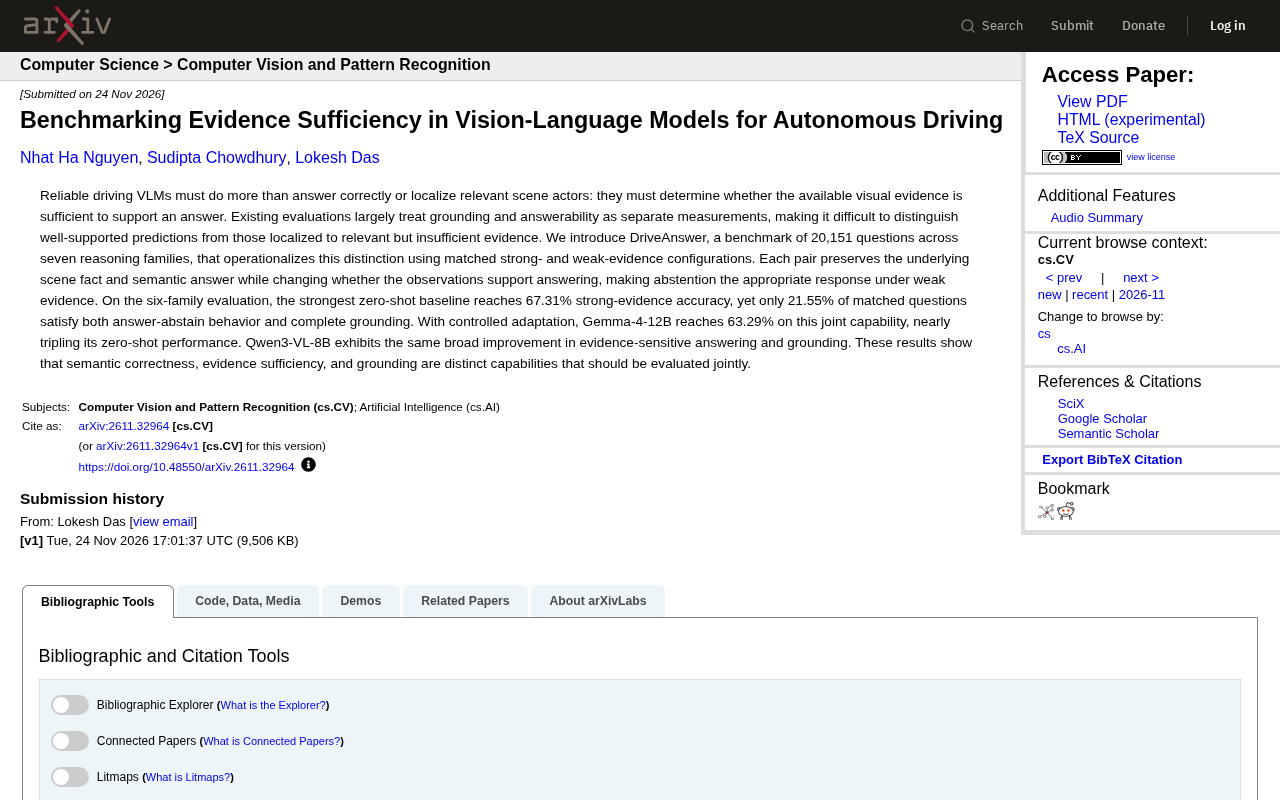
DriveAnswer Benchmark: Evaluating Evidence Sufficiency in Autonomous Driving VLMs
DriveAnswer benchmark with 20,151 questions uses strong/weak evidence pairing to jointly evaluate answer correctness, evidence sufficiency, and visual grounding in autonomous driving VLMs, revealing zero-shot joint capability of only 21.55%.

Hijacking a US Treasury Subdomain for $3: The Overlooked Vulnerability
An attacker can take over a US Treasury subdomain for just $3. This article explains how subdomain takeover works, the special risks facing government domains, and how organizations can close this low-cost security gap through asset discovery and DNS cleanup.