D-JEPA: Breaking the Information Bottleneck in Multimodal Alignment

D-JEPA decouples cross-modal alignment from private information preservation, solving semantic collapse under information asymmetry.
Multimodal representation learning has long prioritized cross-modal alignment, but new research shows alignment alone loses critical information under modality asymmetry. The study proves an alignment redundancy bound where Dirichlet energy minimization eliminates private structure and cross-modal synergy, causing semantic collapse. D-JEPA decomposes latents into an aligned shared core and private fibers, recovering discarded information via masked prediction and asymmetric independence. Experiments show it avoids collapse, boosts downstream accuracy, and flips the synergy gap positive.
Multimodal representation learning has long centered on cross-modal alignment as its core objective, but a recent study points out that when information asymmetry exists between modalities, alignment alone causes substantial loss of critical information. The research proposes Decomposed JEPA (D-JEPA), which decouples alignment from private information preservation, significantly outperforming conventional methods on tasks such as visual question answering.
The Limits of Alignment: Semantic Collapse Under Information Asymmetry
Cross-modal alignment assumes that different modalities can express one another, but in tasks like visual question answering, the question acts as a selective relational operator while the visual field contains a wealth of fine-grained features that no query can fully recover. The study proves an alignment redundancy bound: by minimizing Dirichlet energy through alignment alone, the latent variables retain at most redundant information atoms, while private modality structure and cross-modal synergistic information are eliminated. Under information asymmetry, alignment-only training exhibits catastrophic semantic collapse on compositional reasoning benchmarks, barely surviving on binary queries alone.
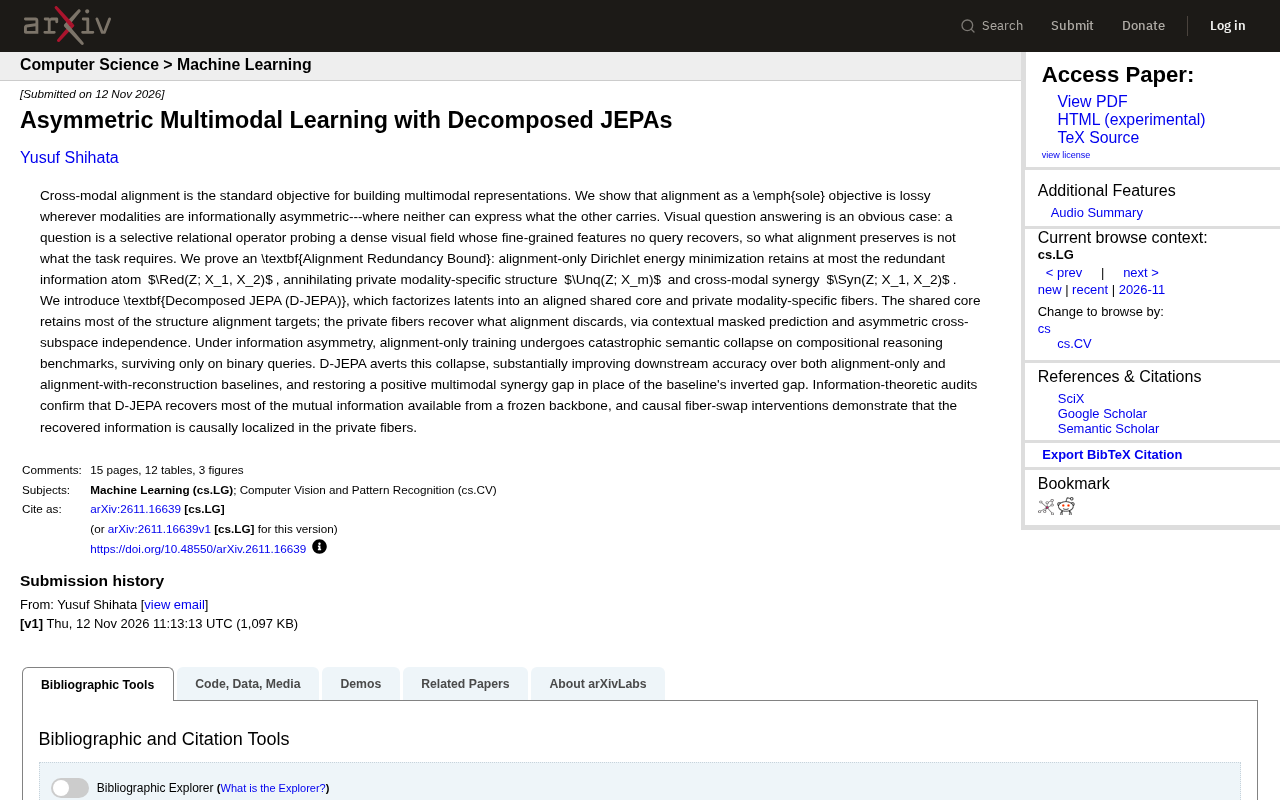
This theory reveals a fundamental flaw in standard alignment objectives: they force the model to discard private information that cannot be aligned—information that is precisely what downstream tasks require.
Dirichlet energy originates from the variational inference framework of the Dirichlet distribution and is often used in multimodal alignment as a divergence measure for distribution matching: the latent representations of each modality are treated as points on a probability simplex, and the Dirichlet energy between them is minimized to drive the representation distributions of different modalities toward consistency. This objective is mathematically equivalent to a soft alignment constraint whose essence is to compress distributional differences between modalities. The researchers point out that when modalities differ greatly in information content, this energy minimization suppresses private dimensions that cannot be matched, causing the latent space to collapse onto only the overlapping portion—precisely the starting point for deriving the "alignment redundancy bound." Understanding this energy objective helps clarify that the alignment loss is not a neutral tool; it embeds a strong assumption that "modalities are fully intertranslatable."
D-JEPA: Decomposing the Latent Space to Preserve Private Fibers
D-JEPA decomposes latent variables into an aligned shared core and modality-specific private fibers. The shared core retains most of the structure required by the alignment objective, while the private fibers recover information discarded by alignment through context-masked prediction and asymmetric cross-subspace independence. This design avoids semantic collapse under information asymmetry and substantially surpasses alignment-only and alignment-with-reconstruction baselines in downstream accuracy.
More critically, D-JEPA restores a positive multimodal synergy gap, whereas baseline methods exhibit a negative gap. Information-theoretic auditing confirms that D-JEPA recovers most of the available mutual information from frozen backbones, and causal fiber-swap interventions further demonstrate that the recovered information is causally localized in the private fibers.
Fiber is borrowed from the concept of fiber bundles in differential geometry: the total space can be viewed as consisting of a shared base space with a "fiber" attached at each point. Analogously in representation learning, the aligned shared core corresponds to the base space, capturing cross-modal common semantics, while each modality's private fiber is attached atop the core, carrying details that cannot be expressed by other modalities. This geometric analogy is more than rhetoric—it implies that the decomposed latent space still maintains global structural consistency, with the shared portion handling semantic interoperability and the fiber portion handling modality-specific information, coupled through asymmetric cross-subspace constraints rather than forcibly merged. This perspective also explains why "decomposition" outperforms "alignment + reconstruction": the latter stuffs private information back into the shared bottleneck, while the former opens an independent channel for it.
JEPA (Joint Embedding Predictive Architecture) was proposed by Yann LeCun, with the core idea of making predictions in latent space rather than at the pixel or token level: given part of the context, predict the representation of another part in embedding space, thereby avoiding reconstruction of irrelevant details. D-JEPA's "decomposed" modification splits JEPA's prediction objective into two branches—the shared core aligns through cross-modal prediction, while private fibers self-recover through context-masked prediction. Compared to masked autoencoder (MAE)-style methods that require reconstruction of the original input, JEPA-family methods inherently possess the ability to discard unpredictable noise, making them more likely to preserve genuinely useful private structure in information-asymmetric scenarios rather than wasting compute reconstructing unalignable minutiae.
The multimodal synergy gap measures the additional information gain that a multimodal joint representation provides over the best unimodal representation: a positive gap indicates that multimodality genuinely integrates complementary information, producing a "1+1>2" synergy effect; a negative gap means that fusion actually degrades information already present in individual modalities. This metric is commonly measured via mutual information or downstream performance differences and is a key diagnostic tool for judging whether fusion is genuinely effective. Many alignment-based methods exhibit negative gaps under information asymmetry, exposing that their fusion is "compromise-style"—trading private information for surface-level consistency. D-JEPA turns the gap from negative to positive, showing that its decomposed structure allows modality complementarity to be exploited rather than flattened by the alignment objective.
Experimental Evidence and Implications
On compositional reasoning benchmarks, alignment-only training suffers semantic collapse, while D-JEPA remains robust. Downstream accuracy improves significantly, and the synergy gap flips from negative to positive, indicating that the model genuinely leverages complementary information across modalities. Causal intervention experiments provide direct evidence for the function of private fibers.
This research has broad implications for multimodal learning: when modality information is asymmetric, forced alignment may backfire. Preserving private structure and allowing asymmetric information flow may be key to building more robust multimodal systems. D-JEPA's decomposition approach also offers a new paradigm for other cross-modal tasks with information bottlenecks.
One-line Summary
D-JEPA decouples cross-modal alignment from private information preservation, solving semantic collapse under information asymmetry.
Paragraph Summary
Multimodal representation learning has long centered on cross-modal alignment, but a new study shows that under information asymmetry, alignment alone loses substantial critical information. The research proves an alignment redundancy bound: Dirichlet energy minimization retains at most redundant information atoms, while private modality structure and cross-modal synergistic information are eliminated, leading to semantic collapse on compositional reasoning benchmarks. To address this, it proposes Decomposed JEPA (D-JEPA), which splits latent variables into an aligned shared core and modality-specific private fibers, recovering discarded information through context-masked prediction and asymmetric cross-subspace independence. Experiments show D-JEPA avoids collapse, significantly improves downstream accuracy, and flips the multimodal synergy gap from negative to positive; causal fiber-swap interventions prove the recovered information is causally localized in private fibers, offering a new paradigm for multimodal learning under information asymmetry.
Related articles

ChatGPT Plus Subscription Pitfall Guide: Go/Plus/Pro Tier Comparison and Quick Activation
A complete ChatGPT Plus subscription guide based on a Bilibili tutorial: from registering an account, comparing Go/Plus/Pro tiers, to the practical steps for quickly completing your subscription.

GPT-6.2 Sol/Astra Released! A Step-by-Step ChatGPT Plus Subscription Guide and Tier Comparison
GPT-6.2 Sol/Astra is out—here's a ChatGPT Plus subscription guide: register an account, compare Go/Plus/Pro tiers, and subscribe in a minute.

Comparing Three Channels for Subscribing to GPT Plus in China: Is Website Top-Up the Easiest?
How to subscribe to GPT Plus in China? This article compares website top-up, credit card, and mobile top-up channels—process, cost, and risk—with steps and tips to help you choose wisely.