Dadan: An AI Video Workspace Combining Recording, Meetings, and Guides

Dadan integrates asynchronous recording, meeting notes, and how-to guides, using interactive video to turn views into leads.
Dadan is an AI video workspace for sales, marketing, and customer success teams that combines asynchronous recording, meeting notes, and how-to guides into one product to solve the cost and efficiency issues of fragmented tools. Its differentiation is interactive video—inserting polls, CTA buttons, and lead forms into videos to turn one-way viewing into an interactive lead generation gateway and help track content ROI. It received 100 upvotes on Product Hunt (ranked 7th for the day), with a team of about 8 people, indicating an early-stage product. Public information mainly comes from the product's own descriptions, lacking third-party reviews and integration details, and the actual experience and conversion performance remain to be verified.
Most teams use separate tools for asynchronous video, meeting notes, and how-to guides. This fragmentation not only increases costs but also makes information flow inefficient. Dadan aims to solve this problem with a single AI video workspace—it integrates recording, meetings, and guides together, and adds interactive elements so that videos themselves become a gateway for lead generation and conversion.
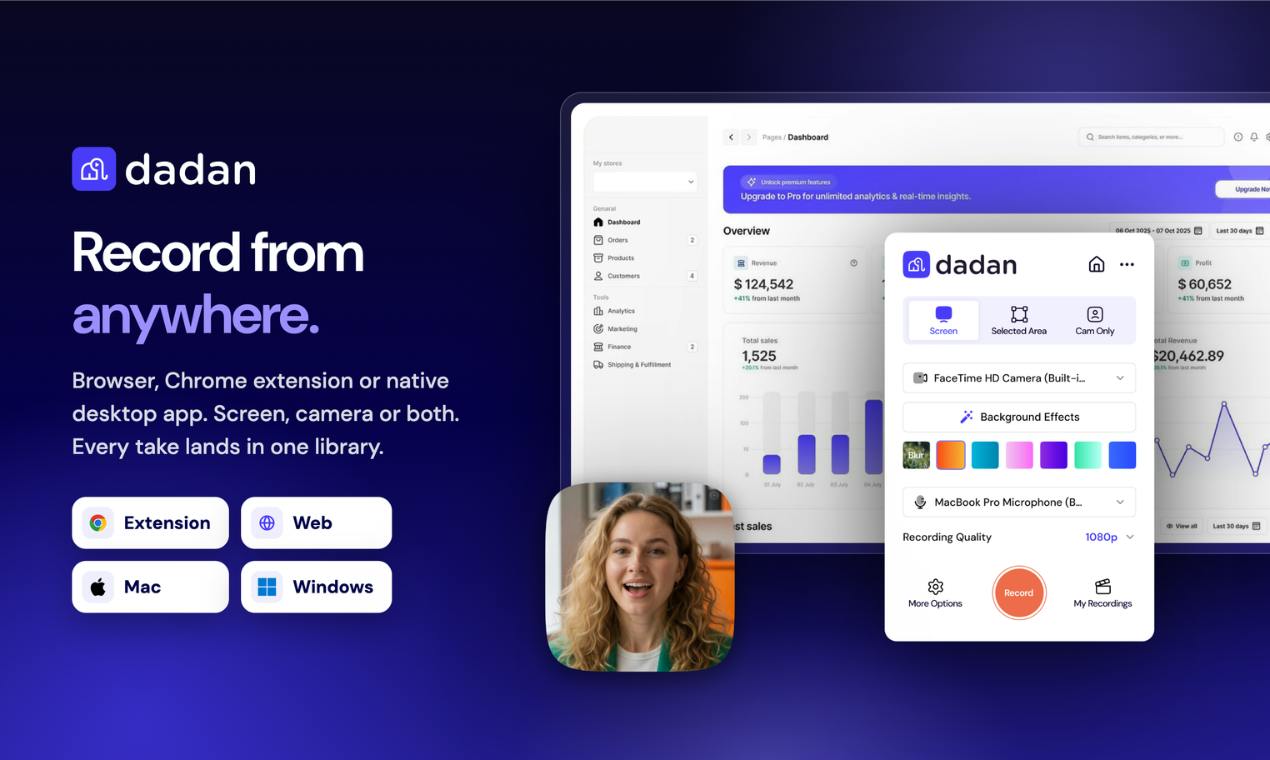
One workspace, three video scenarios
Dadan's positioning is clear: it targets sales, marketing, and customer success teams, covering the creation of demos, onboarding, and training content. It puts three common video needs into one product: asynchronous recording, meeting notes, and how-to guides.
Asynchronous recording addresses the time-zone gap in remote communication—team members can record their screen and camera and share it with colleagues or customers. Meeting notes focus on automatically turning meeting content into usable notes. How-to guides lean more toward knowledge capture, helping teams solidify processes and product usage into reusable video documentation.
The logic behind this combination is that the underlying capabilities of these three scenarios overlap heavily—recording, transcription, editing, and sharing. Purchasing them separately only complicates the workflow.
Interactive video: turning viewers into leads
What truly differentiates Dadan is the interactive layer it adds to videos. According to the official description, users can insert polls, CTA buttons, and lead forms into videos, turning what was originally one-way viewing into interactive touchpoints.
Imagine a product demo video: when viewers see a key feature, they can click a CTA within the video to book a demo, or fill out a form to leave their contact information. For sales and marketing teams, this means video is not just content—it's a channel that can drive sign-ups and leads.
This design turns video from an asset that's "watched and forgotten" into a tool whose conversion performance can be measured. For teams that need to track content ROI, this is an attractive selling point.
What is asynchronous video?
Asynchronous video refers to a video format that conveys information without requiring the sender and receiver to be online at the same time. Unlike live streaming or video conferencing, asynchronous video allows the sender to record their screen, camera, or a combination of both first, and the receiver to watch and reply on their own schedule. This model is particularly well suited to cross-time-zone collaboration, remote onboarding, and customer support scenarios because it eliminates the cost of scheduling coordination. Dadan's asynchronous recording module is based on exactly this logic, allowing team members to record a demo or explanation at any time and share it with colleagues or customers without waiting for everyone to be available simultaneously.
Product performance and market signals
Dadan received 100 upvotes on Product Hunt, ranking 7th for the day, and was categorized under Marketing, Meetings, and Video. This result shows that it hits on a real pain point for some users, but the 10 comments also indicate that discussion buzz isn't particularly high.
Judging from the maker list, the team size is around 8 people (some names are hidden), indicating an early-stage product. Product Hunt also offered a promo code PRODUCTHUNT for 3 months of PRO for free, a typical customer acquisition tactic for new products.
It's worth noting that the currently available public information mainly comes from the product's own descriptions, with a lack of third-party reviews or user case studies to validate the actual experience. How well the interactive video forms and CTAs perform, and how accurate the meeting notes are—these key metrics still lack independent data support.
A few things worth watching
The value of integration depends on depth. Combining three tools into one—if each module is merely "good enough," users may still return to specialized tools. Dadan needs to prove that the integrated experience is better than purchasing separately.
The barrier to interactive video. Polls, CTAs, and forms look simple, but integrating with existing CRMs and tracking lead sources is what truly generates business value. The official information currently doesn't detail integration capabilities.
Trade-offs of an early-stage product. An 8-person team covering three lines—recording, meetings, and guides—at the same time makes resource allocation a challenge. Which module gets deepened first may determine whether it can gain a firm foothold in the competition.
For sales and marketing teams looking for a lightweight video collaboration solution, Dadan is worth trying, especially to use the free PRO period to verify whether interactive video suits their lead generation process. But if there are hard requirements for meeting note accuracy or deep CRM integration, it's advisable to first observe subsequent user feedback.
Why is CRM integration key?
CRM (Customer Relationship Management) systems are core tools for sales and marketing teams to manage leads, customer interactions, and conversion funnels. If the CTAs and lead forms inserted in interactive videos cannot automatically sync the collected data to a CRM, teams will need to manually enter or export it, which undermines the conversion value of interactive video. The real business loop is: after a viewer submits a form in the video, lead information (such as name, email, viewing progress, and interactive behavior) can flow into the CRM in real time and trigger subsequent sales follow-up processes. Dadan currently does not explain its integration capabilities in detail, which is an important dimension for evaluating its enterprise-grade usability.
One-line Summary
Dadan integrates asynchronous recording, meeting notes, and how-to guides, and uses interactive video to turn views into leads.
Paragraph Summary
Dadan is an AI video workspace for sales, marketing, and customer success teams that integrates three scenarios—asynchronous recording, meeting notes, and how-to guides—into one product, aiming to solve the cost and efficiency problems caused by teams using multiple fragmented tools. Its differentiation lies in interactive video features, which allow polls, CTA buttons, and lead forms to be inserted into videos, turning one-way viewing into an interactive lead generation gateway and helping track content ROI. The product received 100 upvotes on Product Hunt, ranking 7th for the day, with a team of about 8 people, indicating an early-stage product. Currently, public information mainly comes from the product's own descriptions, lacking third-party reviews and integration details, and the actual experience and conversion performance remain to be verified.
Related articles

WorkBuddy Agent in Action: From AI Q&A to Automated Office Work
WorkBuddy is Tencent's AI agent desktop workbench that reads local files, operates office software, executes multi-step tasks, and runs on schedules. This article explains its core features, key differences from traditional AI tools, and use cases.

Anthropic Research: LLMs Make Formal Software Verification at Scale Possible
Anthropic Frontier Red Team research shows LLMs can generate formal proofs at the RISC-V assembly level for over 100 real open-source libraries, covering 123 OSS-Fuzz libraries and 239 entry points, totaling about 180 million lines of Rocq proofs and finding hundreds of bugs. The article analyzes specification generation, the proof pipeline, trust boundaries, and cost reduction paths.

Prompt Engineering for Beginners: From Writing Prompts to Building AI Collaboration Skills
From the four functions of prompts to the six-step prompt engineering process, this article systematically covers core concepts, business value, and three layers of limitations to help beginners build a complete cognitive framework for prompt engineering.