daily.dev Brings AI Agents into the Developer Feed

daily.dev lets AI agents tap into developer feeds via MCP, building out an agent ecosystem.
daily.dev announced MCP support, letting compatible clients like Claude, Cursor, and Codex directly access its developer feed. Agents can read personalized feeds, search posts, learn from discussions, save bookmarks, and even retune recommendations. Choosing an open protocol over a proprietary API lowers integration costs and positions daily.dev as an upstream supplier for agents rather than a bypassed source. The platform also teased a plugin marketplace and app ecosystem. It earned 101 votes, ranking 5th on Product Hunt.
Millions of developers use daily.dev every day to follow tech news, read discussions, and save bookmarks. Now, this developer community platform has done something in step with the AI agent wave: it's letting agents read daily.dev too—by connecting Claude, Cursor, Codex, and other clients via the MCP protocol, AI assistants can directly read your personalized feed, search posts, learn from discussions, save bookmarks, and even retune your feed recommendations.
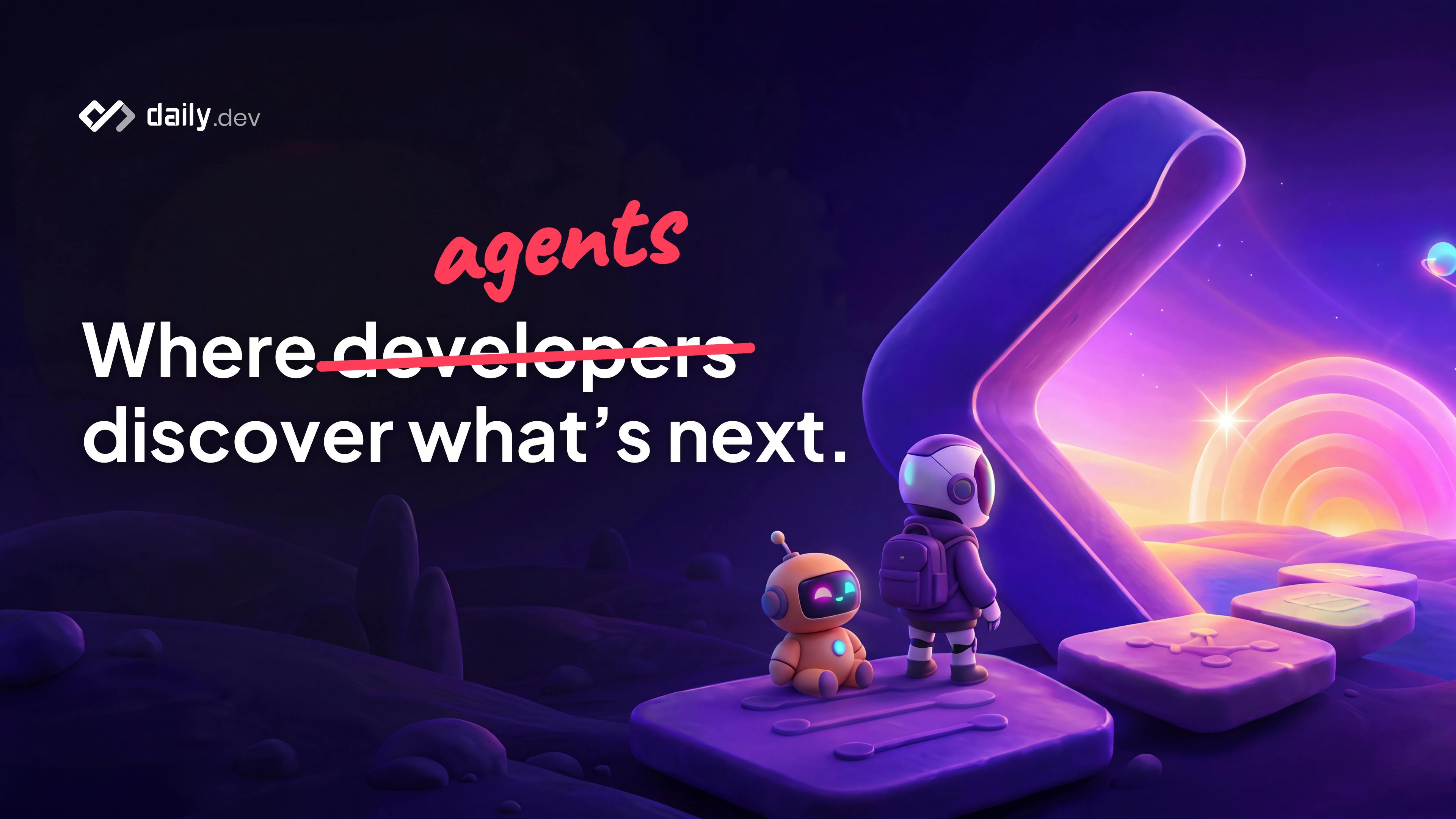
daily.dev launched on Product Hunt with the tagline "Where agents discover what's next," earning 101 votes and ranking 5th, categorized under News, Developer Tools, Artificial Intelligence, and Google Cloud Run.
MCP Protocol: The Key to Agent Access to the Feed
The core of this update is MCP (Model Context Protocol) support. Rather than building its own proprietary API from scratch, daily.dev chose to adopt this open protocol championed by Anthropic—meaning any MCP-compatible client (Claude, Cursor, Codex, and whatever tools emerge next) can interact with daily.dev in a unified way.
For developers, the value of this choice is clear: you don't need to configure a separate integration for each AI tool. Set up MCP once, and your agent can perform a range of actions on daily.dev: read a feed sorted by your interests, run full-text searches across technical posts, extract hands-on experience from other developers in the comments, and save valuable links to bookmarks.
Four Things Agents Can Do
Specifically, daily.dev's agent capabilities cover several high-frequency scenarios. Reading your personalized feed is the most basic—the agent can access the same content stream you'd see when scrolling daily.dev manually. Searching posts lets AI pinpoint technical discussions by keyword. Learning from discussions goes a step further, since the experience shared in comment sections is often the most valuable part beyond the article itself. Saving bookmarks and tuning the feed are write operations—the agent isn't just consuming content, it can also help you manage your information stream.
Together, these four capabilities effectively turn daily.dev into a "tech intelligence hub" for agents. When you hit a problem while coding in Cursor, the agent can first search community discussions on daily.dev and bring back the conclusions—rather than requiring you to switch to a browser and search manually every time.
MCP (Model Context Protocol) is a communication protocol open-sourced by Anthropic in late 2024, designed to let AI models connect with external data sources and tools through a unified standard. Before MCP, every time you integrated a data source (a calendar, a database, some SaaS platform), developers often had to write custom function calls or plugin wrappers for the large model, and these weren't compatible across different clients. MCP borrows from the approach of the Language Server Protocol (LSP): it decouples the "model side" from the "resource side," so a service provider only needs to implement an MCP Server once, and any MCP-compatible client (Claude Desktop, Cursor, Continue, etc.) can call it directly. It defines primitives such as Resources, Tools, and Prompts, and supports both local stdio and remote SSE/HTTP transports. For a platform like daily.dev, adopting MCP means exposing its capabilities to the entire agent ecosystem in a "standardized" way, rather than being tied to a single AI vendor.
The "read" and "write" distinction mentioned here is a common one in MCP tool design. Read operations (like reading the feed, searching posts, fetching comments) are idempotent queries that agents can call repeatedly and compose as needed; write operations (like saving bookmarks or adjusting feed preferences) change server-side state and typically require more careful permission controls and user confirmation. By opening up "feed tuning" to agents, daily.dev means the model isn't just passively fetching data—it can actively adjust recommendation signals based on conversation context. For example, if you complain in Cursor that there's too much of a certain type of content, the agent can call an interface to adjust the weight of topics you follow. This combination of reading and writing is a key step in turning the platform from a "content repository" into a "programmable information pipeline."
From Information Consumption to Agent Ecosystem
daily.dev's ambitions go beyond letting agents read the feed. The company also mentioned a plugin marketplace and app ecosystem, hinting at further expansion around agent scenarios.
This direction isn't surprising. daily.dev's product logic has always been "help developers discover what's worth reading," and agents happen to be tireless information consumers. Once an agent handles the filtering, summarizing, and recommending for you, you may open daily.dev less often yourself—but the platform's embedding in your workflow will actually deepen.
The Possibilities of a Plugin Marketplace and App Ecosystem
The existence of a plugin marketplace means third-party developers can build extensions for daily.dev's agent capabilities. Think vertical feeds for specific tech stacks (Rust, Kubernetes, AI frameworks), or integrations with team collaboration tools to automatically share valuable discussions to Slack. An app ecosystem could bring daily.dev's data into more developer tools—IDEs, note-taking apps, even CI/CD pipelines.
Looking at the competitive landscape, what daily.dev is doing is fundamentally different from tools like GitHub Copilot or Sourcegraph. The latter focus on code understanding and generation, while daily.dev is betting on agent-based access to technical information flows. It's a narrower but more focused angle.
In the context of AI tools, "plugin marketplace" usually refers to third-party developers publishing extensions based on a platform's open interfaces, similar to the Chrome extension or VS Code Marketplace model. If daily.dev goes this route, the technical foundation will likely still be MCP Server or App API: external developers write an MCP service for a vertical domain, and once users install it, their agents gain specialized information retrieval capabilities for that domain. One thing to watch: multi-source agent plugins introduce permission and trust issues—a third-party extension that can read your bookmarks and write your feed preferences effectively holds a fairly personal profile of your technical interests. The more open the ecosystem, the more critical the platform's design for authentication, auditing, and data boundaries becomes. This is an unavoidable challenge for any platform building an agent ecosystem.
How Developers Get Information Is Changing
On Product Hunt, 101 votes and 4 comments suggest daily.dev's agent features have drawn some attention, though the discussion isn't particularly heated yet. This may be related to the barrier to entry—to use this capability, you first need Claude, Cursor, or Codex, then configure the MCP connection. For developers already using these tools, the setup cost isn't high; but for the broader developer community, the value of "letting an agent read tech news" still needs to be proven.
One question worth pondering: when an agent reads daily.dev for you, do you still need to scroll it yourself? In the short term, the two are complementary—the agent handles initial screening and summarization, while you handle deep reading and judgment. But in the long term, if the agent's recommendation quality is high enough, how often you manually browse the feed may decline.
daily.dev clearly doesn't want to become an information source that agents bypass—it's choosing to actively become an "upstream supplier" for agents. Whether this strategy works depends on whether it can make agents truly understand the technical signals developers care about—not just package post titles and summaries into AI-friendly formats.
For developers, what you can do right now is simple: if you already use Claude, Cursor, or Codex, try adding daily.dev to your MCP configuration and see whether the agent can find those technical discussions you might have missed.
One-line Summary
daily.dev lets AI agents tap into the developer feed via the MCP protocol, staking out the agent ecosystem.
Paragraph Summary
daily.dev has announced MCP protocol support, enabling compatible clients like Claude, Cursor, and Codex to directly access its developer feed. Agents can read personalized feeds, search technical posts, learn from comment discussions, save bookmarks, and even retune recommendation preferences. Choosing an open protocol over a proprietary API lowers the configuration cost for multi-tool integration and shifts daily.dev from a content source that agents bypass to an upstream information supplier for agents. The platform also hinted at plans for a plugin marketplace and app ecosystem to expand agent scenarios. The feature earned 101 votes and ranked 5th on Product Hunt, though discussion remains limited—the barrier being that users must first have an MCP-compatible AI tool.
Related articles

Random Pruning of the DPO Computation Graph: 1.4x Training Speedup and Lower Peak Memory
DPO training too slow and memory-hungry? This paper proposes a random pruning framework for the DPO computation graph, sampling independently across position, sequence, and branch dimensions; branch pruning achieves a 1.426x step-time speedup and cuts training time by about 30%, with in-depth attribution of memory and time gains.

Why Does JEPA Underperform MLM in Longitudinal EHR Representation Learning?
New study compares JEPA and MLM for longitudinal EHR representation learning on MIMIC-IV: three JEPA variants train stably without collapse but underperform MLM; target size, not heterogeneity, drives prediction error.

Transfer Learning + Visible Light Communication: A New Approach to Energy-Efficient Indoor Positioning
A study proposes a transfer learning-based visible light communication indoor positioning method, achieving 47% accuracy improvement on the BOSCH factory dataset, 67.5% model efficiency under high noise, and introducing the ME composite metric for energy-efficient positioning in energy-constrained industrial IoT scenarios.