DantinoX: An Open-Source Language Modeling Framework That Unifies Three Paradigms
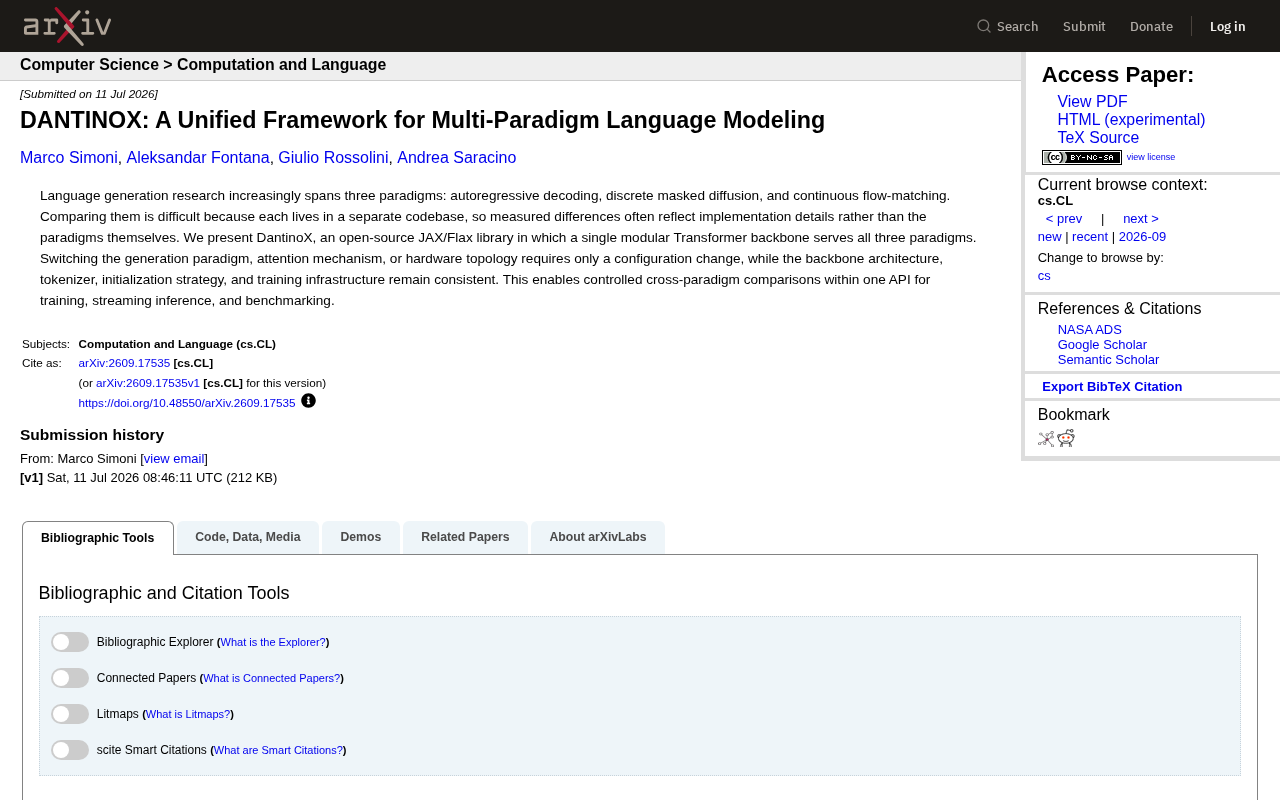
DantinoX unifies autoregressive, diffusion, and flow-matching paradigms under one modular Transformer backbone for controlled comparison.
The three major language generation paradigms — autoregressive decoding, discrete masked diffusion, and continuous flow-matching — have long lived in separate codebases, making it hard to distinguish paradigm differences from implementation differences. DantinoX is a JAX/Flax-based open-source framework that unifies all three under a single modular Transformer backbone, allowing researchers to switch paradigms, attention mechanisms, or hardware topologies via configuration alone, while keeping the tokenizer, initialization, and training infrastructure identical. By integrating training, streaming inference, and benchmarking in one API, it provides the infrastructure for controlled experiments in language generation research.
The Fragmentation Problem in Language Generation
Current language generation research is advancing along three parallel technical tracks: autoregressive decoding, discrete masked diffusion, and continuous flow-matching. These represent fundamentally different generative philosophies — autoregressive models predict word by word, diffusion models iteratively denoise from noise, and flow-matching constructs probability paths in continuous space.
The problem is that these three paradigms have largely evolved in isolated codebases. When researchers try to compare their performance, they run into a persistent trap: are the observed differences due to the paradigms themselves, or to implementation details like tokenizers, initialization strategies, and training infrastructure? This "apples-to-oranges" comparison has long plagued empirical research in language generation.
Autoregressive decoding is the dominant approach in today's large language models — the GPT series being the prime example. The model predicts the next token based on all previously generated tokens, producing output serially word by word. Its strengths are a simple training objective and controllable sampling; its weakness is that inference speed scales linearly with sequence length. Discrete masked diffusion borrows BERT's masked language modeling idea and transplants the diffusion model's "iterative denoising" framework into discrete token space — during training, sequences are randomly masked and reconstructed; during inference, generation starts from a fully masked sequence and iteratively fills in content over multiple steps. Representative works include MDLM and SEDD. Continuous flow-matching steps entirely outside the discrete token space, constructing a probability flow from a noise distribution to the data distribution within the continuous embedding space of word vectors. The generative trajectory is described by an ordinary differential equation (ODE), and sampling is performed by integrating along that trajectory. This approach has already achieved significant results in image generation (e.g., Stable Diffusion 3), while its application to language remains in early stages. Each of the three paradigms involves trade-offs in decoding parallelism, training stability, and generation quality — and without a unified comparison benchmark, it remains an open question which paradigm performs best on language tasks.
DantinoX's Solution
Addressing this pain point, a paper published on arXiv introduces DantinoX — an open-source library built on JAX/Flax. Its core design philosophy can be summarized in one sentence: a single modular Transformer backbone that serves all three generation paradigms simultaneously.
This means that when a researcher wants to switch from autoregressive to diffusion, adjust the attention mechanism, or even change the hardware topology, only a single configuration entry needs to be modified. The backbone architecture, tokenizer, initialization strategy, and training infrastructure remain completely consistent throughout.
This "controlled variable" design is precisely what makes DantinoX most valuable. It locks down the implementation noise that was previously impossible to isolate, allowing comparisons between paradigms to focus on the paradigms themselves.
One API for Training, Inference, and Evaluation
DantinoX integrates three key stages under a unified API:
- Training: All three paradigms share a unified training pipeline
- Streaming inference: Supports real-time generation scenarios
- Benchmarking: Enables cross-paradigm evaluation under controlled conditions
This integrated design lowers the migration cost for researchers — no more maintaining separate engineering stacks for each paradigm.
Why This Matters
From a methodological perspective, the significance of DantinoX goes beyond the tool itself. The language generation field has seen a surge of new paradigms in recent years, but the lack of a fair comparison benchmark has made many findings difficult to reproduce or mutually contradictory. A framework capable of isolating implementation noise and enabling "controlled experiments" can help the community converge on more reliable shared conclusions.
The choice of JAX/Flax as the technical foundation is also well-considered. JAX's advantages in hardware parallelism, functional programming, and large-scale training make the framework naturally suited for exploring different hardware topology configurations — which explains why switching hardware topologies requires only a configuration change.
As an open-source project, DantinoX's value also lies in reproducibility. The research community can validate each other's findings on the same codebase, reducing disputes caused by engineering differences.
JAX is a numerical computing framework developed by Google. Its core features are function transformations: jit (just-in-time compilation to XLA), vmap (automatic vectorization), and pmap/shard_map (cross-device parallelism) can be freely composed, enabling the same Python code to run on CPUs, GPUs, and TPU Pods with minimal engineering overhead, automatically adapting to different hardware topologies (data parallelism, model parallelism, pipeline parallelism). Flax is a neural network library built on JAX that provides PyTorch Module-like modular abstractions while retaining JAX's functional style — model parameters are passed in as explicit state rather than being implicitly bound to objects, making multi-device parameter sharding more transparent to control. For research scenarios that require testing the same model under different hardware topologies, this stack enables switching at the configuration level without rewriting model logic — a key reason DantinoX chose JAX/Flax over PyTorch.
Summary
DantinoX addresses a foundational yet thorny engineering and methodological problem in language generation research: how to fairly compare different generation paradigms. By unifying autoregressive decoding, discrete masked diffusion, and continuous flow-matching under a single modular Transformer backbone, it makes controlled cross-paradigm comparisons possible. For researchers focused on the underlying mechanisms of language models, this kind of infrastructure work often carries more long-term value than chasing benchmark leaderboards with a single model.
(Note: This article is based on an arXiv preprint abstract. Please refer to the original paper for specific implementation details and experimental results.)
Related articles
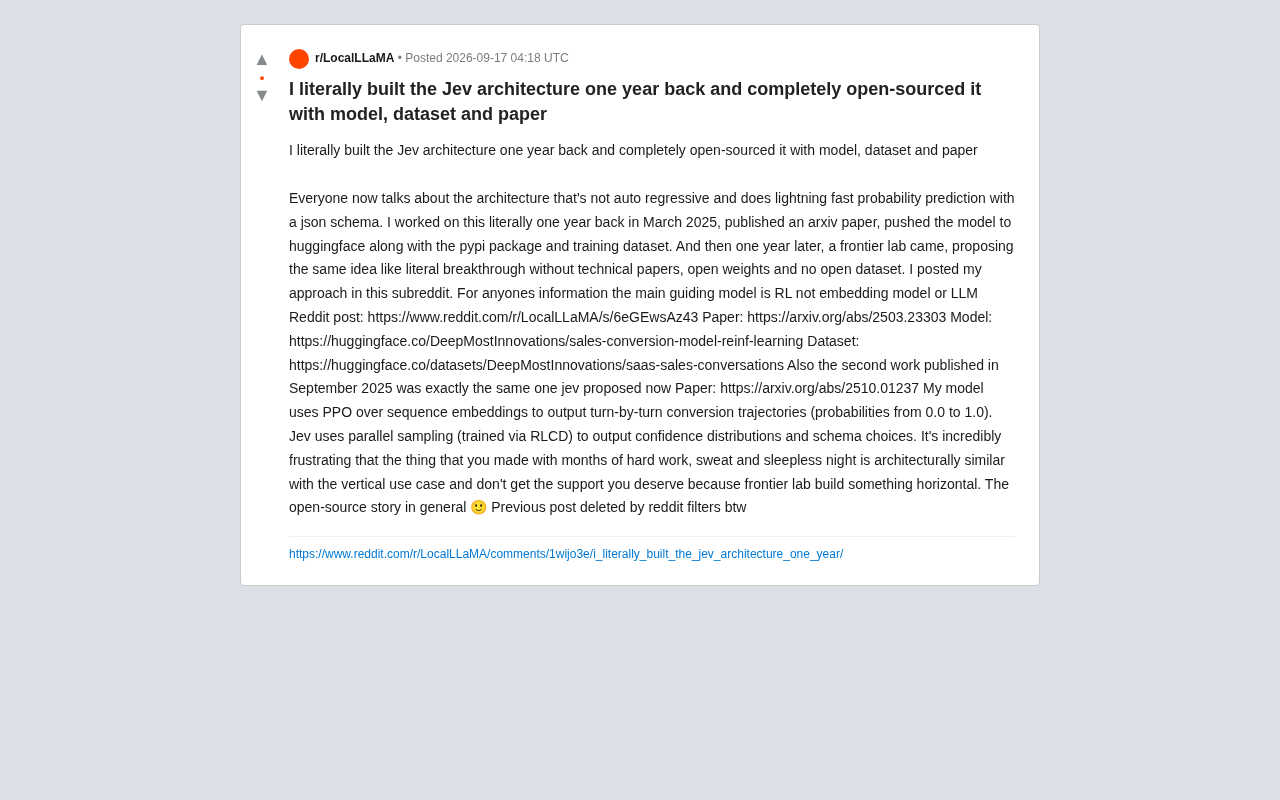
The Open Source Dilemma: A Non-Autoregressive Architecture Pioneer Overshadowed by Frontier Labs
An indie developer claims a frontier lab repackaged his year-old open-source non-autoregressive RL architecture as a breakthrough. We compare PPO sequence embeddings vs. RLCD parallel sampling and examine open source attribution gaps.
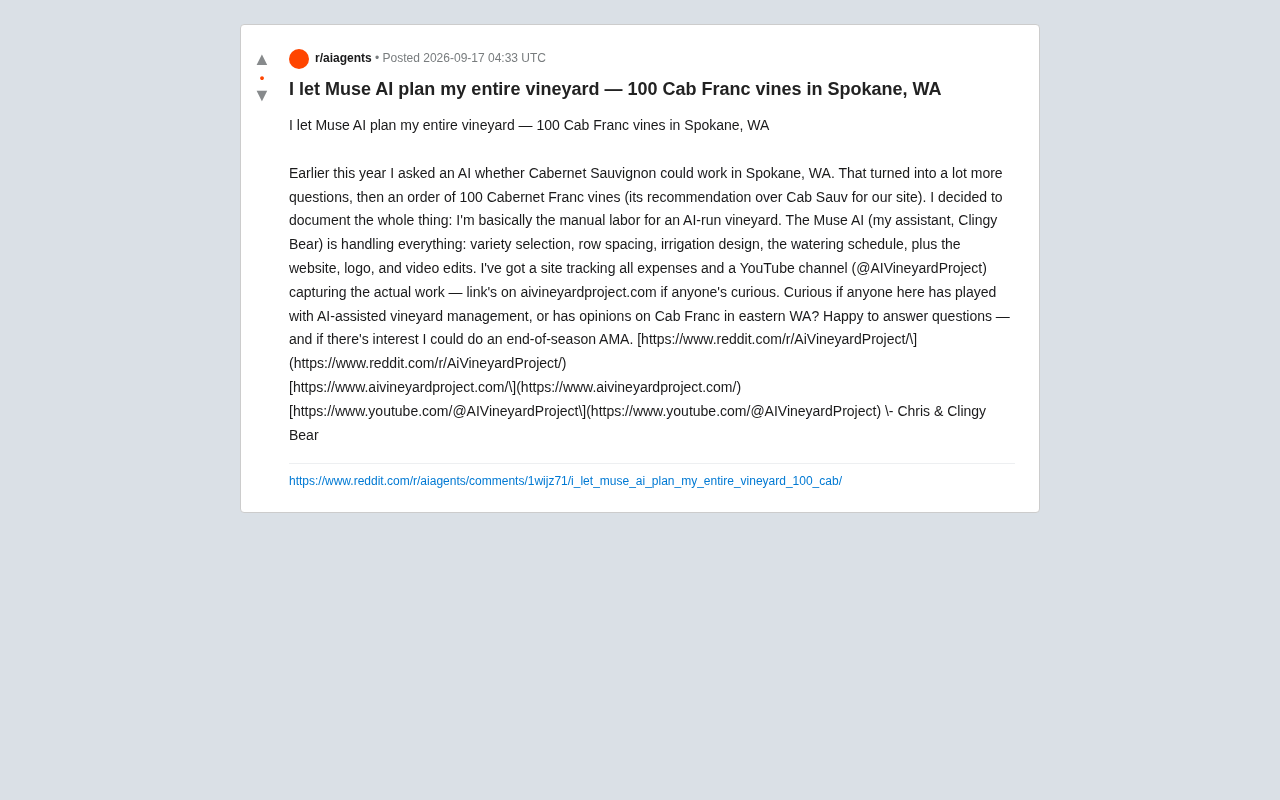
AI Plans an Entire Vineyard: A Real-World Experiment with 100 Grapevines
A Spokane hobbyist let Muse AI plan his entire vineyard — variety, spacing, irrigation, even the logo. He planted 100 Cabernet Franc vines and is documenting everything publicly.

Iceland's Treble Raises $18M to Bet on Voice Simulation Platform
Iceland-based voice simulation company Treble raises $18M. Its platform serves voice AI developers, AI wearables, and robotics firms. A deep dive into the technology and what the funding signals.