Dash to Cart 2.0 Explained: A Lightweight All-in-One E-commerce Platform for DTC Brands
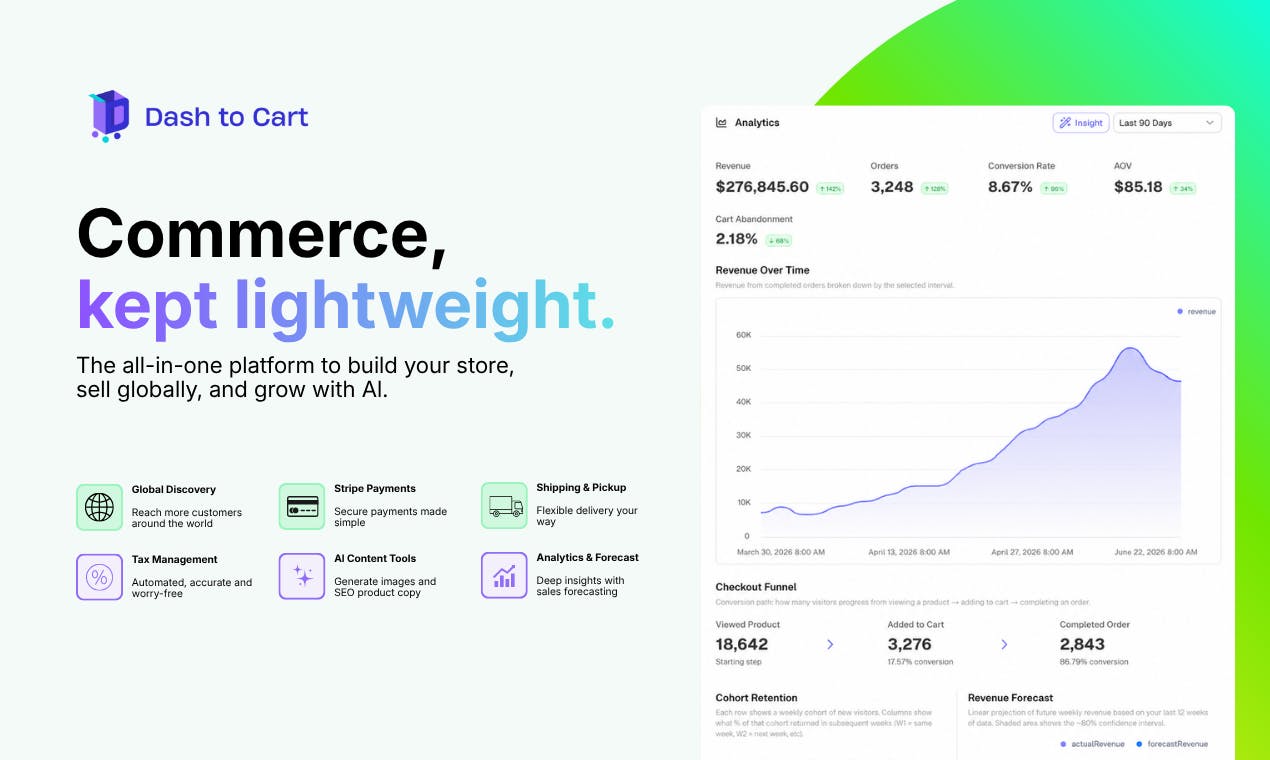
Dash to Cart 2.0 offers DTC brands a lightweight all-in-one e-commerce platform replacing complex multi-tool tech stacks.
Dash to Cart 2.0 is a rebuilt, lightweight all-in-one e-commerce platform designed for DTC brands. It consolidates no-code store building, Stripe-powered payments, automatic Google Merchant Centre syncing, AI-driven analytics, and a built-in product discovery feature into a single platform — eliminating the need to juggle tools like Shopify, Google Analytics, and Mailchimp. Ideal for startups validating PMF and small merchants seeking simplicity.
In an era of increasingly complex e-commerce tools, Dash to Cart 2.0 takes the opposite approach with a simple yet powerful philosophy: e-commerce should stay lightweight. Rebuilt from the ground up, this product offers DTC brands an all-in-one e-commerce solution that eliminates the need to cobble together multiple tools.
DTC (Direct-to-Consumer) refers to brands selling products directly to end consumers, bypassing traditional distribution channels. In recent years, the success of brands like Warby Parker, Glossier, and Allbirds has made the DTC model a mainstream path for consumer goods startups. However, running a DTC brand typically requires stitching together a multitude of tools: Shopify for storefront building, Google Analytics for data analysis, Mailchimp or Klaviyo for email marketing, and ShipStation for logistics management — a combination commonly known as the "E-commerce Tech Stack." For resource-constrained small and mid-sized merchants, the steep subscription costs, complex integration configurations, and fragmented data management have become significant pain points — and this is precisely the core problem Dash to Cart 2.0 aims to solve.
All-in-One Lightweight E-commerce: Core Features of Dash to Cart 2.0
The core value of Dash to Cart 2.0 lies in consolidating the scattered functions of a traditional e-commerce tech stack into a single platform. Merchants can quickly launch an online store, get discovered by potential customers through the built-in Dash to Cart Discovery feature, and automatically sync eligible products to Google Merchant Centre to expand product visibility.
Google Merchant Centre is a product information management platform provided by Google. Once merchants upload product data (including names, prices, images, inventory, etc.) to the platform, their product information can appear across multiple traffic entry points within Google's ecosystem, including Google Shopping search results, Google Image Search, and YouTube. For e-commerce merchants, Google Shopping traffic carries exceptionally high purchase intent, with conversion rates that typically outperform standard display ads. Traditionally, merchants need to manually create product Feed files that comply with Google's specifications or use third-party plugins for data integration — a process with a non-trivial technical barrier. Dash to Cart 2.0 automates this workflow, meaning merchants can gain Google Shopping traffic exposure without needing to understand Feed specifications or XML formats.
Payments are powered by Stripe, allowing merchants to centrally manage payment and refund processes within the platform. Stripe is a globally leading online payment infrastructure provider, used by over millions of businesses including giants like Amazon, Google, and Shopify. Unlike consumer-facing payment tools like PayPal, Stripe leans toward developer-friendly underlying payment APIs, supporting credit cards, debit cards, Apple Pay, Google Pay, and other payment methods, processing transactions in over 135 currencies worldwide. Stripe's standard rate is 2.9% + 30 cents per transaction (U.S. domestic), and its built-in fraud detection system, Stripe Radar, uses machine learning to analyze billions of transactions to identify and block suspicious activity. Choosing Stripe as the payment engine means merchants get enterprise-grade payment security and global payment capabilities, while complex processes like refunds and dispute resolution can all be handled within a unified interface.
Complex operational details such as tax calculations, shipping logistics, and in-store pickup are also unified within the platform, significantly lowering the technical threshold and operational costs for small and mid-sized merchants.
Data Analytics and AI-Driven Growth Tools
Beyond basic store operations, Dash to Cart 2.0 also features built-in deep data analytics capabilities. The platform's analytics tools help merchants track key business metrics, while forecasting features make it possible to anticipate sales trends in advance. Email tracking ensures that every marketing touchpoint can be quantitatively evaluated, and the addition of AI capabilities provides merchants with intelligent operational recommendations.
The integrated nature of these features means merchants no longer need to constantly switch between Shopify, Google Analytics, Mailchimp, and other platforms as they would with traditional solutions — fundamentally eliminating the data silo problem and the high costs of integration. Data Silos refer to the state where data across different systems or tools within an organization cannot be shared or interconnected. This problem is particularly acute in e-commerce operations: order data from the store backend, traffic data from Google Analytics, and open rate data from email marketing platforms are all stored in separate systems, making it impossible for merchants to build a complete customer journey view from "ad impression → website visit → add to cart → purchase → repeat purchase." According to McKinsey research, data silos cause businesses to lose an average of 20%-30% in operational efficiency. Additionally, passing data between different platforms typically relies on automation tools like Zapier or custom API integrations, and each additional link increases the probability of errors and maintenance costs. The core advantage of an all-in-one platform lies precisely in eliminating this data fragmentation at the source.
No-Code Store Building: Zero Technical Barrier E-commerce
Dash to Cart 2.0 is a quintessential no-code e-commerce tool, enabling entrepreneurs with zero technical background to quickly build a professional-grade e-commerce platform. The no-code movement has been one of the most important trends in technology over the past five years, with the core philosophy of empowering non-technical users to build software applications through visual interfaces and drag-and-drop operations. Gartner predicts that by 2025, 70% of new applications will be developed by enterprises using no-code or low-code technologies. In e-commerce, the proliferation of no-code tools has dramatically lowered the barrier to entrepreneurship — building a professional e-commerce website a decade ago might have required tens of thousands of dollars in development costs and months of development time, but now it can be done in just a few hours. The no-code e-commerce tools represented by Dash to Cart 2.0 take this trend even further: not only is store building code-free, but processes like payment integration, logistics configuration, and data analytics — which traditionally required technical team support — are also fully zero-code.
This design philosophy is highly aligned with the rapid experimentation and agile iteration needs of today's DTC brands. The product attracted community attention on its first day of launch on Product Hunt, indicating genuine market demand for lightweight e-commerce solutions.
Competitive Advantages Compared to Shopify and Other Platforms
Compared to mature e-commerce platforms like Shopify, Dash to Cart 2.0's differentiated positioning is very clear — lightweight and all-in-one. Traditional e-commerce platforms tend to be overly feature-heavy, making it easy for new merchants to get lost in complex backend settings. Dash to Cart 2.0, through streamlined features and optimized workflows, lets merchants focus their energy on core business activities — selling products and serving customers.
The built-in Discovery feature is another key differentiator. In an environment where traffic acquisition costs continue to climb, the platform's native product discovery mechanism can potentially bring merchants additional organic traffic — something pure store-building tools simply cannot offer. Customer Acquisition Cost (CAC) in e-commerce has been skyrocketing over the past five years. According to research by Simplicity DX, e-commerce CAC has risen approximately 222% since 2013. Core reasons include: Apple's iOS 14.5 privacy policy update significantly weakening the ad targeting capabilities of platforms like Facebook, increasingly fierce Google Ads bidding, and consumers' growing immunity to traditional advertising. Against this backdrop, a platform's built-in product discovery mechanism offers a differentiated value of "built-in traffic" — similar to how Etsy and Amazon Marketplace provide in-platform search traffic for their merchants, but focused on the independent brand ecosystem. If this feature can cultivate an effective buyer community, it would give merchants a growth channel that doesn't depend on paid advertising.
Target Users and Use Cases
Dash to Cart 2.0 is particularly well-suited for the following types of users:
- Emerging DTC brands: E-commerce startups that need to launch quickly and operate at low cost
- Small merchants looking to simplify their tech stack: Operators tired of switching between multiple tools
- Entrepreneurs needing to quickly validate PMF: Those looking to test product-market fit at minimal cost
PMF (Product-Market Fit) is a concept coined by renowned Silicon Valley investor Marc Andreessen, referring to the state where a product achieves sufficiently strong demand in its target market. Y Combinator co-founder Paul Graham has stated that the primary reason startups fail is building a product the market doesn't need. In e-commerce entrepreneurship, PMF validation typically means testing market response with a Minimum Viable Product (MVP) before committing significant capital to brand building and inventory procurement. This requires e-commerce tools that support rapid launch, low-cost operations, and agile adjustments. Traditional platforms with monthly fees of several hundred dollars and lengthy configuration cycles directly contradict this need, and lightweight tools like Dash to Cart 2.0 fill precisely this gap.
For small and mid-sized merchants with annual sales under one million dollars, the features provided by Dash to Cart 2.0 are more than sufficient to support daily operational needs.
Future Outlook
With continued deepening of AI capabilities and gradual maturation of its platform ecosystem, Dash to Cart 2.0 is well-positioned to carve out a place in the lightweight e-commerce space. Its long-term growth prospects will depend on whether it can consistently find the optimal balance between product simplicity and feature richness. For DTC brands looking for a Shopify alternative, this product is worth watching and trying out.
Related articles

TiVo Charging for Ad-Skipping? DVR User Rights and the Digital Ownership Debate Explained
TiVo plans to charge DVR users for ad-skipping, sparking debate over digital ownership and consumer rights. A deep dive into subscription trends and their implications.

Batch Generating Ad Creatives from a Single Product Image: Real Bottlenecks and Solutions for Scaled Workflows
From one product photo to multi-platform ad assets—brand consistency, text rendering, and cross-platform adaptation collapse first. Deep dive into AIGC marketing workflow bottlenecks with template-driven and layered composition solutions.

Scriptly: AI Voice-Following iOS Teleprompter That Eliminates Pace-Chasing
Scriptly is an iOS voice teleprompter using AI real-time voice-following technology to auto-match speaking pace. Supports local storage for privacy, integrates writing, script management & video recording workflow for content creators.