Data Center Backlash Escalates: Can the AI Industry Win Back Public Trust by Dropping NDAs?

AI data center expansion meets community backlash as NDA transparency debates expose structural tensions over local resources.
As AI computing demand surges, data centers are sparking intensifying community resistance across the US, with water use, electricity costs, and noise concerns prompting local moratoriums. A core flashpoint is the industry's use of NDAs to shield energy, water, and tax incentive data — creating information vacuums that breed distrust. While dropping NDAs and increasing transparency is seen as a necessary first step, it won't resolve the underlying tension: disclosed data revealing massive resource consumption could deepen opposition rather than ease it. The real issue is structural — a conflict between AI infrastructure's relentless expansion and local resource capacity — requiring substantive action on energy, water management, and community benefit-sharing.
When Data Centers Become a Lightning Rod
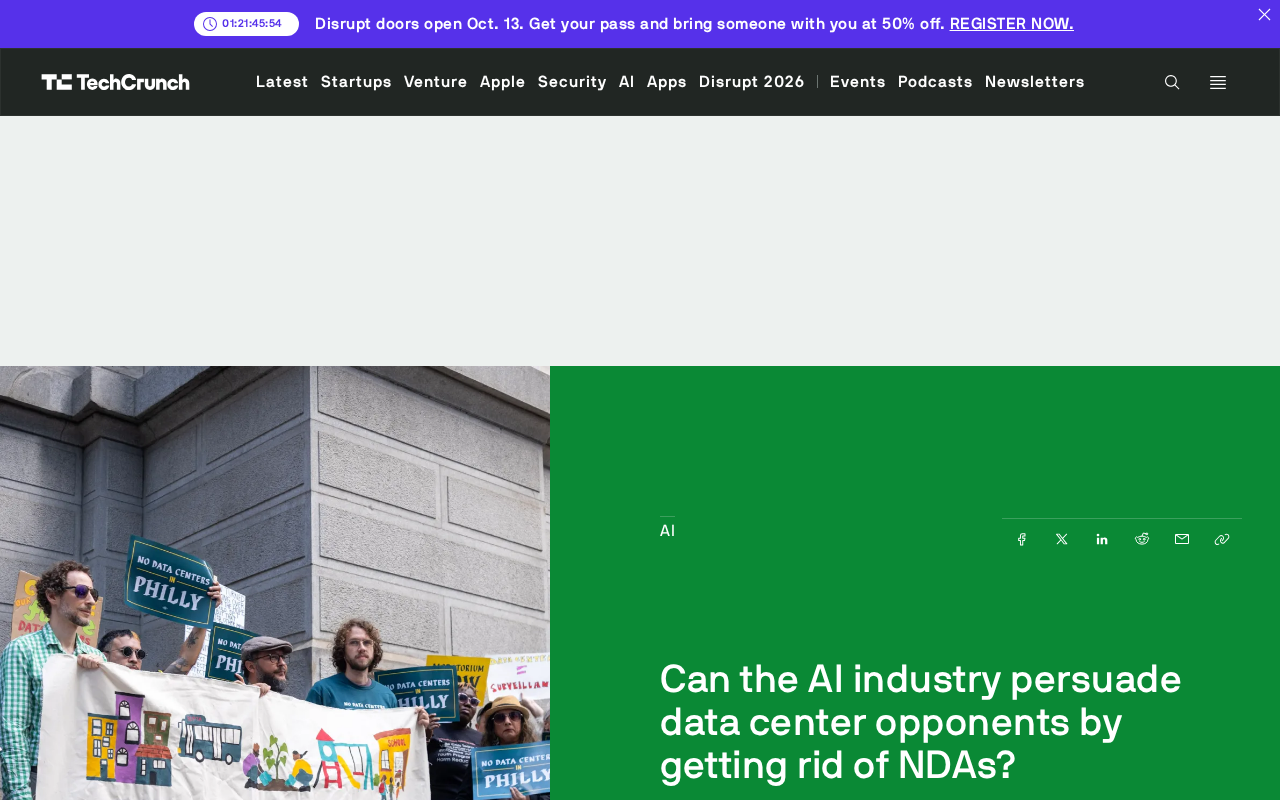
The surging demand for computing power driven by the AI boom is pushing data centers into communities across the United States. In their wake comes intensifying local resistance — from water usage and rising electricity bills to noise pollution, residents' concerns are translating into political action. Some local governments have begun pursuing construction moratoriums, creating real friction for an AI industry that depends heavily on expanding its infrastructure.
Tech media podcast Equity recently tackled this topic head-on: What are the actual consequences of data center moratoriums? And more importantly, does the AI industry have a long-overlooked communications problem?
NDAs: The Root of a Trust Deficit?
At the heart of the discussion is a controversial industry practice — non-disclosure agreements (NDAs). For years, data center operators have required local governments and communities to sign confidentiality clauses during negotiations, covering everything from water usage and energy consumption data to tax incentives and site selection details.
This approach may have a certain commercial logic: protecting competitive information and preserving negotiating leverage. But in the public eye, a closed information environment is precisely where distrust takes root. When residents can't find out how much local water a data center will consume or how much it will drive up their electricity bills, opposition is almost inevitable.
This raises a pointed question: If the AI industry proactively abandons NDAs and embraces transparency, can it win back its critics? This isn't just a question of PR strategy — it cuts to the fundamental logic of the relationship between industry and community.
Can Transparency Solve the Problem?
Those in favor of transparency argue that publishing data can dispel misconceptions. Much of the opposition stems from speculation and amplification in an information vacuum — when real energy and water consumption figures are laid out on the table, some concerns may prove to have been exaggerated, and communities can more easily engage in constructive regulatory dialogue.
But the counterargument is equally grounded in reality: transparency doesn't equal acceptance. Even if data is made public, if that data reveals enormous resource consumption, it might actually confirm residents' fears rather than ease them. In other words, a communications problem and a substantive problem cannot simply be conflated.
The use of NDAs in data center projects has a long history, well predating the AI boom. Early tech giants introduced NDAs into site selection negotiations primarily to prevent competitors from learning of expansion plans in advance, or to avoid speculative land price increases. But as data centers evolved from single buildings into hyperscale campuses of hundreds of megawatts, the scope of NDAs expanded accordingly — from trade secrets to water use agreements, grid access terms, and even Tax Increment Financing (TIF) details negotiated with local governments. This means that public resource subsidies funded by taxpayers are often kept opaque under the guise of "trade secrets." Legislative efforts in some U.S. states — notably Virginia and Georgia — have attempted to require data centers receiving tax incentives to disclose minimum employment numbers and energy consumption benchmarks, a direct response to this information asymmetry.
The Dual Impact of Moratoriums
Local construction moratoriums have a two-sided impact on the AI industry.
In the short term, they directly slow the pace of computing infrastructure expansion. With demand for model training and inference exploding, any delay in site selection and construction translates into real capacity bottlenecks and can even drive up operational costs across the industry.
In the longer term, moratoriums may force the industry to adapt: more careful site selection, more efficient use of energy and water resources, and more proactive mechanisms for sharing benefits with local communities. From this perspective, community resistance isn't necessarily just an obstacle — it may also serve as external pressure pushing the industry toward a more sustainable operating model.
A moratorium, as a local governance tool, is typically passed as a resolution by a city council or county commission, temporarily halting permit approvals for certain types of projects to allow time to assess environmental and infrastructure impacts. Recent notable cases include Prince William County, Virginia, which imposed restrictions on data center expansion in certain zones in 2023, and multiple agricultural counties in Kentucky and Tennessee that entered review moratorium periods following resident petitions. Importantly, a moratorium doesn't necessarily mean a project is permanently canceled — it more often acts as a mandatory cooling-off period, forcing developers back to the negotiating table with communities. But for capital-intensive data center projects with construction timelines stretching years, even a delay of several months significantly raises financing costs and can trigger a chain reaction, prompting operators to shift their siting targets to regions with more permissive regulatory environments — effectively creating regulatory arbitrage.
Is This a PR Problem or a Structural Problem?
The real value of the Equity discussion lies in forcing the industry to confront a fundamental question: Is the controversy surrounding data centers a perception problem that can be resolved through better communication, or is it a structural tension between AI infrastructure expansion and the resource-carrying capacity of local communities?
Abolishing NDAs and improving transparency is undoubtedly a necessary step toward rebuilding trust — but it looks more like a prerequisite for solving the problem than an answer in itself. If the AI industry hopes to maintain its community "social license" in the years ahead, better information disclosure alone will not be sufficient. It will also need to deliver substantive solutions on energy mix, water resource management, and local economic benefit-sharing.
For practitioners and observers tracking the trajectory of the AI industry, this battle over data centers is becoming a mirror that reflects the industry's sense of social responsibility. At the end of the computing pipeline are electricity and water — and electricity and water ultimately connect back to real communities.
"Social License to Operate" (SLO) is a concept long used in capital-intensive industries like mining and energy, referring to a company's ability to obtain and maintain informal approval from local communities and stakeholders. Unlike a government-issued legal permit, a social license cannot be secured once and for all through regulatory filings — it requires the continuous accumulation of trust. Once lost, even a legally compliant project can stall indefinitely due to sustained community opposition. The AI data center industry has rarely incorporated SLO into its strategic agenda, partly because early site selection tended to favor sparsely populated remote areas (where low electricity costs were the primary consideration), limiting the intensity of community disputes. But as computing demand drives site selection toward areas with higher population density and tighter water resources, the absence of SLO is shifting from a latent risk to a real-world obstacle — pushing the industry to draw on decades of community relations management experience accumulated by the traditional energy sector.
Related articles

Gaussian Process Bandit Optimization: Exploration Strategies and Inference Regret Guarantees
Cumulative regret guarantees in Bayesian optimization fail to reflect final recommendation quality. This article examines a new study that provides inference regret guarantees for Gaussian process bandit optimization through exploration query strategies and fill distance analysis, validated on hyperparameter optimization and control tasks.

The Most Detailed Codex Guide on Bilibili: From Installation to Real-World Practice
The most detailed Codex guide on Bilibili: from app store installation to daily work mode configuration, with a real coffee shop project demonstrating file organization, data extraction, dashboard creation, and other practical tasks. Learn to use Plan Mode and desktop pets to leverage Codex efficiently.

Appearance Compensation in Volume Rendering: Why RGB Accuracy Cannot Guarantee Density Correctness
Volume rendering research reveals that volumetric data perfectly reproducing external RGB views may still contain density errors: appearance compensation can double central density and keep external rays unchanged even when L2 error exceeds 14.52%. Density recovery depends on appearance capacity, spatial resolution, and measurement design.