Databench: An Open-Source Collaborative AI Agent Workspace for Data Teams

Databench is an open-source data science workspace combining real-time collaboration, multi-agent AI, and self-hosting.
Databench is an open-source collaborative data science platform from Alkera, designed to break down the siloed workflows that plague data teams. It unifies real-time multiplayer Notebook editing, team chat, and AI agent collaboration in a single interface, allowing users to launch multiple agents in parallel to explore different analytical approaches. Any cell or agent can run locally, on a remote machine, or on a GPU node. Every result traces back to its underlying data and code for full reproducibility. Databench offers both an official hosted tier and self-hosting via GitHub — earning 167 upvotes and a top-5 ranking on Product Hunt at launch.
Data science teams have long been stuck in siloed workflows — each person running analyses in their own Jupyter Notebook, sharing results via screenshots and messages, and spending hours hunting down scattered code and data just to reproduce an experiment. Databench, an open-source project from Alkera, aims to change this by bringing real-time multiplayer collaboration, AI agents, and a traceable computation environment together in a single workspace. After launching on Product Hunt, it earned 167 upvotes and ranked 5th for the day, appearing in the Open Source, Artificial Intelligence, and Data Science categories.
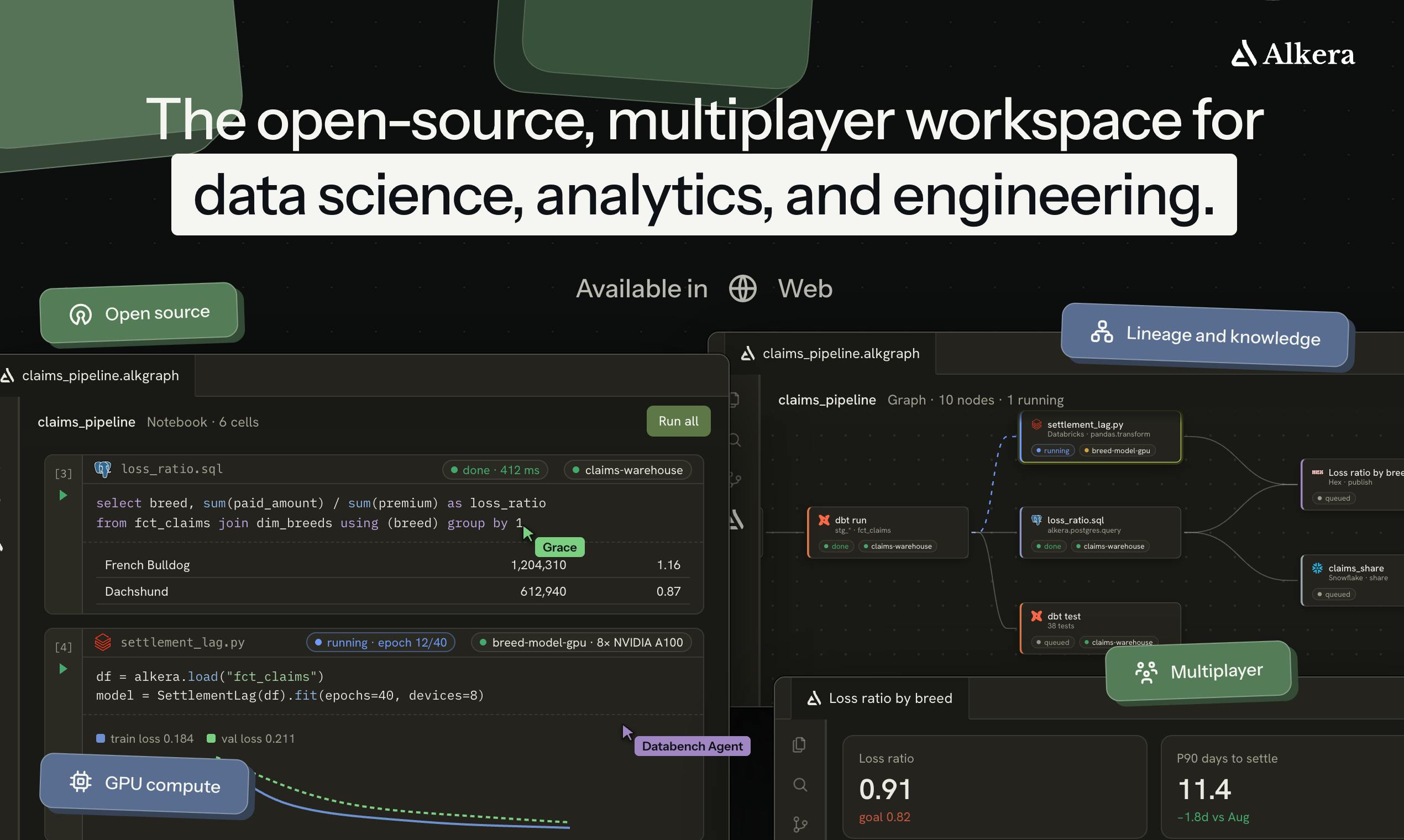
A Multiplayer, Real-Time Data Workspace
Databench positions itself as an "open-source multiplayer workspace for data science, analytics, and engineering." Its core value proposition is real-time collaboration: team members can work side by side in the same Notebook and chat window — much like Google Docs — instead of maintaining separate local copies and manually merging changes afterward.
This "multiplayer" model means more than just a better editing experience for data teams. In traditional workflows, analysts, engineers, and data scientists often operate across different toolchains, making handoffs costly. Bringing Notebooks and chat into the same interface keeps discussions, code, and results in a shared context, reducing the information loss that occurs when communication is fragmented across channels.
Bringing AI Agents into the Notebook
What sets Databench apart from standard collaboration tools is its agentic nature. Users don't just collaborate with human teammates — they also work alongside AI agents.
One particularly compelling capability mentioned in the official description is the ability to launch many agents in parallel to explore different ideas. For data exploration — an inherently iterative, trial-and-error process — this parallelism means you can have multiple agents simultaneously trying different approaches to feature engineering, model hypotheses, or data cleaning strategies, then compare their outputs, rather than waiting for each attempt to finish sequentially.
This design reflects a broader trend in AI tooling: agents are evolving from "single assistants" toward "orchestrable multi-agent workflows," and data analysis is a natural fit for multi-path parallel exploration.
Multi-Agent Workflow represents a significant paradigm shift in applied LLM development. Unlike single-model conversations, multi-agent frameworks allow a complex task to be broken into subtasks, each executed by an independent agent — with its own tool access, context memory, or model backend. In data science contexts, this could mean one agent focuses on feature engineering, another on model selection, and a third on aggregating evaluation metrics, all running in parallel before results are compared. Frameworks like LangGraph, AutoGen, and CrewAI are working to standardize this kind of orchestration logic, but natively embedding it in a Notebook-style interactive environment and connecting it to a real-time collaboration interface remains a relatively new frontier. Databench's parallel agent design taps into this trend, though scheduling stability and result interpretability in multi-agent setups remain real engineering challenges that have yet to be fully validated in practice.
Flexible Compute Backends and Full Traceability
Databench offers considerable flexibility in how computational resources are allocated. Any cell or agent can be run on a local laptop, a remote machine, or a GPU node. This decoupling makes it practical to keep lightweight tasks local while offloading heavy computations to GPU nodes — a workflow that suits teams who need to switch between rapid prototyping and large-scale training.
Another noteworthy feature is complete traceability — the team emphasizes that "every result traces back to the data and code behind it." In a collaborative setting where AI agents are auto-generating content in parallel, traceability is directly tied to the credibility and reproducibility of results. When multiple agents produce conclusions simultaneously, being able to trace back to the specific data and code path is a critical safeguard against opaque, unverifiable outputs.
Experiment Lineage / Reproducibility is one of the core metrics for engineering maturity in data science. A well-known pain point with traditional Jupyter Notebooks is execution-order dependency: cells can be run out of sequence, and the same notebook can produce different results at different times or on different machines, making reproduction by others unreliable. Tools like MLflow, DVC (Data Version Control), and W&B (Weights & Biases) were built specifically to address this, tracking data versions, code snapshots, and hyperparameters to construct a full experiment lineage. Databench treats traceability as a built-in feature rather than an add-on plugin. In theory, this allows it to automatically maintain mappings between each conclusion and its input data and execution code — even in the complex scenario of multiplayer collaboration and parallel agent outputs — reducing the common "the result exists but nobody knows how we got it" cognitive debt that plagues collaborative data work.
Open Source and Self-Hostable
Databench takes an open-source approach and offers two usage paths: the official hosted service at alkera.ai, which includes a "generous free tier," or self-hosting directly from the GitHub repository (AlkeraAI/Databench).
For data teams, the self-hosting option is particularly important. Data assets frequently involve privacy and compliance requirements, and many organizations cannot send sensitive data to third-party cloud services. The combination of open source and self-hosting lets teams run the full feature set within their own infrastructure, audit and modify the codebase as needed, and stay aligned with the growing demand across the data and AI infrastructure space to keep data within organizational boundaries.
Summary
Databench combines three currently prominent directions — real-time collaboration, AI agents, and open-source self-hosting — into a single workspace designed for data teams. The pain points it targets are well-defined: fragmented toolchains, hard-to-reproduce experiments, and the emerging need for multi-agent parallel exploration in the age of AI.
It's worth noting that publicly available information is still primarily focused on product positioning and feature descriptions. Real-world collaboration latency, the maturity of multi-agent orchestration, and the depth of integration with existing data stacks (such as dbt, Spark, and various data warehouses) all remain to be validated in practice. For data teams looking for a team-level Notebook collaboration solution who also value open-source control, Databench is worth adding to the evaluation list.
Related articles

Amphibious Transforming Drone: Beyond 100x Power Savings, What Are the Real Needs?
Is the amphibious transforming drone just a gimmick? Starting from the 100x power difference of the M4 Morphobot, explore real application scenarios and thesis topic ideas, analyzing boundary conditions where pure drones and pure ground robots both fail.

Warhound Raises $200 Million: Genetically Engineered "War Dogs" Paired with Anduril Gear
Warhound raises $200M, backed by Ben Lamm and Palmer Luckey, to genetically engineer dogs for military and law enforcement use and equip them with Anduril gear. This article analyzes its technology direction, funding logic, and ethical controversy.

Claude API Comes to Google Cloud: IAM Integration and SDK Access Guide
Anthropic hosts the full Claude API on Google Cloud with IAM-controlled permissions and unified billing. This guide covers the Vertex AI and Anthropic-hosted entry points, IAM role configuration, and SDK access.