Databricks Data Warehousing & BI Practical Guide: From Architecture to AI Readiness

Databricks releases a practical guide on building Lakehouse-based data platforms with integrated governance and AI readiness.
Databricks' *Big Book of Data Warehousing and BI* argues that data teams must move beyond dashboards and build complete platform infrastructure covering architecture, governance, and AI integration. The guide covers Lakehouse architecture, migration strategies, dimensional modeling, and performance and cost optimization at scale. On the governance side, Unity Catalog provides unified access control, data lineage, and compliance management. Its most forward-looking section introduces the concept of AI/BI readiness — emphasizing that data quality and interface foundations for AI must be planned from the architectural design stage, extending the platform's ability to answer not just "what happened" but "why" and "what's next."
Data teams shouldn't stop at dashboards. Databricks recently released The Big Book of Data Warehousing and BI — a hands-on guide focused on delivering faster insights, stronger data governance, and AI/BI readiness on the Databricks Lakehouse platform. This article distills the core ideas from that e-book into key takeaways for modern data platform builders.
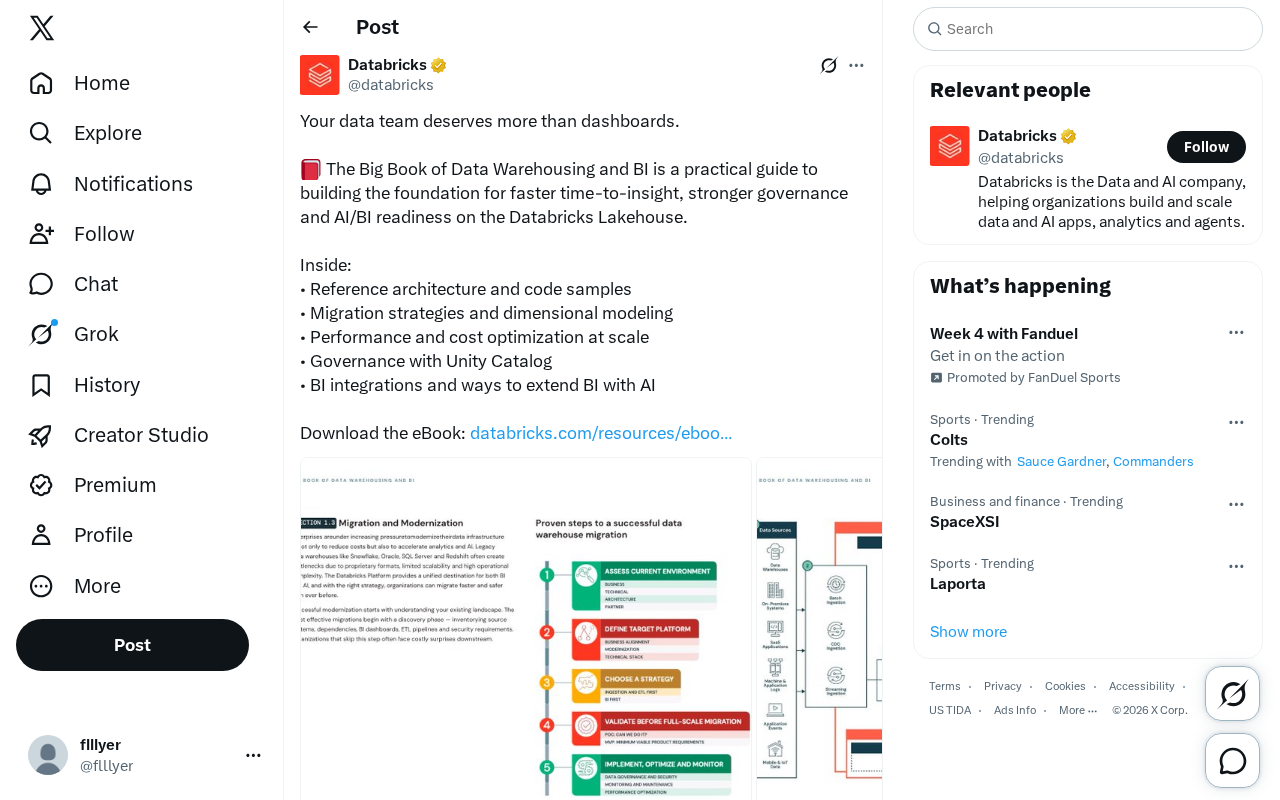
Why Dashboards Aren't Enough Anymore
For a long time, many enterprise data teams centered their work on delivering BI dashboards. But as data volumes continue to explode and AI applications roll out rapidly, dashboards are just the final presentation layer — the underlying architecture is what truly determines the speed and quality of insights.
The central argument of this guide is that data teams need a complete infrastructure, not just a visual endpoint. Only by integrating data warehousing, governance, and AI capabilities into a unified architecture can teams achieve a genuinely faster time-to-insight. This thinking reflects a broader industry shift away from report-driven operations and toward treating data platforms as an engineering discipline.
Lakehouse Architecture: Merging the Warehouse and the Lake
The Lakehouse concept that Databricks champions combines the flexibility of a data lake with the structured query capabilities of a data warehouse. This guide provides reference architectures and ready-to-use code samples, helping teams quickly stand up a platform skeleton that follows best practices.
Migration and Modeling Strategies
For organizations with existing traditional data warehouses, migration is often the most challenging step. The guide dedicates significant attention to migration strategies and covers dimensional modeling in detail — the classic methodology for building analytical data models. Applying proven dimensional modeling principles to a Lakehouse platform means teams can preserve their existing analytical logic while gaining the scalability of the new architecture.
Dimensional Modeling, systematized by data warehousing pioneer Ralph Kimball in the 1990s, organizes business data into two structures: Fact Tables (storing measurable business metrics such as revenue or order volume) and Dimension Tables (storing descriptive context such as time, region, or product category). These are connected via a Star Schema or Snowflake Schema, making analytical queries both intuitive and efficient. The methodology has remained mainstream for over three decades because it aligns naturally with how business users think, while providing data structures inherently optimized for OLAP (Online Analytical Processing) queries. The biggest challenge when migrating to a Lakehouse architecture is that traditional dimensional modeling relies on strict ETL processes and relational database constraints, whereas Lakehouse open formats (such as Delta Lake) require finding a new balance between schema flexibility and analytical performance.
Performance and Cost Optimization at Scale
When data volumes and query concurrency reach enterprise scale, performance and cost become unavoidable concerns. The guide offers concrete approaches for performance and cost optimization at scale. This section is especially critical for controlling the long-term operational costs of a cloud data platform and serves as a key measure of whether a data architecture is truly sustainable.
Unified Governance with Unity Catalog
Data governance is another cornerstone of the modern data platform. The guide grounds its governance discussion in Unity Catalog — Databricks' unified governance component covering access control, data lineage tracking, and compliance management across data assets.
As data flows across different teams and applications, the absence of unified governance creates security risks and compliance exposure. By establishing centralized permissions and metadata management through Unity Catalog, teams can maintain open collaboration while upholding data security and compliance requirements. This is the technical backbone behind the guide's promise of stronger governance.
Data Lineage is a critical capability in data governance — it refers to the ability to trace data across its full journey from source to consumption, including where data comes from, what transformations it passes through, and which downstream systems or reports use it. When an upstream table undergoes a structural change or a data quality issue arises, a lineage map helps teams quickly identify the blast radius without manually auditing every downstream dependency. Unity Catalog's lineage tracking achieves visibility at the column level (Column-level Lineage), which is particularly important for compliance with data privacy regulations like GDPR — regulators require organizations to demonstrate the complete flow path of specific personal data through their systems. For large enterprises running multiple business lines with complex data flows, column-level lineage is often the central evidence in data compliance audits.
Merging BI and AI: The Next Step
The most forward-looking section of the guide explores how to extend BI with AI. Traditional BI answers the question "what happened," while a platform enhanced with AI capabilities can go further — answering "why did it happen" and "what's likely to happen next."
AI/BI readiness means that a data platform is designed from the outset with the data quality, governance, and interface capabilities that AI applications require. When the underlying data has been properly modeled and governed through a unified framework, it becomes a more reliable foundation — whether for training models, powering natural language queries, or building intelligent analytics assistants. This is why the guide emphasizes planning architecture, modeling, and governance together with AI capabilities from the start, rather than retrofitting them later.
Natural Language Query (NLQ) is one of the most direct real-world applications of "AI-extended BI." It allows business users to ask questions in everyday language (e.g., "How did sales in the East China region change year-over-year last quarter?"), with an AI layer translating the question into SQL and returning results — bypassing the need for a professional analyst or SQL expertise. The practical effectiveness of this capability depends heavily on how well-structured the underlying data is: the clearer the table names, field naming conventions, and business-meaning annotations (metadata), the more accurate the SQL that large language models will generate. This is the deeper reason the guide stresses that AI/BI readiness must be planned at the architectural design stage — retrofitting an NLQ interface onto a messy data model tends to produce large numbers of hallucinated, incorrect answers, which ultimately erodes business trust in the data platform.
What This Means for Data Teams
The structure of this guide makes clear that building a modern data platform is a systems-level endeavor, spanning architecture design, migration planning, modeling, performance tuning, governance, and AI integration. For teams currently evaluating technology choices or driving platform upgrades, the value of a practical guide like this lies in the end-to-end reference path it provides, along with deployable code samples.
One caveat worth noting: as an official publication from a vendor, the content naturally centers on the Databricks ecosystem. While the methodology is worth referencing, readers should make independent judgments based on their own technology stack and business context. The complete e-book is available for free download through Databricks' official channels.
Related articles

Chain of Thought Isn't Just for AI: How Humans Can Use CoT to Improve Thinking Quality
Chain of Thought isn't just a prompt trick for large models. Starting from a Hacker News discussion, this article analyzes why CoT works for human thinking too, breaks down actionable ways to transfer it, and highlights the key differences between human CoT and machine CoT.
Cloudflare Teams Up with OpenAI: Closi…
Cloudflare Teams Up with OpenAI: Closing the Loop from Vulnerability Discovery to Defense with AI
Cloudflare uses OpenAI Daybreak to investigate security vulnerabilities and generate reviewable remediation plans, while developers use Codex to boost coding efficiency and quality.

Orca Multi-Agent Orchestration in Practice: A Guide to Parallel Collaboration with Claude and Codex
Orca is Stable AI's free open-source agent workbench supporting 34 agents like Claude Code and Codex in parallel. Learn its Git worktree isolation, multi-model orchestration, and mobile management.