Databricks Feature Platform: Define Once, Reuse Across Training and Production

Databricks Feature Store eliminates training-serving skew with a define-once, reuse-everywhere approach to feature engineering.
This article explores the core design philosophy and key capabilities of Databricks Feature Store. Its fundamental goal is to eliminate training-serving skew — the subtle divergence that arises when features are reimplemented separately for offline training and online inference. Feature Store unifies batch and streaming features through Feature Views, prevents data leakage at the source via automatic point-in-time joins, and provides built-in governance and observability to make features trustworthy organizational assets. Combined with MLflow for experiment tracking and model management, and Genie Code for assisted development, Databricks aims to deliver a complete end-to-end loop from feature definition to model deployment.
The Old Pain Point: Consistency Between Training and Production
ML teams have long faced a silently costly problem: the way features are defined during training often differs from how they're implemented in production inference. Data scientists compute features with one set of logic in an offline environment, while engineering teams rewrite that logic in online systems — and the subtle gaps between the two cause training-serving skew, ultimately degrading model performance in real-world scenarios.
Databricks Feature Store addresses this with a straightforward core idea: define once, reuse everywhere. Feature logic is shared across training and production, fundamentally eliminating the risk of divergence caused by duplicate implementations. The principle sounds simple, yet it targets one of the most chronically underestimated pain points in ML engineering.
Training-serving skew is extremely common in industry, and its root causes typically fall into three categories: code implementation differences (where offline Python logic isn't perfectly equivalent to online Java/C++ code); data source differences (training uses historical snapshots while inference hits live databases, and field-processing logic can quietly diverge); and timing differences (when online features are computed doesn't match the assumptions made during training). Mild skew results in slightly lower online metrics compared to offline evaluation; severe skew can trigger serious business failures — for example, a risk-control model that performs well in the lab but completely breaks down in production due to feature inconsistencies. This is the core motivation behind the rise of the Feature Platform infrastructure category in recent years. Uber's Michelangelo, LinkedIn's Feathr, and Airbnb's Chronon are all attempting to systematically solve this problem.
Feature Views: A Unified Abstraction for Batch and Streaming Features
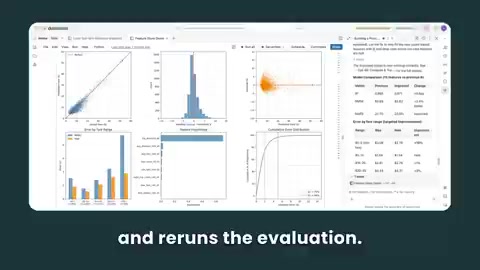
According to the official demo, Databricks Feature Store enables teams to build both batch and streaming features through Feature Views. This means features can be managed under a unified abstraction layer regardless of whether they come from daily-updated historical data tables or real-time event streams.
For teams that need to handle both offline batch training and online real-time inference, this unified abstraction reduces cognitive overhead. Developers no longer need to maintain two parallel feature pipelines for different data freshness requirements. Instead, they organize feature logic around the Feature View concept, making the boundary between batch and streaming transparent at the usage level.
Automatic Point-in-Time Joins: The Key to Building Training Sets
The demo placed particular emphasis on automatic point-in-time joins in the context of creating training datasets. This is one of the more technically demanding aspects of feature platforms.
Point-in-time joins solve the data leakage problem: when building training samples, each record should only use feature values available at or before its corresponding timestamp — future information must never leak into the training set. Implementing this logic manually is both tedious and error-prone. When handled incorrectly, model evaluation metrics look artificially inflated, only to collapse dramatically after deployment. Databricks automates this process, giving teams inherent temporal correctness guarantees when generating training datasets. This is especially important for use cases that heavily depend on time-series features, such as time-series forecasting, risk control, and recommendations.
Data leakage is one of the most insidious causes of ML project failures, and temporal leakage is particularly hard to detect. Consider credit risk scoring: if training samples for a loan application accidentally include repayment records that were only updated days after the application occurred, the model effectively "sees the future." The resulting AUC can be artificially inflated by 5 to 10 percentage points, but once the model goes live, that future data is no longer available and performance drops off a cliff. The standard implementation of point-in-time joins assigns an event_timestamp to each training sample and then looks up the most recent valid feature value before that timestamp in the feature table (commonly called an "as-of join"). This logic involves extensive window functions and sort operations. Writing it by hand on large-scale datasets is not only error-prone but also difficult to optimize for performance — making platform-level automation a significant engineering win.
Productionization: Built-in Governance and Observability
Moving features from experimentation to production is often the most fragile stage of an ML project. Databricks Feature Store provides built-in governance and observability capabilities at this step.
Governance means that feature access permissions, lineage, and usage standards can be centrally managed, preventing features from being casually copied across teams with inconsistent definitions. Observability makes it possible to monitor data quality, distribution drift, and call patterns for features in production. Together, these capabilities transform features from disposable, one-off artifacts into trustworthy, reusable organizational assets.
Supporting Tools: Genie Code and MLflow for Iteration
Beyond the feature platform itself, the demo also highlighted the roles of Genie Code and MLflow in supporting the iteration process. MLflow, as a mature ML lifecycle management tool, handles experiment tracking, model versioning, and deployment. Genie Code provides assistance during the development and coding phase.
This combination reflects Databricks' ambition to build a complete end-to-end loop: from feature definition, training set construction, and model training through to production deployment and monitoring, with corresponding tools connecting each stage and reducing the friction of switching between different systems.
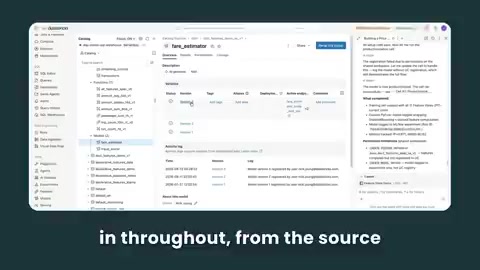
MLflow was originally open-sourced by Databricks in 2018 and has since become one of the de facto standards for ML experiment tracking. Its core modules include: MLflow Tracking (recording experiment parameters, metrics, and artifacts), MLflow Projects (packaging reproducible training code), MLflow Models (defining a unified model packaging format), and MLflow Registry (centrally managing model versions and lifecycle states). When integrated with Feature Store, MLflow can automatically record the feature versions and dataset snapshots used during training, enabling full model lineage traceability from feature definitions all the way to the final deployed version — providing complete context for auditing and reproducibility. Genie Code is a more recently launched AI-assisted programming feature from Databricks, primarily targeting data engineering and analytics use cases. It can generate SQL or PySpark code from natural language descriptions, lowering the development barrier for feature logic.
Conclusion: The Value of Platform Thinking
The core signal this demo conveys is that feature engineering is moving away from "every team reinventing the wheel" toward platformization and standardization. For organizations looking to scale machine learning in production, feature definition reuse, training-serving consistency guarantees, and production-level governance and observability often matter more to project success than the model algorithms themselves.
It's worth noting that this article is based on a product demo walkthrough, and the actual effectiveness of the capabilities described still needs to be validated against each team's specific context. But conceptually, the direction Databricks emphasizes — define once, reuse everywhere — represents the mainstream trajectory of ML infrastructure development today.
Related articles

CSS Anchor Positioning: A New UI Positioning Approach Without JavaScript
A deep dive into CSS Anchor Positioning: from anchor-name and position-anchor to the anchor() function, position-area shorthand, position-try-fallbacks, anchor-size, and upcoming anchor queries.

New AI Chart Interaction: Continuous Follow-up Questions and Visualization in Conversation
Explore a new AI interaction method for continuously generating charts in conversation. Use the /visualize command to ask follow-up questions and visualize answers in the same chat window, improving data analysis efficiency.

Cursor Merges Into X Subscription: Paid Plans Share Unified Usage Pool, Grok Model Coding Usage Doubled
Cursor joins The X Subscription with a unified usage pool and doubled Grok coding quota. Third-party models shift to API pricing. Existing users can keep or migrate plans.