Databricks Introduces On-Demand State Repartitioning to Solve Spark Streaming Scaling Challenges
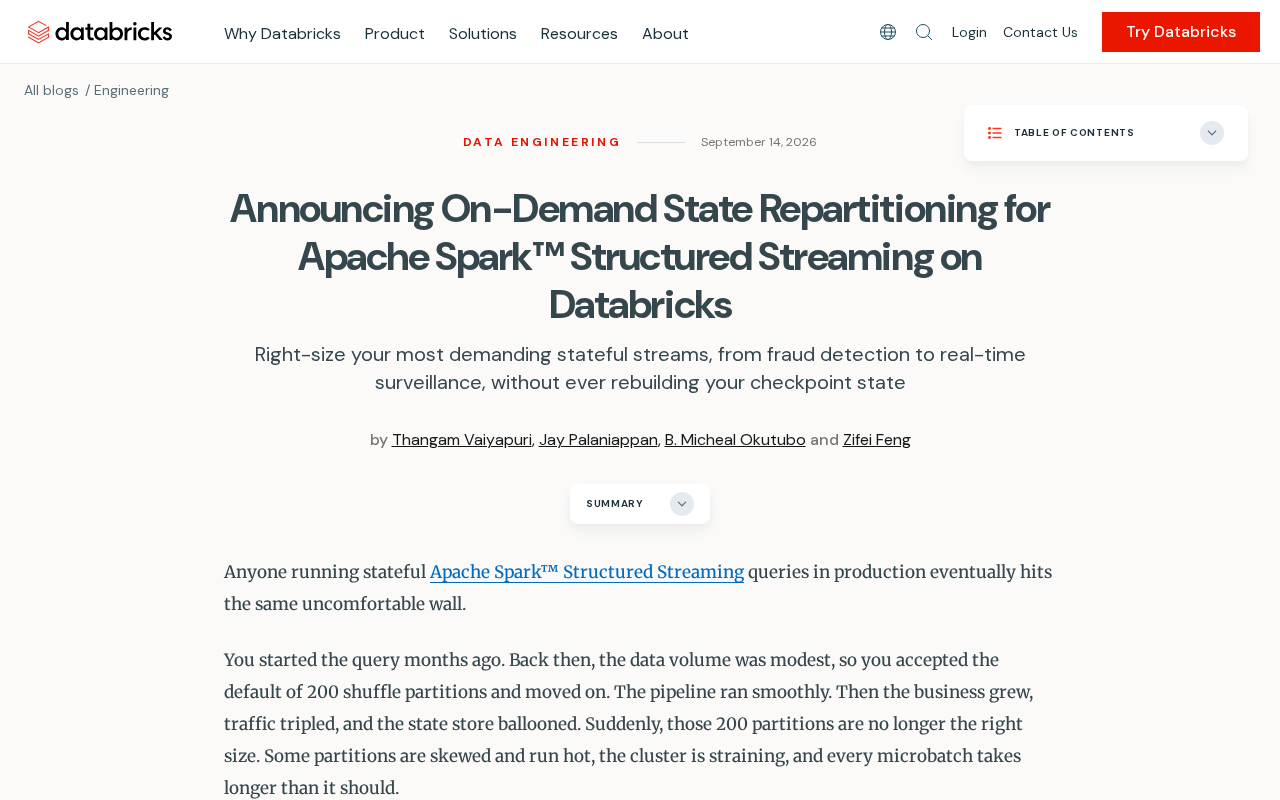
Databricks enables dynamic state repartitioning for Spark Structured Streaming without Checkpoint rebuilds.
Databricks has released On-Demand State Repartitioning to address a long-standing pain point in Apache Spark Structured Streaming: state partition counts are nearly immutable after initialization, requiring a costly Checkpoint wipe and full reprocess to change. The new feature lets teams dynamically adjust partition counts for running stateful jobs without losing existing state or rebuilding the Checkpoint, transforming partition configuration from a one-time upfront decision into a continuously tunable runtime parameter that reduces operational overhead and lowers the design barrier for stateful stream processing at scale.
The Long-Standing Problem with Stateful Stream Processing
Any team running stateful Apache Spark™ Structured Streaming queries in production has inevitably run into this frustrating constraint: once the number of state partitions (shuffle partitions) is set, it's nearly impossible to change without rebuilding the Checkpoint from scratch.
For stateful operators like aggregations, deduplication, stream joins, and flatMapGroupsWithState, state data is persisted to the Checkpoint using the partition count defined at initialization. This means that when data volumes grow or traffic patterns shift significantly, teams are stuck in a difficult tradeoff: too few partitions cause state skew and processing bottlenecks, while too many partitions waste compute resources during low-traffic periods.
Historically, changing this configuration required wiping the Checkpoint and reprocessing from the beginning — a nearly unacceptable option in production environments. Not only does it mean losing intermediate state, it also introduces data consistency risks and potentially long service interruptions.
Checkpoint is the cornerstone of Structured Streaming's fault-tolerance mechanism. During each micro-batch, Spark persists operator state snapshots (the State Store) and execution progress to external storage (typically HDFS or object storage). State data is written as a fixed number of file shards based on
spark.sql.shuffle.partitionsor the operator-level partition count, and Spark relies strictly on this partition layout when recovering or resuming execution. This is precisely why changing the partition count causes incompatibilities between historical state files in the Checkpoint and the new configuration — leading to read errors or silent state loss, and why this problem has historically required a cold restart to resolve.
What On-Demand State Repartitioning Delivers
Databricks' newly announced On-Demand State Repartitioning feature targets exactly this pain point. It allows users to dynamically adjust the state partition count of a stateful streaming query without rebuilding the Checkpoint or losing existing state.
The real value here is transforming the partition count from a near-irreversible initial decision into a runtime parameter that can be flexibly tuned as the business evolves. When upstream data volume doubles, teams can increase partitions to distribute load and eliminate hot spots. When traffic drops, they can reduce partitions to reclaim resources — striking a better balance between performance and cost.
This kind of elasticity is especially critical for long-running streaming jobs. Data distributions in production are rarely static, and the ability to repartition on demand means operations teams no longer have to pay a steep price for a one-time capacity planning mistake.
Under the hood, on-demand state repartitioning must solve a non-trivial problem: how to migrate state data already persisted in an old partition layout to a new partition key mapping, without interrupting the streaming query. The typical approach involves introducing a "repartitioning micro-batch" that performs a shuffle re-routing of all keys in the State Store, while guaranteeing atomicity — either the new layout is fully written successfully, or the system rolls back and continues running with the old layout. This process is transparent to downstream consumers, but it does cause a brief spike in latency for that batch. Operations teams should plan for an appropriate processing window when triggering a repartition.
Implications for Streaming Architecture Design
From an engineering perspective, on-demand state repartitioning lowers the upfront design barrier for stateful stream processing. Previously, teams had to accurately forecast peak traffic at the start of a project and lock in a partition configuration accordingly. Now, they can launch with a reasonable initial value and iteratively optimize based on real operational data.
This also shifts the capacity planning mindset from "get it right once" to "continuously adjust." Combined with Databricks' platform observability capabilities, teams are far better equipped to handle seasonal traffic spikes, rapid business growth, or temporary data surges.
For enterprises building real-time data pipelines on Structured Streaming, this feature further strengthens Spark's operational manageability in large-scale stateful streaming scenarios.
Summary
Rigid state partitioning has long been a hidden cost of scaling stateful stream processing in production. With on-demand state repartitioning, Databricks transforms what was once a disruptive, downtime-requiring operation into an online, elastic adjustment — giving production streaming jobs stronger scalability and better cost control. For teams currently running or planning to run large-scale Structured Streaming queries, this is a capability upgrade well worth paying attention to.
Related articles
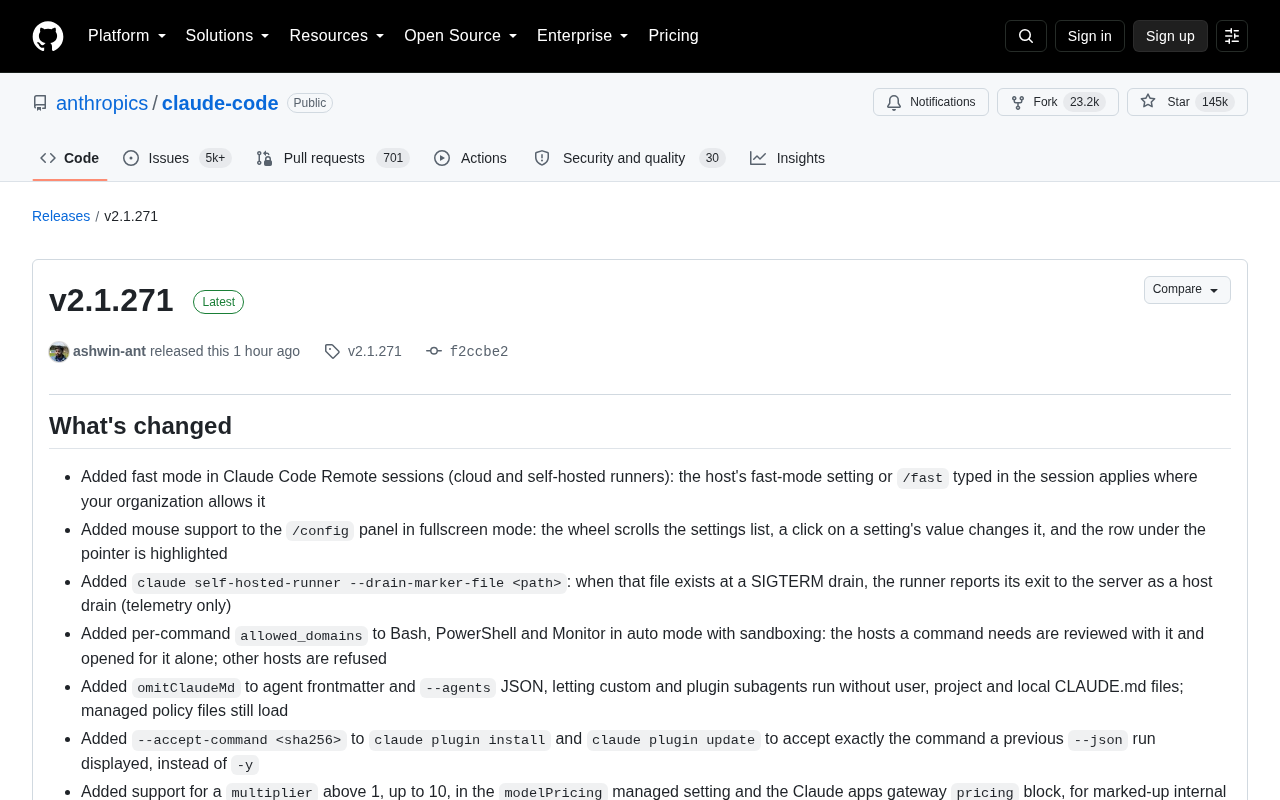
Claude Code v2.1.271 Update Deep Dive: Fast Mode, Sandbox Security, and Enterprise Improvements
Claude Code v2.1.271 adds fast mode for remote sessions, per-command sandbox network controls, enterprise policy fixes, MCP protocol improvements, and terminal/IDE enhancements.

AI Giants Collectively Hit the Brakes: Safety Protocol or Industry Cartel?
OpenAI, Anthropic, Google DeepMind, and SpaceX leaders agree to slow AI development. Is this a responsible safety pact — or an oligopolistic cartel in disguise?

Apple Home Gets AI Camera Features with iOS 27: Up to $60/Month
iOS 27 and tvOS 27 bring Apple Intelligence to Apple Home with AI video summaries for HomeKit Secure Video — but unlocking them costs up to $60/month via subscription.