Databricks Lakebase: A Database Architecture Rebuilt for AI Speed

Databricks launches Lakebase, a database rebuilt from scratch to spin up and shut down at AI speed.
Databricks has introduced Lakebase, positioning it as a ground-up rearchitecture of databases designed to spin instances up and down at "AI speed" — addressing the fragmented, short-lived workloads generated by AI agents and automated pipelines. The name extends Databricks' Lakehouse lineage, signaling an intent to unify OLTP capabilities with the existing analytical platform. Named to Fast Company's Next Big Things in Tech list, Lakebase reflects growing industry interest in AI-native infrastructure. However, public information remains largely marketing-driven, with independent benchmarks and technical details still forthcoming.
Databricks Targets the Database Pain Points of the AI Era
Databricks recently announced on social media that its new product, Lakebase, has been named to Fast Company's "Next Big Things in Tech" list. The company's positioning is unmistakably clear — Lakebase is described as "a ground-up rearchitecture of databases," designed to help databases keep pace with AI-driven development.
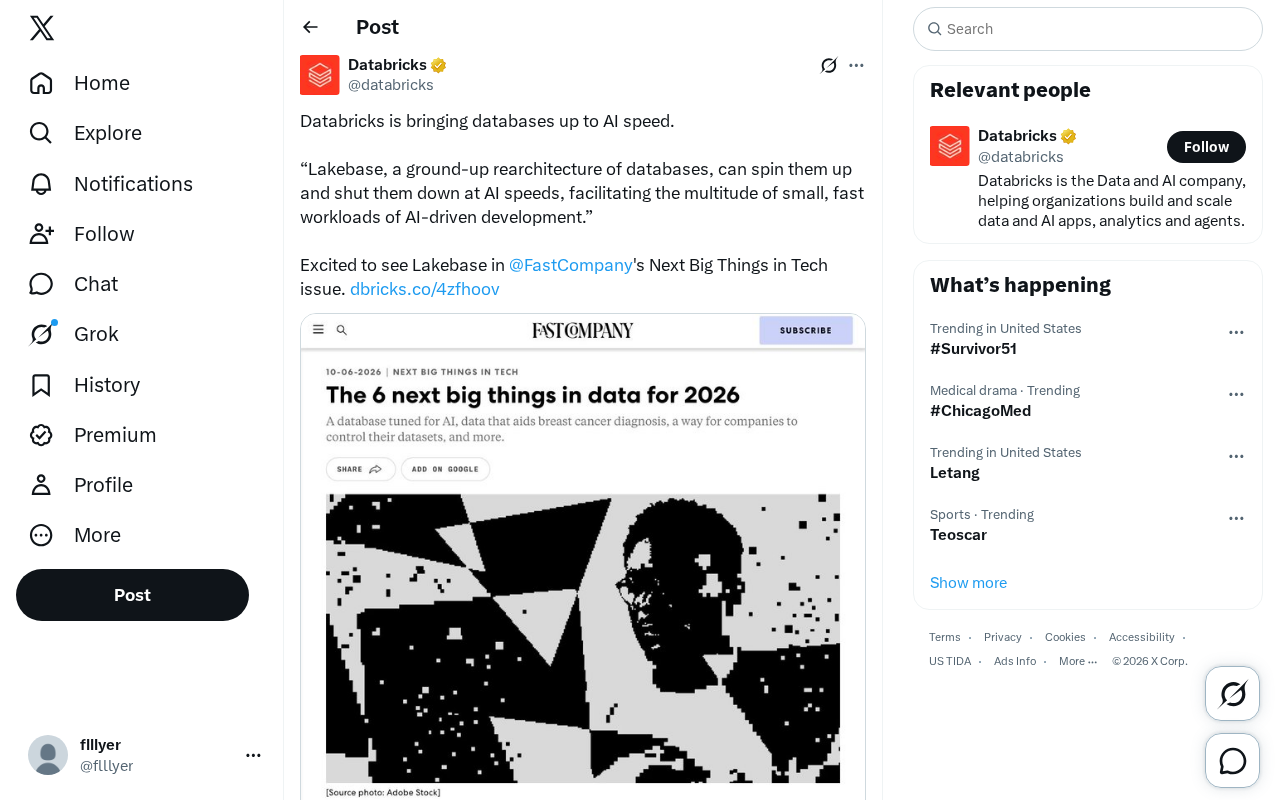
The key phrase here is "AI speed." In traditional database systems, spinning up or shutting down an instance can take minutes or longer — acceptable for conventional enterprise applications, but a glaring bottleneck in AI development workflows. The mismatch in tempo is exactly what Databricks is trying to solve with Lakebase.
Why AI Development Demands a Faster Database
According to Databricks, Lakebase can "spin them up and shut them down at AI speeds," supporting "the multitude of small, fast workloads" that characterize AI-driven development.
This points to a defining trait of modern AI application development: fragmented workloads. Unlike the long-running, relatively stable database usage patterns of the past, AI agents, automated pipelines, and experimental development constantly generate short-lived tasks. Each task may require only a temporary database instance — use it and discard it. If every task must absorb the cost of a traditional database's slow cold start, overall efficiency suffers significantly.
Lakebase's emphasis on rapid spin-up and shutdown is essentially about turning database resources into elastically schedulable units that can be provisioned almost instantly. This aligns with the broader cloud computing trend toward serverless and on-demand billing — except Databricks has tied this philosophy more directly to the demands of AI workflows.
The challenges that AI agents and automated pipelines place on databases are not unlike those of the microservices era, but at a far more extreme pace. A typical AI agent executing a task might need to — within seconds — retrieve context memory, write intermediate state, invoke tools and log results, then commit or roll back. This demands sub-second or even millisecond-level cold start capability. Traditional relational databases like PostgreSQL and MySQL require buffer pool warm-up and WAL recovery during instance initialization, making cold starts often exceed tens of seconds — a range that even containerized deployments struggle to compress into something acceptable. Products like Neon and PlanetScale, which pursue a "Serverless Postgres" approach, have been attempting to break through this barrier using storage-compute separation and instant branching techniques. Databricks enters this space backed by its large-scale cloud infrastructure. Whether Lakebase can deliver a genuinely differentiated architectural answer to "AI-speed" startup is one of the most closely watched technical questions.
The Evolution from Lakehouse to Lakebase
Those familiar with Databricks will immediately notice the intentionality behind the name "Lakebase." Databricks has long been synonymous with the "Lakehouse" architecture — the idea of unifying the strengths of data lakes and data warehouses. The name "Lakebase" continues that lineage, signaling an intent to bring transactional database (OLTP) capabilities into the same unified data platform.
For enterprises, this kind of integration has real appeal: developers no longer need to shuttle data back and forth between analytical systems and operational databases, and AI applications can complete the full loop — from data storage and processing to model invocation — within a single platform. Being selected for Fast Company's annual tech list also reflects broader industry recognition of the "rearchitect infrastructure for AI" movement.
The core idea behind the Lakehouse architecture is to store data in open formats (such as Delta Lake and Apache Iceberg) on object storage (S3, ADLS, etc.), while layering on top of it the ACID transactions, metadata management, and query optimization capabilities typically associated with data warehouses. This theoretically allows the flexibility that data scientists need from a raw data lake and the structured query performance that BI teams require to coexist on the same underlying data — without ETL copying data between two separate systems. Databricks formally introduced the Lakehouse concept in 2020, using the open-source Delta Lake project as its technical foundation. Lakebase attempts to take this one step further: while the existing Lakehouse excels at analytical (OLAP) queries, many AI applications also require high-frequency read/write online transaction processing (OLTP) — for example, storing user session state, agent memory, and tool call records. If Lakebase can simultaneously handle both OLAP and OLTP within the same platform, it could meaningfully reduce the complexity of enterprises maintaining multiple heterogeneous database systems.
A Measured Perspective
It's worth noting that the information currently available comes primarily from Databricks' own marketing and the榜single list announcement — independent technical details, performance benchmarks, and third-party evaluations are still absent. Key questions remain unanswered: What exactly does "AI speed" mean in concrete millisecond terms? What storage-compute separation approach is used under the hood? How compatible is it with existing PostgreSQL workloads? These will need to be addressed in official technical documentation.
For now, Lakebase reads more as a clear product vision and directional statement than a fully validated, production-ready solution. The real signal it sends is this: as AI development patterns become mainstream, the database layer — long considered a mature and stable piece of infrastructure — is being fundamentally re-examined and rebuilt to fit an era defined by faster iteration and more fragmented workloads.
Summary
Databricks Lakebase represents one infrastructure vendor's response to the AI era — not just competing at the model and compute layer, but pursuing a ground-up rethink at the database level. For developers and enterprise technology decision-makers tracking AI engineering and data platform evolution, this is a direction worth watching. A more accurate assessment of its real-world value will only be possible once additional technical details and independent benchmark data become available.
Related articles

Random Pruning of the DPO Computation Graph: 1.4x Training Speedup and Lower Peak Memory
DPO training too slow and memory-hungry? This paper proposes a random pruning framework for the DPO computation graph, sampling independently across position, sequence, and branch dimensions; branch pruning achieves a 1.426x step-time speedup and cuts training time by about 30%, with in-depth attribution of memory and time gains.

Why Does JEPA Underperform MLM in Longitudinal EHR Representation Learning?
New study compares JEPA and MLM for longitudinal EHR representation learning on MIMIC-IV: three JEPA variants train stably without collapse but underperform MLM; target size, not heterogeneity, drives prediction error.

Transfer Learning + Visible Light Communication: A New Approach to Energy-Efficient Indoor Positioning
A study proposes a transfer learning-based visible light communication indoor positioning method, achieving 47% accuracy improvement on the BOSCH factory dataset, 67.5% model efficiency under high noise, and introducing the ME composite metric for energy-efficient positioning in energy-constrained industrial IoT scenarios.