Databricks Launches Workday Data Connect Federation Connector: Unity Catalog Now Connects HR Data

Databricks launches a Workday federation connector to unify HR and finance data governance in Unity Catalog.
Databricks has opened public beta for the Workday Data Connect federation connector in Unity Catalog, allowing enterprises to query Workday HR and finance data on demand without physically copying it. Key benefits include unified governance with lineage and audit tracking, cross-domain analytics connecting people data with business metrics, and reduced ETL maintenance overhead. However, federated queries have performance limitations at scale, and the feature remains in beta — enterprises should validate in test environments before considering production deployment.
A Notable New Development in Enterprise Data Integration
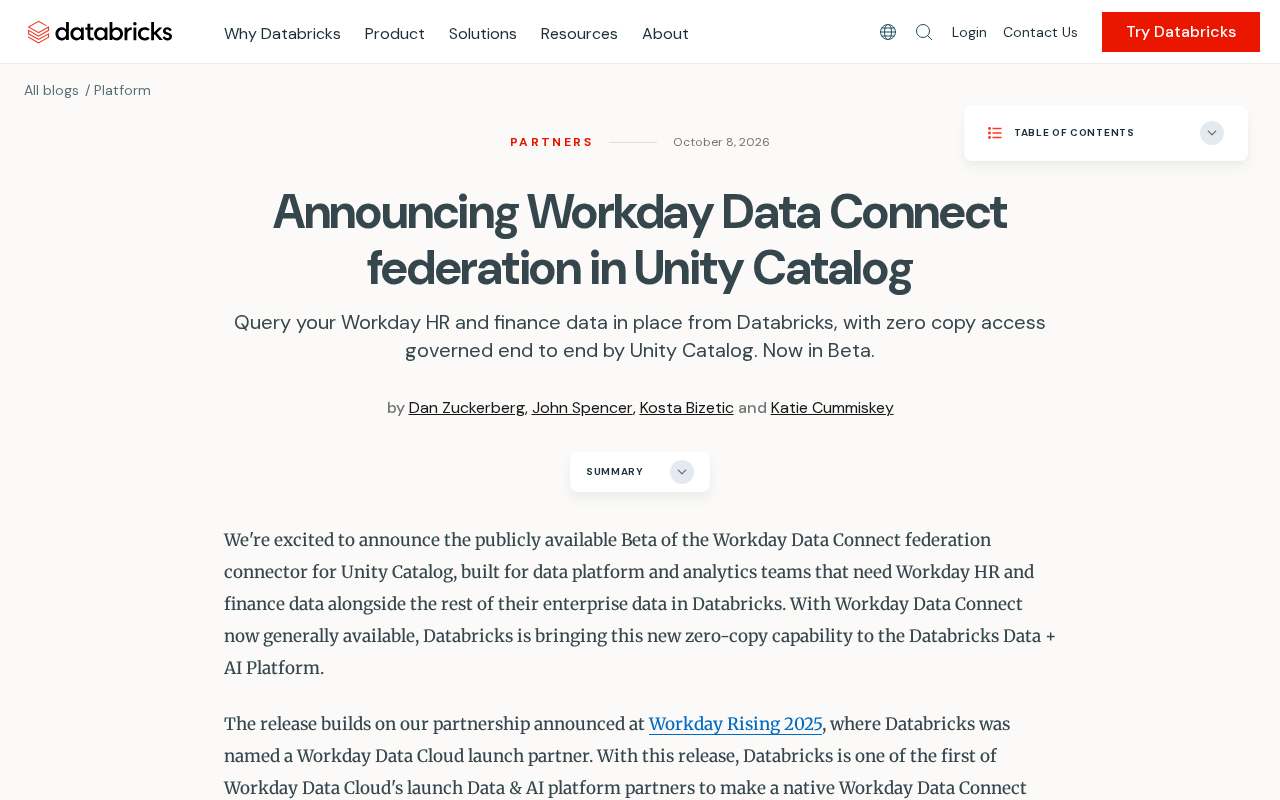
Databricks recently announced that the Workday Data Connect federation connector for Unity Catalog has officially entered public beta. While this may appear to be just another data source integration, it represents a significant simplification of a long-standing pain point for enterprises that rely on Workday for HR and finance systems while using Databricks for data analytics.
This article is based on information from Databricks' official announcement and outlines the connector's core value, applicable use cases, and key considerations during the current beta phase. Note that the original materials provide limited technical detail, so this piece focuses primarily on interpreting its positioning and potential impact.
What Is the Workday Data Connect Federation Connector
Workday is a widely adopted cloud platform for Human Capital Management (HCM) and financial management, housing large volumes of structured data on employees, organizations, payroll, attendance, and more. Historically, bringing this data into an analytics platform required building ETL pipelines to periodically extract and land data into a data warehouse or data lake — a complex process prone to data freshness issues.
The newly released federation connector is part of Unity Catalog's Query Federation capability. Its core idea is simple: rather than physically moving Workday data into Databricks, users can register Workday Data Connect as an external data source directly within Unity Catalog and access it on demand through federated queries. This "data stays in place, query pushdown" approach reduces data duplication and lowers the cost of maintaining multiple pipelines.
Workday Data Connect is Workday's official data access service that allows enterprises to export structured business data from Workday to external systems in bulk or via API. It is not a direct database connection — it operates through a Workday-managed data export framework, which means onboarding a third-party platform requires separately enabling and authorizing Data Connect on the Workday side. This explains why the connector is not truly "plug-and-play": while configuring the federation connector on the Databricks side, enterprises must also ensure that the Workday tenant has Data Connect access enabled and that the necessary security credential exchange has been completed.
Query Federation refers to the technical pattern where a query is initiated in a local analytics engine (in this case, Databricks), which then "pushes down" predicate conditions to the remote data source for filtering before returning results. The advantage is that no full data migration is required upfront, but performance is limited by the remote system's throughput capacity and network latency — potentially becoming a bottleneck in large-scale full-table scans or high-frequency query scenarios.
Why This Matters for Enterprises
Unified Governance and Access Control
One of Unity Catalog's most significant selling points is unified governance across data sources. By bringing Workday data into Unity Catalog, enterprises can manage HR data under a single framework of permissions, lineage, and auditing. For sensitive Workday data covering employee privacy, compensation, and similar topics, centralized access control and audit capabilities are especially critical.
Data Lineage refers to the metadata capability that records the full path of data from source to consumption — tracing a metric in an analytics report back to its original table and the transformation steps it went through. Unity Catalog's lineage tracking automatically captures table-level and column-level dependencies in SQL queries and Spark jobs. For sensitive sources like Workday HR data, lineage is particularly important: in the event of a data breach or compliance audit, enterprises can quickly answer questions like "who queried which employee fields at what time, and which downstream reports did that data flow into" — helping satisfy data traceability requirements under regulations like GDPR and SOX.
Connecting HR Data with Business Analytics
Once HR data can be brought into a unified analytics platform, enterprises can correlate human capital data with sales, operations, finance, and other business data. This enables analyses such as the relationship between team size and business output, or the impact of employee turnover on project delivery — cross-domain analyses that were previously difficult to execute due to data being siloed across separate systems.
Reducing Engineering Overhead
The federated query model reduces dependence on custom ETL pipelines. Data engineering teams no longer need to maintain dedicated extraction jobs for Workday, nor worry about consistency between data copies and the source system. On-demand querying keeps data fresher.
Use Cases and Positioning
This connector is primarily aimed at enterprises already running on the Databricks Lakehouse architecture with Workday as their core HR and finance system. Typical use cases include People Analytics, organizational effectiveness assessments, compliance reporting, and integrated analytics scenarios that require merging employee data with other business data.
For scenarios involving massive data volumes that require high-frequency batch processing, federated queries are not always the optimal solution — physical data extraction still has value in certain performance-sensitive contexts. Enterprises should therefore evaluate the right combination of federated queries and traditional data pipelines based on their query patterns, data volumes, and real-time requirements.
What to Keep in Mind During Beta
The connector is currently in public beta, meaning it is available for trial use but has not yet reached the maturity of General Availability (GA). Before deploying in production environments, enterprises should note:
- Feature behavior and performance may still be iterating, and certain capabilities may change;
- It is recommended to first validate connection stability and query performance in a non-critical test environment;
- Confirm that the configuration and authorization requirements on the Workday Data Connect side are met;
- Plan Unity Catalog permission policies in advance for access to sensitive HR data.
Conclusion
The launch of the Workday Data Connect federation connector continues Databricks' strategic direction of positioning Unity Catalog as a unified data governance and access hub. By bringing key enterprise HR and finance systems into the federated query ecosystem, Databricks further lowers the barrier to cross-system data analytics. For enterprises looking to unlock the value of human capital data without bearing the costs of complex integrations, this beta feature is worth evaluating. As it moves toward GA, its performance and feature completeness will be the key metrics to watch.
Related articles

Chain of Thought Isn't Just for AI: How Humans Can Use CoT to Improve Thinking Quality
Chain of Thought isn't just a prompt trick for large models. Starting from a Hacker News discussion, this article analyzes why CoT works for human thinking too, breaks down actionable ways to transfer it, and highlights the key differences between human CoT and machine CoT.
Cloudflare Teams Up with OpenAI: Closi…
Cloudflare Teams Up with OpenAI: Closing the Loop from Vulnerability Discovery to Defense with AI
Cloudflare uses OpenAI Daybreak to investigate security vulnerabilities and generate reviewable remediation plans, while developers use Codex to boost coding efficiency and quality.

Orca Multi-Agent Orchestration in Practice: A Guide to Parallel Collaboration with Claude and Codex
Orca is Stable AI's free open-source agent workbench supporting 34 agents like Claude Code and Codex in parallel. Learn its Git worktree isolation, multi-model orchestration, and mobile management.