Datasette 1.0a43 Released: Streaming Exports, Security Fixes, and Cross-Page Animations

Datasette 1.0a43 adds streaming exports, security fixes, and cross-document view transitions.
Datasette 1.0a43 is an important milestone toward the official 1.0 release, with the 1.0 milestone now 53% complete thanks to Simon Willison's work with Claude Fable 5.2. The core architectural change is streaming support for output renderers: built-in TSV/CSV exports now use `Response.stream()`, avoiding loading all rows into memory when exporting large tables. Two security issues were fixed, including a private stored query vulnerability where SQL statements could be read without authorization, prompting a GitHub advisory. The row page JSON representation is now finalized for 1.0, plus new utilities like a copy-button Web Component and `DatasetteModal.confirm()`. The author's favorite change is the smallest: CSS cross-document view transitions bring an SPA-like navigation feel to multi-page apps.
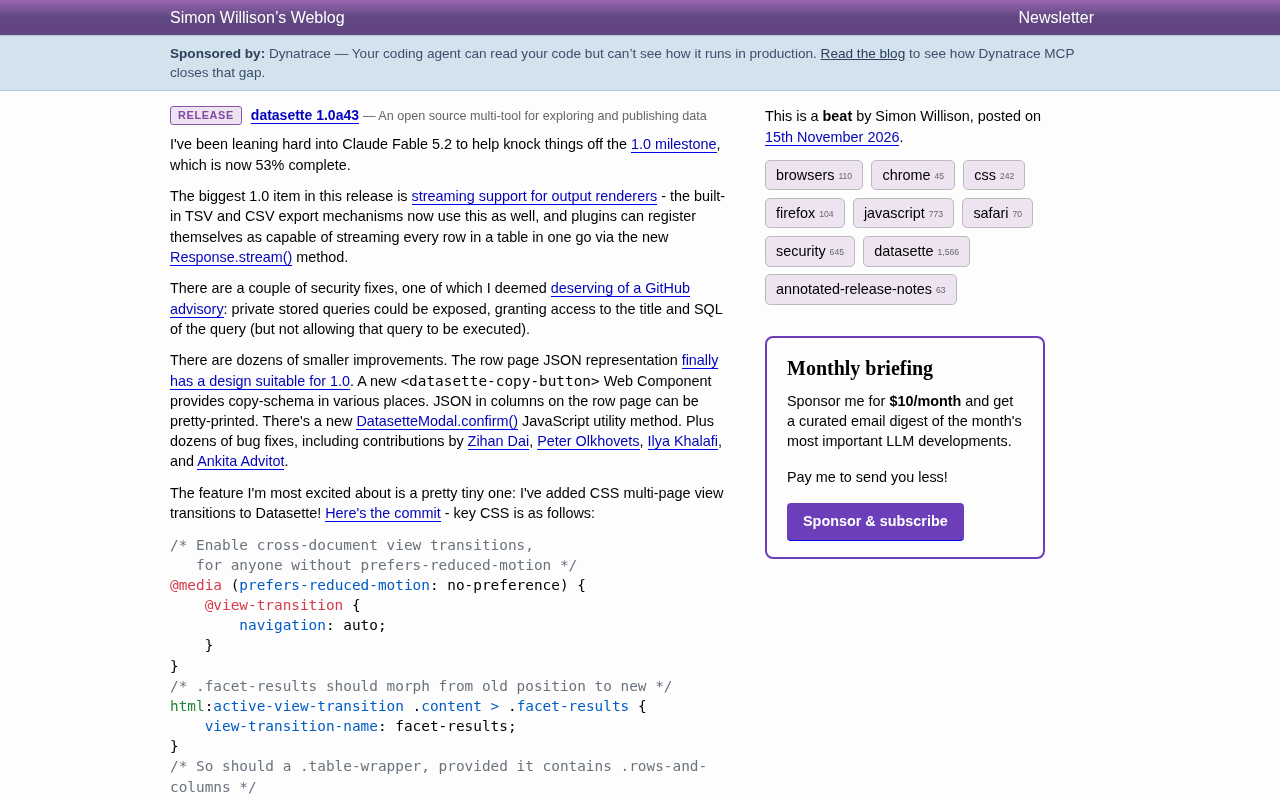
Datasette 1.0a43 has been released, marking another important milestone on the road to the final 1.0 release. In the release notes, author Simon Willison revealed that he has recently been leaning heavily on Claude Fable 5.2 to push the 1.0 milestone forward, which is now 53% complete. This version adds architectural capabilities like streaming rendering, addresses security vulnerabilities, and introduces a CSS animation that seems minor but significantly changes the user experience.
Output renderers now support streaming, benefiting large dataset exports
The most important 1.0 feature in this release is that output renderers now have streaming support. Datasette's built-in TSV and CSV export mechanisms have switched to this path, meaning that exporting all the data in a table no longer requires accumulating all rows in memory before outputting them all at once.
For plugin developers, the new Response.stream() method allows plugins to register their ability to "stream out every row of a table in a single pass." For scenarios involving exporting large tables or serving public datasets with substantial data volume, the importance of this change is obvious: memory usage and response latency will both improve noticeably.
Output renderers are an extension point in Datasette's plugin system: plugins can register a renderer that converts query results into a specific format (such as CSV, TSV, JSON, GeoJSON, etc.) and returns it to the client. Datasette selects the appropriate renderer based on the request's extension or the _format parameter. Previously, renderers typically received a result set that had already been fully materialized in memory, so memory pressure grew linearly with row count when exporting large tables. With streaming capability, renderers can write the response while result rows are read one by one, enabling query-and-transfer simultaneously in conjunction with ASGI's chunked response mechanism. This also means renderers must handle incremental encoding themselves (for example, per-row escaping for CSV) and error handling—once response headers have been sent, it is no longer possible to fall back to an error page, so plugin authors need to adjust their implementations accordingly.
Two security fixes, including a GitHub security advisory
This version includes two security fixes, one of which the author deemed worthy of a separate GitHub security advisory. The vulnerability involves the potential exposure of private stored queries—an attacker could obtain the query's title and SQL statement, but could not actually execute the query.
Although the impact is limited, for users who rely on Datasette's stored query feature to carry internal logic, the leakage of the SQL statements themselves could still expose table structures, field naming, and business logic. Deployments using this feature are advised to upgrade as soon as possible.
Private stored queries are a Datasette feature that allows users to save SQL queries as named entries and control their visibility, commonly used to encapsulate internal reporting logic or parameterized queries into reusable endpoints. The key issue with this vulnerability was that access control only covered the "execution" step but not the "metadata reading" step, allowing unauthorized parties to still obtain query titles and SQL bodies. SQL statements themselves often contain table names, column names, JOIN relationships, and even business explanations in comments, making them highly valuable reconnaissance information for attackers, who can use them to infer database structure and pave the way for subsequent injection or privilege escalation attempts. After the fix, metadata reading and execution follow the same set of permission checks.
Row page JSON design for 1.0 finalized
In addition to the two major changes, 1.0a43 also includes a large number of detail improvements. The JSON representation of row pages finally has a design suitable for 1.0, meaning the API output format is stabilizing before the official release.
Other improvements include: a new <datasette-copy-button> Web Component that provides schema copying functionality in multiple locations; JSON within columns on row pages can now be formatted and pretty-printed; and a new DatasetteModal.confirm() JavaScript utility method that makes it easier for plugins to implement confirmation dialogs. There are also dozens of bug fixes, including contributions from Zihan Dai, Peter Olkhovets, Ilya Khalafi, and Ankita Advitot.
Cross-document view transitions: multi-page apps get an SPA-like feel
The feature the author is most excited about is actually the smallest one: Datasette has added CSS cross-document view transitions. The core CSS logic is written inside a prefers-reduced-motion: no-preference media query, enabling navigation transitions via @view-transition { navigation: auto; }, and assigning view-transition-name separately to .facet-results and the .table-wrapper containing the .rows-and-columns table, so these elements smoothly morph from their old positions to their new positions during page transitions.
The effect is that Datasette remains a committed multi-page application, but in-site navigation feels closer to a single-page application. Currently this feature works in Safari and Chrome; the author mentions that Firefox support is expected to land with Firefox 162 on December 8 (it is no longer behind a feature flag in Firefox Nightly).
The significance of this change goes beyond aesthetics. It shows that multi-page applications can achieve smooth transition experiences using native platform capabilities without rewriting as an SPA—a low-cost progressive enhancement path for the many traditional server-side rendered projects.
Cross-document view transitions are a capability introduced by the CSS View Transitions Level 2 specification. Unlike the earlier same-document version that only applied to DOM updates within a single-page application, it lets the browser automatically capture a snapshot of the old page, load the new page, and interpolate position and size animations for elements with the same view-transition-name between two independent page navigations. Developers only need to declare @view-transition { navigation: auto; } and assign unique names to elements that need continuous transitions—no JavaScript navigation interception or route rewriting required. Because transitions are handled by the browser's compositor layer, performance overhead is low; the feature also respects prefers-reduced-motion, automatically degrading to a normal navigation when the user requests reduced motion. For server-side rendered multi-page applications, this is a path to an SPA-like experience at minimal retrofit cost.
Directions to watch
With the 1.0 milestone more than halfway complete, the remaining work will likely focus on API stability and plugin ecosystem compatibility. The investment in streaming rendering shows that Datasette's performance boundaries for large dataset scenarios are being actively expanded; the introduction of view transitions demonstrates the author's continued attention to detail in user experience. For users of this self-hosted data publishing tool, this alpha version already contains enough substantive changes to be worth validating in a test environment first.
One-line Summary
Datasette 1.0a43 is released, bringing streaming exports, security fixes, and cross-document view transitions.
Paragraph Summary
Datasette 1.0a43 is an important milestone on the road to the official 1.0 release. Author Simon Willison has been using Claude Fable 5.2 to advance development, and the 1.0 milestone is now 53% complete. The core architectural change in this version is streaming support for output renderers: built-in TSV/CSV exports now use Response.stream(), so exporting large tables no longer requires piling all rows into memory, and plugins can register one-pass streaming output capabilities. On security, two issues were fixed, including one where private stored queries' titles and SQL statements could be read without authorization, prompting a separate GitHub security advisory. In addition, the row page JSON representation has a design suitable for 1.0, and new utilities include a copy-button Web Component, pretty-printing of JSON within columns, and DatasetteModal.confirm(). What the author values most is the smallest change: CSS cross-document view transitions give multi-page apps a navigation feel close to an SPA.
Related articles

RePlan-VLA: Progress-Aware Replanning Breakthrough for Long-Horizon Robotic Manipulation
The RePlan-VLA framework converts VLA models' short-horizon capabilities into reliable long-horizon execution through progress-aware adaptive replanning, improving success rates by 21.9% and 10.4% on RoboCasa365 and CALVIN, and validating real-world deployment on a Franka Research 3 robot.

Geometric Bridge Flow Matching: A New Breakthrough in Blind Rigid Motion Correction
Geometric bridge flow matching enables blind rigid motion correction in head CBCT, achieving 37.1 dB PSNR and 0.27 mm RPE on simulated data in ~9.1 minutes, outperforming existing methods.

Google Releases Gemini 4 Hydrogen: 2.5x Faster Without Sacrificing Intelligence
Google releases the lightweight Gemini 4 Hydrogen: 2.5x faster task completion, AA Intelligence Index of 54 beating its flagship sibling, 7.3s single-step on Agent Arena faster than Claude and GPT rivals, four thinking levels with pay-as-you-need pricing, now available across AI Studio and more.