Declare: A UI Language Co-Written by Humans and AI
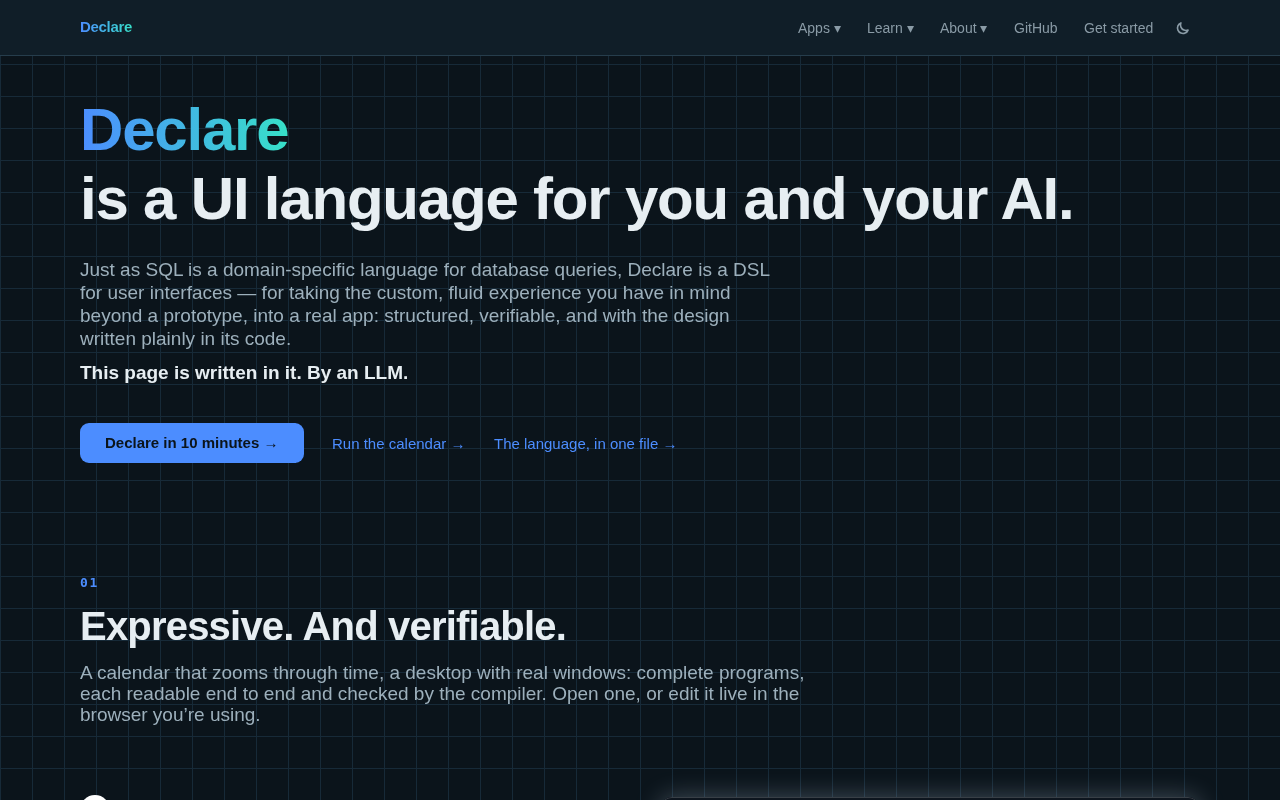
The Declare project proposes a UI language shared by humans and AI, exploring a new front-end collaboration paradigm in the AI era.
This article introduces Declare, a project on Hacker News positioned as "a UI language designed for you and your AI." It argues that traditional front-end frameworks are designed for humans, contain many implicit conventions, and cause AI to make mistakes when generating UI code. Declare uses a purer declarative language to reduce implicit runtime behavior and provide a shared, precise means of expression for humans and AI to solve intent alignment. The article also analyzes its core challenge: an insufficient ecosystem may limit AI training data coverage. It represents a trend of AI toolchains moving from "assisted coding" toward "defining new abstraction layers."
When AI Becomes Your UI Collaborator
On Hacker News, a project called Declare has put forward a thought-provoking positioning: a UI language designed for you and your AI. Unlike typical AI-assisted code generation tools, Declare attempts to redefine how interfaces are built at the language level, enabling human developers and AI systems to collaborate within the same semantic framework. This raises a key question — when AI is deeply involved in interface development, are traditional front-end languages and frameworks still sufficient?
Declare's official description doesn't stop at the superficial level of "generating UI with AI" but instead emphasizes a UI language "designed for AI." This suggests that its syntax and abstractions may inherently account for AI's comprehension patterns while retaining human readability and maintainability. Although public discussion has offered only a few brief remarks, the direction itself is worth noting.
Why Do We Need a "UI Language for AI"?
Current mainstream front-end development toolchains — React, Vue, SwiftUI, and others — are all designed for human developers. Their component models, state management, and styling systems are intuitive to humans, but for AI models, they often require handling a large number of implicit conventions and framework-specific syntax details. When AI attempts to generate or modify interface code, it easily makes mistakes in state flow, style specificity, or component lifecycle.
Declare's premise is: if the UI description language itself is more declarative and less dependent on implicit runtime behavior, AI can produce results more reliably. According to discussions on Hacker News, this approach is not meant to replace existing frameworks but to provide an intermediate-layer language that both humans and AI can read and write directly, reducing collaboration costs. Another implicit benefit is that the system may inherently offer better predictability and auditability.
Declarative UI and Implicit Runtime Behavior
Declarative UI refers to a programming paradigm where developers describe "what the interface should look like" rather than "how to build the interface step by step." React's JSX and SwiftUI's view builders fall into this category. Their core advantage lies in decoupling view state from rendering logic, making code easier to reason about. However, mainstream declarative frameworks still contain a great deal of implicit runtime behavior — for example, React's reconciliation algorithm, state batching, lifecycle side effects, and SwiftUI's environment dependency propagation. These mechanisms are understandable to humans through experience and documentation, but for AI models, they are invisible "black boxes" — AI can only infer behavior from the surface of the code and cannot simulate runtime semantics during generation. Therefore, when AI modifies code involving state priority or side-effect ordering, it easily produces output that appears valid but is actually wrong. If a purer declarative language could make these conventions explicit (such as clear state transition rules and no implicit side effects), it would reduce AI's reasoning burden and improve generation reliability.
The Boundary of Human-AI Collaboration
A consensus that repeatedly emerges across multiple discussions is: the biggest obstacle to AI participation in UI development is not generation capability but "intent alignment." Humans describe interfaces in natural language, and AI needs to translate that into structured UI code — a process prone to losing details or over-interpreting. The approach of languages like Declare is to give both parties a shared, precise means of expression — humans write requirements in Declare, AI generates implementations in Declare, and the language itself becomes the collaboration contract.
However, a view from a single source also points out that the challenges facing such languages are equally obvious: if the ecosystem isn't large enough, AI models will have insufficient training data coverage for it, resulting in generation quality that is actually worse than mature frameworks. This may be the threshold Declare needs to cross.
Intent Alignment
Intent alignment refers to the degree to which an AI system's behavior, when executing a task, remains consistent with the human user's true intent. In UI development scenarios, humans typically describe interface requirements in natural language (such as "a responsive navigation bar with a search box"), and AI needs to translate this into structured code. This process involves a semantic gap: ambiguity in natural language (such as the specific breakpoints of "responsive") and AI's over-generalization (such as adding unrequested animations) can both lead to intent deviation. The difficulty of intent alignment is that humans themselves often struggle to fully articulate all design constraints, and AI lacks commonsense reasoning to fill in the gaps. The value of a shared language like Declare is that it provides a precise vocabulary that allows humans and AI to express and verify intent at the same semantic level — humans write requirement specifications in Declare, AI generates implementations in Declare, and the language itself becomes an auditable contract, thereby reducing ambiguity and rework.
Practical Significance for Developers
For developers focused on AI programming and AI applications, Declare represents a trend: AI toolchains are moving from "assisted coding" toward "defining new abstraction layers." If this language proves effective, more similar projects may emerge in the future, covering UI, data flow, and even backend service descriptions. At this stage, Declare remains an exploratory project, and the attention on Hacker News indicates that the community remains curious about this direction. What is worth continuing to observe is whether it can attract enough early adopters to form syntax habits around AI collaboration.
The Evolution of Abstraction Layers in AI Toolchains
Traditional AI programming tools (such as GitHub Copilot) mainly provide code completion on top of existing languages and frameworks, belonging to the "assisted coding" level. "Defining new abstraction layers" means redesigning language primitives and interaction paradigms so that AI becomes a first-class citizen. Such attempts have not been common historically because new languages face a cold-start ecosystem problem: toolchains, communities, documentation, and training data all need to be accumulated from scratch. But AI's involvement may change this dynamic — if the language design is concise enough and comes with formal semantics, AI models can generalize from a small number of examples, reducing dependence on massive training data. The trend Declare represents is that future tool design will consider both human readability and machine reasonability, and DSLs (domain-specific languages) optimized for AI collaboration may emerge, covering UI, data flow, API contracts, and other layers. Developers need to watch whether the semantic design of such languages truly reduces AI error rates and whether their ecosystems can grow rapidly with AI assistance.
Conclusion
The proposal of Declare is essentially about designing a language with AI as a first-class citizen of UI development. Whether it succeeds depends on the simplicity of its semantic design and the speed of ecosystem building. For developers, this is a reminder: in the AI era, tool design may no longer consider only how humans use it, but also how AI can "understand" it.
One-line Summary
Declare proposes a UI language shared by humans and AI, exploring a new paradigm for front-end collaboration in the AI era.
Paragraph Summary
This article introduces a project called Declare on Hacker News, positioned as "a UI language designed for you and your AI." It points out that traditional front-end frameworks (React, Vue, SwiftUI) are designed for humans and contain many implicit conventions, causing AI to make mistakes when generating UI code. Declare attempts to use a purer declarative language to reduce implicit runtime behavior and provide a shared, precise means of expression for humans and AI, thereby solving the intent alignment problem. The article analyzes its core challenge: an insufficient ecosystem may lead to inadequate AI training data coverage, resulting in generation quality that is worse than mature frameworks. Finally, it notes that this represents a trend of AI toolchains moving from "assisted coding" toward "defining new abstraction layers," which is worth continued observation by developers.
Related articles

The Gemini 4 Trio and 3.8 Flash: A Full Comparison of Positioning, Pricing, and Benchmarks
A comparison of Gemini 4 Neon, Carbon, Argon, and Gemini 3.8 Flash: positioning, context, API pricing, Artificial Analysis and Arena benchmark scores, and available entry points.

AI Coding Model Leaderboard: Opus 5.5 Crowned, Gemini Neon Stages a Comeback
Tech blogger Matthew Berman releases an AI coding model tier list: Claude Opus 5.5 holds S-tier, Gemini Neon surprises with A-tier, OpenAI Astra lands B-tier. How do open-source models like DeepSeek fare? We break down the scoring logic and practical takeaways.

New Jersey Joe Sandwich: Meat and Coleslaw on Triple-Decker Rye
New Jersey Sloppy Joe isn't a ground beef burger—it's triple-decker rye bread with meat, Swiss cheese, and coleslaw, plus Russian dressing. Learn the authentic Essex County method and family recipe.