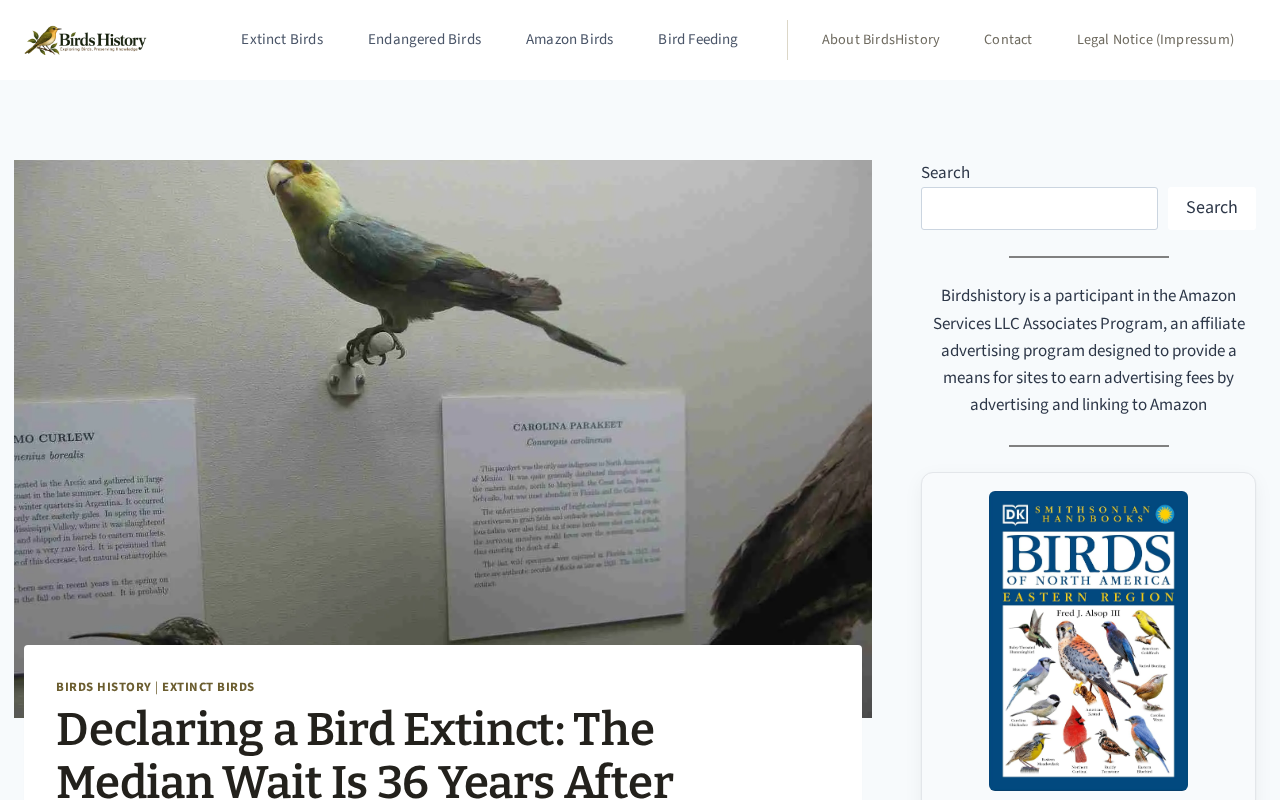
Declaring a Bird Extinct: An Average Wait of 36 Years from Last Sighting to Confirmation

The median gap between a bird's last sighting and its official extinction declaration is 36 years.
A study found that the median time between a bird's last confirmed sighting and its official declaration of extinction is 36 years. The root cause: proving a species "doesn't exist" is scientifically difficult, and historical Lazarus species rediscoveries have pushed conservation agencies toward extreme caution. This caution — while preventing premature write-offs — means protective action often arrives too late, and existing extinction lists systematically undercount actual biodiversity loss. Emerging tools like eDNA detection, automated acoustic monitoring, and machine learning offer a path to compressing this decades-long delay.
A Neglected Scientific Puzzle: How Do We Confirm a Species Is Truly Gone?
When we talk about species extinction, we tend to assume it's a clear-cut judgment — the creature either exists or it doesn't. But reality is far more complex. According to a study that sparked discussion on Hacker News, the median time between the last confirmed sighting of a bird species and its official declaration of extinction is a staggering 36 years.
This means that for nearly half a century, a bird that may have long since vanished from the earth remains listed as "surviving" or "data deficient." This lag isn't merely a bureaucratic problem — it reflects a profound methodological dilemma at the heart of biodiversity monitoring.
Why Confirming Extinction Is So Difficult
Declaring a species extinct is essentially an attempt to prove something doesn't exist — and in science, proving a negative is extraordinarily difficult. You cannot survey every possible habitat, every season, and every corner where a species might conceivably persist to confirm it has truly disappeared.
Search Difficulty and the Risk of Misjudgment
Many bird species inhabit remote, hard-to-reach areas, and their populations are often already critically small before extinction occurs. The fewer individuals remain, the lower the probability of any being observed — creating a statistical trap: does an absence of sightings mean the species is extinct, or simply that it's too elusive to find?
History offers no shortage of "Lazarus species" — birds once believed extinct that were rediscovered decades later. These comebacks have made conservation agencies extremely cautious about declaring extinction. Prematurely declaring a species extinct can cause the withdrawal of protection resources, potentially accelerating the true demise of a still-surviving population.
The term "Lazarus species" is borrowed from the biblical story of Lazarus, who rose from the dead. In biology, it refers to species declared extinct that are subsequently rediscovered years or even decades later. Famous examples include the coelacanth — a fish thought to have gone extinct alongside the dinosaurs 65 million years ago, rediscovered off the coast of South Africa in 1938 — and New Zealand's takahē, which reappeared in 1948 more than 50 years after being declared extinct. For birds, species confined to remote tropical islands or mountain forests can easily produce extended "observation gaps" based on human sightings alone, making it statistically difficult to distinguish between "critically endangered but still alive" and "extinct." These cautionary tales are precisely why the IUCN sets an extremely high evidentiary bar before listing a species as Extinct (EX).
What a 36-Year Median Actually Means
A median waiting period of 36 years lays bare the tension in conservation biology between "caution" and "timeliness." On one hand, a conservative approach avoids writing off species that still have a chance. On the other, delays spanning decades mean that genuine protective action may only arrive long after a species has passed the point of no return.
In other words, by the time a bird is officially declared extinct, any window for saving it has almost certainly closed. This lag is itself a microcosm of how the biodiversity crisis is systematically underestimated.
What This Means for Conservation
This finding raises sharp questions for wildlife conservation strategy. If confirming extinction takes this long, then existing lists of extinct species likely dramatically understate the true scale of biodiversity loss. Many species may already be gone — they simply haven't been formally "recorded" yet.
For policymakers and conservation organizations, this means they cannot rely solely on confirmed extinction data to gauge the severity of the crisis. A more sensible approach would combine statistical modeling to generate extinction probability estimates for species with prolonged absence records, triggering protective or investigative action much earlier.
Can Technology Shorten the Wait?
While the original discussion didn't delve into technical details, this is precisely the domain where modern monitoring tools can intervene. Environmental DNA (eDNA) detection, automated acoustic monitoring, satellite remote sensing, and machine-learning-based species identification systems all have the potential to dramatically improve monitoring efficiency for rare species.
In theory, denser and more automated monitoring networks could fill "sighting gaps" more quickly — whether to confirm a species still exists or to infer with greater confidence that it has disappeared. This may be the key pathway to compressing that 36-year median down to something more actionable.
Environmental DNA (eDNA) technology involves extracting and detecting genetic material shed by organisms into water, soil, or air samples — allowing researchers to infer whether a species is present without directly capturing or sighting it. This approach is particularly effective for aquatic and amphibious species, and has increasingly been applied to birds as well. Automated acoustic monitoring deploys recording devices in the field and uses machine learning models to automatically identify bird calls, enabling passive, round-the-clock population detection across large areas — greatly reducing dependence on manual surveys. What these technologies share is their ability to systematically accumulate "negative evidence" — records of a target species not being detected during continuous monitoring of a given area. Once negative evidence reaches sufficient spatiotemporal density, statistical models can support an extinction determination with high confidence in far less than 36 years, providing a much more timely basis for conservation decisions.
Conclusion
This seemingly obscure piece of research touches on a fundamental question about knowledge and responsibility: at what point do we actually know a species is gone? The 36-year answer reminds us that humanity's understanding of the natural world is far less timely and certain than we like to think. In an era of accelerating biodiversity loss, closing this lengthy confirmation gap is not just a matter of scientific progress — it may determine whether we can act before it's too late.
Related articles

Amphibious Transforming Drone: Beyond 100x Power Savings, What Are the Real Needs?
Is the amphibious transforming drone just a gimmick? Starting from the 100x power difference of the M4 Morphobot, explore real application scenarios and thesis topic ideas, analyzing boundary conditions where pure drones and pure ground robots both fail.

Warhound Raises $200 Million: Genetically Engineered "War Dogs" Paired with Anduril Gear
Warhound raises $200M, backed by Ben Lamm and Palmer Luckey, to genetically engineer dogs for military and law enforcement use and equip them with Anduril gear. This article analyzes its technology direction, funding logic, and ethical controversy.

Claude API Comes to Google Cloud: IAM Integration and SDK Access Guide
Anthropic hosts the full Claude API on Google Cloud with IAM-controlled permissions and unified billing. This guide covers the Vertex AI and Anthropic-hosted entry points, IAM role configuration, and SDK access.