Decoding an AI-Native Full-Stack Engineer Job Post: What a Berlin Team Is Really Looking For

A Berlin AI startup job post decoded: the real technical bar and talent standards for enterprise AI adoption.
A job posting from an early-stage Berlin AI team reveals the typical technical profile of today's enterprise AI application startups: pragmatic backends built with Python/TypeScript, PostgreSQL, and Docker; RAG, agents, and document intelligence deployed in real estate and finance; and private AI infrastructure for data compliance. The role demands "AI-native" engineers — those who build AI-first products and deeply integrate AI tools into their own workflows. A C1+ German requirement and remote-Europe-preferred hiring reflect how enterprise AI adoption hinges on industry context and local market understanding. The posting confirms key trends: the application layer is the main AI startup battleground, private deployment demand is rising, and technical hiring is shifting toward output-driven evaluation.
The Industry Signal Behind One Job Posting
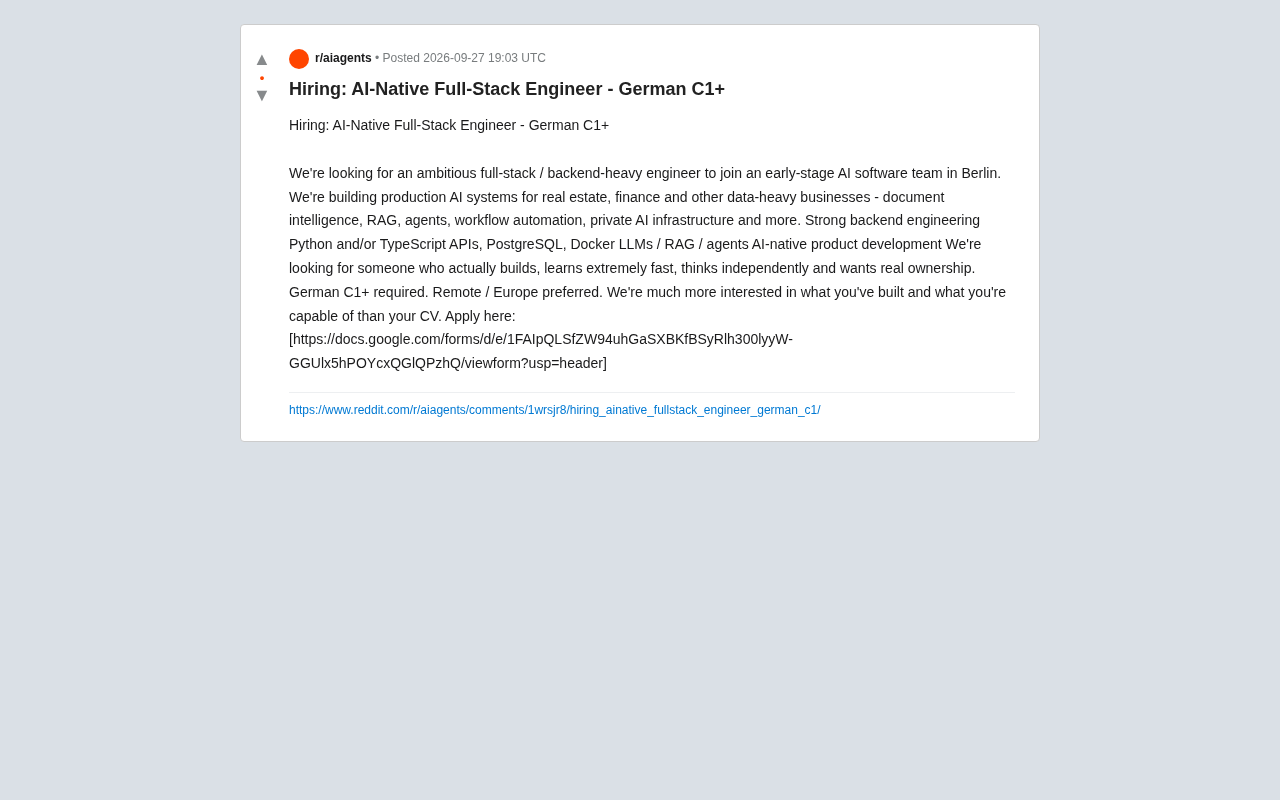
An early-stage AI software team in Berlin is hiring an "AI-native" full-stack/backend-leaning engineer. What looks like an ordinary job listing is actually a clear window into the real talent demands of AI application-layer startups — it tells you more about what a "production-grade AI systems" team actually does, and what skill combinations it needs, than any traditional job description ever could.
This company focuses on building production AI systems for data-intensive industries like real estate and finance, covering areas such as document intelligence, retrieval-augmented generation (RAG), agents, workflow automation, and private AI infrastructure. These keywords almost perfectly trace the main thread of enterprise AI adoption today: not building general-purpose foundation models, but embedding LLM capabilities into the real data workflows of specific industries.
Breaking Down the Tech Stack: What These Requirements Actually Mean
The core technical requirements listed in the posting are worth unpacking one by one — they represent the typical engineering profile of an AI application team.
Backend-Heavy Full-Stack Skills
The role explicitly requires "strong backend engineering skills," building APIs in Python and/or TypeScript, paired with PostgreSQL and Docker. This is a very mainstream stack: Python handles AI/data processing logic, TypeScript bridges interfaces and frontend, PostgreSQL serves as reliable relational storage (with pgvector support for vector search), and Docker handles deployment and environment consistency.
This reveals something important — AI startups don't need flashy tech stacks; they need solid, maintainable engineering foundations that ship fast. The real complexity isn't in framework selection; it's in combining these mature tools into a production system that runs reliably.
Hands-On Experience with LLMs / RAG / Agents
Listing "LLMs / RAG / agents" as hard requirements — not nice-to-haves — signals that these are now table stakes. For use cases like real estate contracts and financial documents, RAG is the key mechanism that lets LLMs "understand" private data, while agents automate multi-step business processes. This demands engineers who don't just know how to call an API, but who understand retrieval quality, context management, and hallucination control as real production challenges.
RAG (Retrieval-Augmented Generation) works by injecting retrieved results from an external knowledge base into the LLM's input context, enabling the model to answer questions about private or real-time information beyond its training data. The typical pipeline involves three stages: chunking documents, encoding them as vectors, and storing them in a vector database (e.g., pgvector, Weaviate); encoding the user's query as a vector and running similarity search; then concatenating the retrieved results into the prompt before the LLM generates a response. In domains like real estate contracts and financial statements — where document structure is complex and terminology is dense — retrieval quality directly determines output accuracy. This makes chunking strategy, embedding model selection, reranking, and hallucination detection genuine engineering problems, not things you can solve with a single API call. Agents take this further by adding multi-step reasoning and tool-calling capabilities, allowing models to autonomously decompose tasks, call external APIs, execute code, and adjust subsequent actions based on intermediate results — well-suited for business automation scenarios like approval workflows and data verification that require cross-system coordination.
What "AI-Native" Actually Means for an Engineer
A phrase the posting repeatedly emphasizes is AI-native product development, and it specifically notes that the team cares more about "what you've built and what you can do" than your résumé.
"AI-native" carries two meanings here: first, the product is built with AI capabilities at its core from day one, rather than bolting an AI feature onto traditional software; second, the engineer themselves should deeply integrate AI tools into their own development workflow — using AI to learn faster and build faster. The posting explicitly asks for someone who "genuinely gets their hands dirty, learns extremely fast, thinks independently, and craves real ownership" — a universal expectation for core members of any early-stage team, but especially urgent in the AI space, where the pace of change far outstrips anything that came before.
Two Hiring Conditions Worth Noting
Two additional requirements carry meaningful signal.
The first is the hard requirement of German C1+. This is uncommon for technical roles, and typically means the team's clients — in real estate and finance — are primarily in German-speaking markets, requiring engineers to directly understand business documents, communicate with clients, or participate in localized product design. It's also a reminder that enterprise AI adoption is deeply dependent on understanding industry context; language and domain knowledge are themselves competitive moats.
The second is the remote-first, Europe-preferred hiring strategy. Early-stage teams use remote hiring to expand their talent pool while using geography and language constraints to ensure collaboration efficiency and market fit — a practical compromise.
What This Posting Tells Us About Broader Trends
Zooming out, this job listing confirms several shifts already underway:
- The application layer is the main battleground for AI startups. Compared to training foundation models, applying RAG, agents, and document intelligence to specific industries like real estate and finance offers a more manageable barrier to entry and a clearer path to monetization.
- Demand for private AI infrastructure is rising. The explicit mention of "private AI infrastructure" reflects the strong demand from data-sensitive industries for on-premises deployment and data sovereignty.
- Talent evaluation is shifting toward output-driven criteria. "We care more about what you've built than your CV" represents a broader move in technical hiring away from credential worship toward demonstrated capability.
For engineers looking to break into the AI application space, this posting is essentially a capability checklist: build a solid backend foundation, master the engineering realities of RAG and agents, and use AI tools to amplify your own productivity — that's worth more than a polished résumé.
Private AI Infrastructure typically refers to deploying all components — LLM inference services, vector databases, orchestration frameworks — entirely within a company's own or private cloud environment, with no data passing through any third-party API. Implementation approaches include locally deploying open-source models (e.g., Llama series, Mistral), using Ollama or vLLM as inference engines, and building self-hosted RAG pipelines in private environments. For financial and real estate firms holding customer contracts, credit records, and property transaction data, data compliance (GDPR and similar regulations) and information security audits are often prerequisites for purchasing any AI solution. This gives vendors who can deliver "controllable deployment" a significant differentiation advantage — and explains why even an early-stage team has already made private infrastructure a core capability focus.
Related articles

macOS Is No Longer UNIX: Apple Didn't Renew Certification, But the Technology Is Unchanged
Apple did not renew macOS's UNIX certification, and the Open Group has removed Apple's entry. This article analyzes the technical reality behind the expiration, Apple's possible intentions, and the practical impact on developers.

Building Stateful Multi-Agent Systems with Azure Cosmos DB
Based on the official Azure Cosmos DB tutorial, this article explains how to use the Agent Memory Toolkit to add shared persistent memory to a multi-agent travel planner, covering short-term, long-term, episodic, and semantic memory plus cross-session state continuity.

Production AI Agent Operations: A Three-Step Framework for Observing, Evaluating, and Optimizing
Azure Cosmos DB team proposes a three-step framework for production AI Agent operations: observe trace tracking, evaluate with LLM as a judge and regression testing, optimize cost across RU, retrieval, memory, and LLM layers.