Decoding Oura's $2.2B IPO: A Windfall Exit for Existing Investors

Oura's $2.2B IPO is largely an insider cash-out, with Forerunner Ventures exiting its entire stake for up to $1.26B.
Smart ring maker Oura has filed for an IPO valued at roughly $2.2 billion, but early investor Forerunner Ventures plans to sell its entire stake — cashing out up to $1.26 billion. The structure reveals an IPO driven primarily by secondary sales rather than new capital formation, meaning little fresh cash actually flows to the company. Facing competition from Apple and Samsung in the wearable market, limited new capital could constrain Oura's R&D and marketing. For public investors, the full exit of a core early backer is a signal worth scrutinizing carefully.
The Other Side of Oura's IPO: Who's Really Cashing In
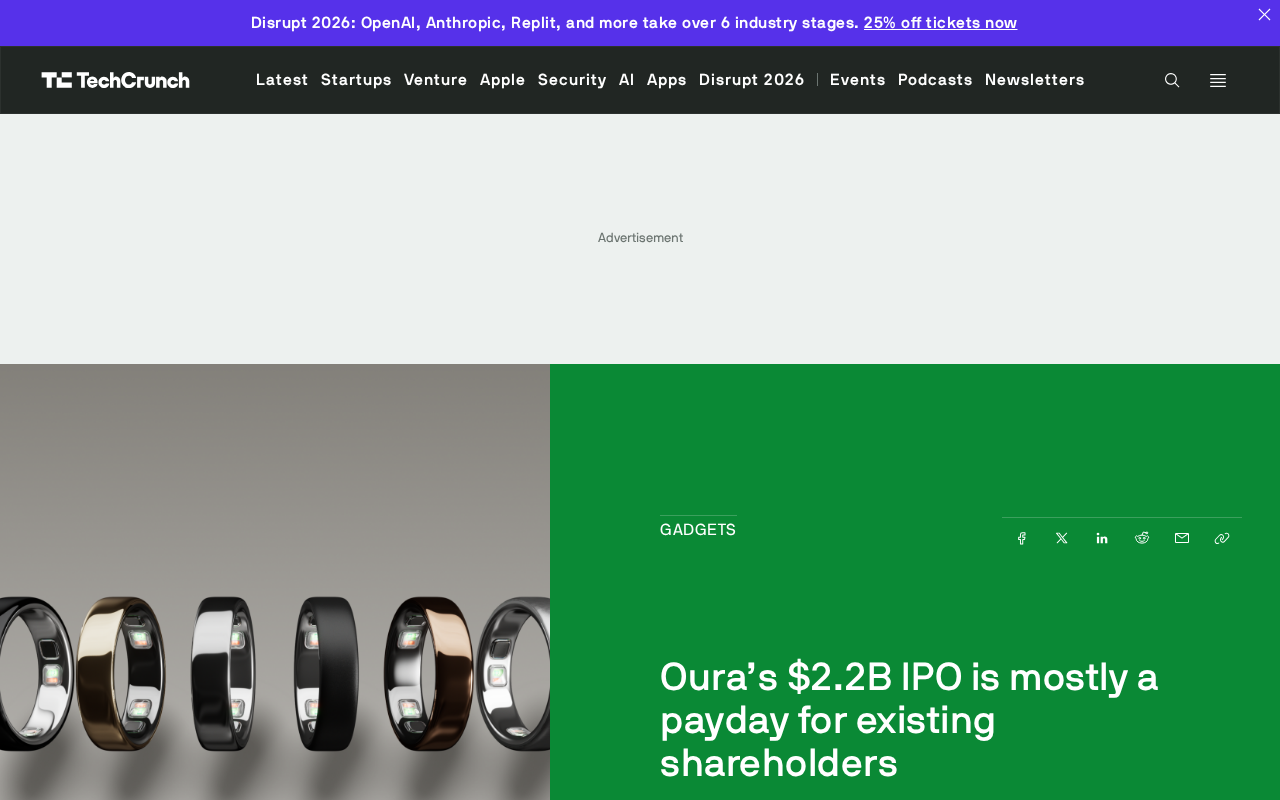
The latest IPO filing from Oura, maker of the popular smart ring, reveals a telling detail: this roughly $2.2 billion public offering is less about injecting fresh capital into the company and more about giving existing shareholders a lucrative exit.
According to Oura's most recent IPO filing, early investor Forerunner Ventures plans to sell its entire stake in the company, cashing out up to $1.26 billion. That figure represents a substantial portion of the overall $2.2 billion raise — and it meaningfully changes the character of this IPO.
Primary vs. Secondary Offerings: Why the Distinction Matters
The key to understanding this IPO lies in the difference between a primary offering and a secondary offering.
In a typical IPO, the company issues new shares to raise capital. That money flows into company coffers to fund R&D, market expansion, or debt repayment. But when a significant portion of the raise comes from existing shareholders selling their old shares, that money goes into investors' and early backers' pockets — the company itself receives no usable operating cash.
Forerunner Ventures choosing a full exit signals that the firm views the current valuation as the ideal moment to leave the table. For a smart wearable company, having a major institutional backer cash out entirely at the IPO stage tends to invite closer scrutiny of the company's future growth prospects.
It's worth noting that mixed structures — combining new share issuance with secondary sales — are common in tech IPOs. The ratio is what matters. Snowflake's 2020 IPO, for example, was primarily a primary offering, leaving the company flush with cash for expansion. Instacart's 2023 IPO, by contrast, skewed heavily toward secondary sales and drew similar questions about the company's growth trajectory. To gauge an IPO's real significance for a company's operations, the "Use of Proceeds" section of the prospectus is your clearest guide. It spells out exactly where the new-share proceeds will go and what proportion represents selling shareholders' gains — the most direct way to tell whether an IPO is genuinely "fueling" the company.
What This Means for Oura
For Oura, the IPO itself is a milestone capital event — it boosts brand visibility, strengthens channel negotiating power, and provides liquidity for employee equity. But if the offering structure is weighted toward insider cash-outs, the company retains relatively little fresh ammunition for growth.
In the fiercely competitive smart wearable market, Oura faces pressure from Apple, Samsung, and a crowded field of health-tracking device makers. Sustained R&D investment and consumer education both require significant funding. An IPO centered on shareholder liquidity may not deliver the robust cash reserves the market might expect.
Oura's current business model runs on two revenue streams — hardware sales and subscription services. After purchasing the ring, users must pay a monthly or annual membership fee to unlock full health data analytics. This "hardware + SaaS" model theoretically generates more stable annual recurring revenue (ARR) and justifies a higher valuation multiple. However, scaling a subscription business depends heavily on continuous investment in user acquisition and retention — and that requires generous marketing and R&D budgets. If available fresh capital post-IPO is limited, Oura could find itself at a disadvantage on user acquisition costs when competing against Apple Watch and Samsung Galaxy Ring, both of which bundle health features for free.
What Investors Should Take Away
This case is a reminder for prospective public market investors: when evaluating an IPO, don't just look at the headline valuation and total raise. Read the filing carefully for disclosures on use of proceeds and the source of shares being sold.
Whether the raise represents "new blood" for the company or simply a "change of hands" has a direct bearing on its financial strength and growth trajectory post-listing. When core early investors choose to exit in full, that signal deserves careful consideration from anyone thinking about buying in.
Note: This article is based on publicly disclosed information in Oura's latest IPO filing. Source reporting details are limited; refer to the official filing for definitive transaction terms.
In the IPO analysis framework, the lock-up period for insider shares is another risk indicator closely tied to secondary offerings. Typically, insiders face a 90-to-180-day lock-up after the IPO, after which large sell-offs can weigh on the stock price. But if core shareholders have already liquidated through secondary sales during the IPO itself, they don't need to wait for the lock-up to expire — which reduces the overhang risk when the lock-up ends, but also eliminates an important market signal that insiders believe in the company's future. Public market investors participating in such an IPO are, in effect, absorbing the positions of early institutional investors, with a significant information asymmetry between the two sides on how they value the company.
Related articles

CSS Anchor Positioning: A New UI Positioning Approach Without JavaScript
A deep dive into CSS Anchor Positioning: from anchor-name and position-anchor to the anchor() function, position-area shorthand, position-try-fallbacks, anchor-size, and upcoming anchor queries.

New AI Chart Interaction: Continuous Follow-up Questions and Visualization in Conversation
Explore a new AI interaction method for continuously generating charts in conversation. Use the /visualize command to ask follow-up questions and visualize answers in the same chat window, improving data analysis efficiency.

Cursor Merges Into X Subscription: Paid Plans Share Unified Usage Pool, Grok Model Coding Usage Doubled
Cursor joins The X Subscription with a unified usage pool and doubled Grok coding quota. Third-party models shift to API pricing. Existing users can keep or migrate plans.