Deconstructing DeepSeek Super Agent: The Real Power Isn't AI Directing AI

DeepSeek Super Agent is a research prototype using a two-layer Router-Worker architecture and three-stage filtering to save human attention.
DeepSeek's Super Agent is not an official product but a research prototype, explicitly labeled for reference only. Its core value isn't the 'AI directing AI' gimmick, but using a minimalist two-layer architecture (Router and Worker) to free human attention from the message flood. The Router receives messages, records context, and dispatches work without writing code; the Worker independently handles each ticket with its own environment and full toolset. Messages pass through three filters (source, authorization, model judgment) to eliminate noise. Ticket Direct Pass routes follow-up messages directly to the Worker, cutting Router decisions by ~30% and token consumption by ~37%. Task completion time's 95th percentile dropped from 29.5 to 15.7 minutes, though this only measures scheduling, not code quality. The article also notes unimplemented features like speculative execution and chain memory, emphasizing the first principle: exchange the least human attention for the greatest value.
DeepSeek's Super Agent has recently been interpreted by many media outlets as a "brand-new Agent architecture release," but the first line of the official README states: research prototype, for reference only, not an official DeepSeek product. The code implements part of it; the article describes the direction. Treating a roadmap as a delivered product is a different matter entirely.
What's truly worth examining isn't the gimmick of "AI directing AI," but how it uses a single layer of architecture to pull human attention out of the message flood.
Only Two Layers: Router and Worker
Super Agent's architecture is remarkably restrained—only two layers: Router and Worker. The Router is responsible for receiving messages from the front end, recording context, and dispatching work; it doesn't write code. In the code, the main orchestration has 14 application tools, but no Write, Edit, Blob, Grab, and no Subagent. The Worker, on the other hand, takes on each ticket: an independent orchestration, an independent directory, a complete set of engineering tools.
One decides what to do, the other actually gets it done. Clear boundaries of responsibility actually make the system more stable.
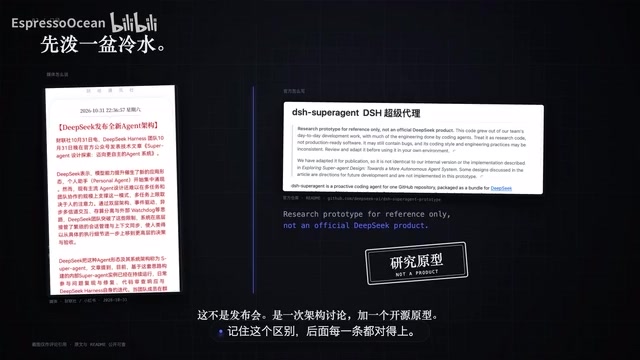
Router–Worker pattern in multi-agent architectures: This is a common task orchestration paradigm whose core idea is separating "decision-making" from "execution." The Router (also called Orchestrator or Dispatcher) receives raw input, maintains context, determines intent, and assigns tasks—typically without directly operating business tools; the Worker receives specific tickets and completes tasks in an isolated environment using the full toolset. The benefits of this layering are single responsibility, fault isolation, and easy horizontal scaling, but it also introduces communication overhead and state synchronization issues. Compared with early monolithic Agents, the Router–Worker pattern is closer to the "scheduler–executor" model in distributed systems, making it suitable for handling high-concurrency, multi-source request streams.
Three Filters Before Messages Enter
The real bulk lies before messages even enter. In experiments, a round has roughly 300 messages, of which only 20 are work requests. The first programmatic filter checks the source: is this group, this repository, this person within scope? The second policy filter checks authorization: are they on the list, are they subject to @ rules and disallowed? Only the third falls to the model to judge whether the message is actually work.
After three gates, the vast majority of noise never reaches the model. This isn't a prompting trick—it's code work.
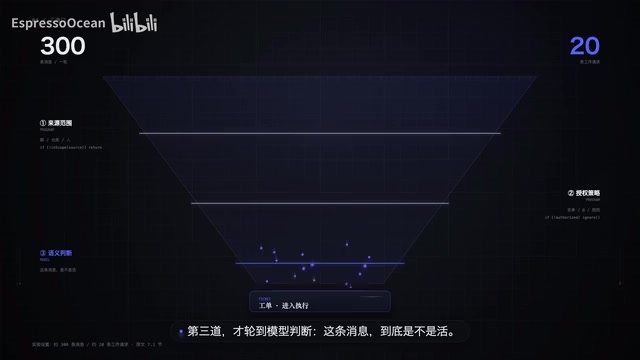
Hybrid filtering combining rule engines and model judgment: Before messages enter the Agent system, programmatic rules (such as source whitelists, authorization lists, @ rules) perform rapid screening, and only messages suspected to be work requests are handed to the model for judgment. This "rules first, model as fallback" design significantly reduces model invocation counts and token consumption while preventing the model from being disturbed by noise. The rule engine handles deterministic, auditable filtering; the model handles fuzzy semantic judgment—the two complement each other. This pattern is common in industrial-grade Agent systems, especially in scenarios with high message volume and high noise ratios.
Ticket Direct Pass: What's Saved Is an Entire Detour
After a ticket is accepted, does every subsequent message still need to go back to the Router? No. The ticket subscribes to the Fred it appears in, and subsequent comments and CI results go directly to the Worker. DeepSeekAd ran a controlled experiment with direct pass removed: completion time was similar, but the Router's decision count increased by about 30%, and unique cached tokens rose from 23.23 million to 31.77 million—an increase of about 37%.
What's saved isn't a prompt—it's an entire detour. Each ticket is an independent office: independent orchestration, independent directory, independent branch and PR. If it crashes, you return to this same office, not to the jungle to start over.
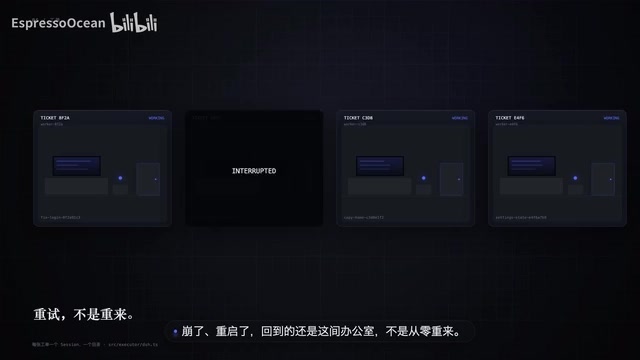
There's another easily misunderstood point: the Worker saying Ready doesn't mean the job is done. Tickets with PRs aren't finished until the PR is merged or closed. It hands off delivery to real acceptance.
Ticket Direct Pass and context isolation: In traditional multi-agent systems, all messages first pass through the Router before being forwarded to Workers, causing the Router to repeatedly process follow-up messages for the same ticket, increasing decision counts and token consumption. Ticket Direct Pass allows Workers to directly subscribe to subsequent events related to their tickets (such as comments and CI results), bypassing the Router and thus reducing routing overhead. Meanwhile, each ticket has an independent runtime environment (directory, branch, PR), achieving fault isolation and state independence, preventing one task's crash from affecting others. This design borrows from the "event-driven" and "bulkhead" concepts in microservices.
Faster, But Not "Double the Efficiency"
In experiments running each approach 5 times on synthetic attachments, the 95th percentile of task completion time dropped from 29.5 minutes to 15.7 minutes. Note that this only measures scheduling and collaboration, not code quality. So don't write it up as doubling efficiency. It doesn't make AI better at writing code; it makes multiple things advancing simultaneously less likely to get stuck at your desk.
What's Not in the Code
The speculative execution, one-step ReAct chain memory, and external watchdog described in the article are not implemented in this open-source prototype. It has concurrency but no advance speculation, background tasks but no one-step ReAct loop, health checks but no in-city watchdog, and no cross-ticket long-term memory.
This isn't to say the research prototype is bad—a research prototype by definition isn't a product—but treating a roadmap as a delivered product is another matter.
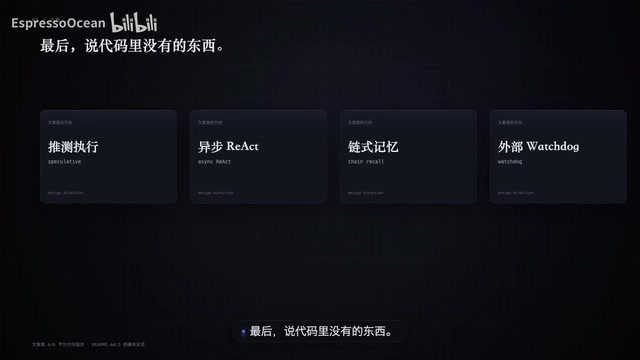
The gap between research prototypes and product delivery: The official README explicitly labels it a "research prototype, for reference only," meaning the code implements partial capabilities while the article may describe a future roadmap. Research prototypes are typically used to validate architectural ideas and conduct controlled experiments, but lack product-grade stability, security, and complete functionality. Common gaps include: missing advanced features such as speculative execution, chain memory, and external monitoring; not tested in large-scale production environments; documentation and interfaces may be incomplete. Readers need to distinguish "implemented" from "planned" to avoid mistaking a roadmap for delivered results.
First Principle: Exchange the Least Human Attention for the Greatest Value
So what DeepSeek is really doing is: turning a person's request to an Agent into an authorized ticket, placing it in an isolated room, and only coming back to you when it's worth it. Its first principle is written in the README—exchange the least human attention for the greatest value.
Compute will get cheaper, models will get stronger—only your attention won't increase. What sets you apart in the future may not be how well you use AI, but whether you can preserve your own attention. Do you manage AI, or does AI own you?
One-line Summary
DeepSeek Super Agent is a research prototype that uses a two-layer Router-Worker architecture and three-stage filtering to save human attention.
Paragraph Summary
DeepSeek's Super Agent is not an official product but a research prototype, explicitly labeled for reference only in the official README. Its core value isn't the "AI directing AI" gimmick, but using a minimalist two-layer architecture (Router and Worker) to free human attention from the message flood. The Router receives messages, records context, and dispatches work without writing code; the Worker independently takes on each ticket with its own environment and full toolset. Before messages enter, they pass through three filters (source, authorization, model judgment), eliminating the vast majority of noise. The Ticket Direct Pass mechanism routes subsequent messages directly to the Worker, bypassing the Router—controlled experiments show about 30% fewer Router decisions and about 37% lower token consumption. The 95th percentile of task completion time dropped from 29.5 to 15.7 minutes, but this only measures scheduling collaboration, not code quality. The article also clarifies that speculative execution, chain memory, and other features are not implemented in the code, emphasizing that the first principle is to exchange the least human attention for the greatest value.
Related articles

Deleted Reddit Post Sparks Debate Over AI Content Moderation
A Reddit post removed with only a 'Removed by Reddit' notice highlights AI content moderation's transparency gaps, misjudgment risks, and appeal challenges for platforms and creators.

DSH + Ollama Local LLM Deployment in Practice: Free Chat with Da Fei Yu
Bilibili creator tests DSH + Ollama local LLM deployment end to end: Ollama install, Xunlei-accelerated downloads, ModelScope GGUF model import, DSH custom API address setup, and a comparison of Qwen 3.5 4B, 8B, Gemma, and other models on 8GB VRAM, with advice on choosing local deployment vs. API calls.

Tested: A $899 Mac Mini vs. a $200/Month AI Subscription
Real-world test of whether an M4 Mac mini can replace a $200 AI subscription: 16GB can't fit large models, and both speed and quality fall short—but privacy, no caps, and near-zero running costs make it an ideal host for an always-on agent. Includes buying advice per configuration and money-saving strategies.