Deep Dive into Claude Fable 5 and Mythos 5: A Dual-Track Distribution Strategy from a Single Source Model
Anthropic's Fable 5 and Mythos 5 pioneer a single-model, dual-track safety distribution paradigm for frontier AI.
Anthropic released Claude Fable 5 and Mythos 5 — two deployment configurations of the same model with different safety levels. Fable 5 is publicly available with full guardrails, while Mythos 5 is restricted to vetted government and defense institutions. Fable 5 leads benchmarks in coding, vision, and reasoning efficiency, while Mythos 5 delivers breakthrough capabilities in cybersecurity, drug discovery, and genomics. This tiered distribution model may become the industry standard for managing frontier AI capabilities.
One Model, Two Faces
Anthopic officially released its next-generation flagship model, Claude Fable 5, on June 9 — just 11 days after the launch of the previous-generation Opus 4.8. Interestingly, three days after launch, official access was temporarily suspended and wasn't restored until July 1 — an unusual episode that itself hints at the complexity behind this release.
Fable 5 and Mythos 5 are not two separate models but rather two deployment configurations of the same underlying model with different safety policies. Fable 5 comes with full safety guardrails and is available to the public; Mythos 5 has certain restrictions removed and is delivered exclusively to government agencies, critical infrastructure organizations, and cyber defense entities after rigorous vetting. This "single-source, dual-track" distribution strategy represents a new paradigm worth analyzing closely on the frontier AI commercialization path.
In the traditional software industry, the distinction between enterprise and consumer editions is primarily based on feature set differences (e.g., Microsoft Office Home vs. Professional). But the Fable 5/Mythos 5 "single-source, dual-track" model is fundamentally different: it's not about feature trimming but safety policy trimming. The underlying model is identical — the only difference lies in the level of safety guardrails applied at deployment. This approach is the first systematic implementation of its kind in the AI industry. Its underlying logic stems from the "dual-use" nature of frontier AI models — the same capability can be used for both defense and offense — which closely parallels the control logic applied to nuclear and biotechnology.
Claude Fable 5: Hard Performance Numbers
Coding: The More Complex the Task, the Greater the Lead
Fable 5 claimed the top spot across mainstream coding benchmarks including SWE-bench. The official team particularly emphasized one pattern: the longer and more complex the task, the greater the lead. This isn't coincidental — it reflects a structural advantage in the model's architecture for long-context reasoning.
SWE-bench is a software engineering benchmark developed by a Princeton University research team, specifically designed to evaluate AI models' ability to solve real issues from actual GitHub repositories. Unlike traditional coding problems, SWE-bench requires models to understand the context of large codebases, locate the files containing bugs, and generate correct patches. The test set includes thousands of real problems from well-known open-source projects like Django, scikit-learn, and sympy. The reason this benchmark is considered the "gold standard" for coding ability is that it reflects not isolated algorithmic problem-solving but engineering-grade code comprehension and modification.
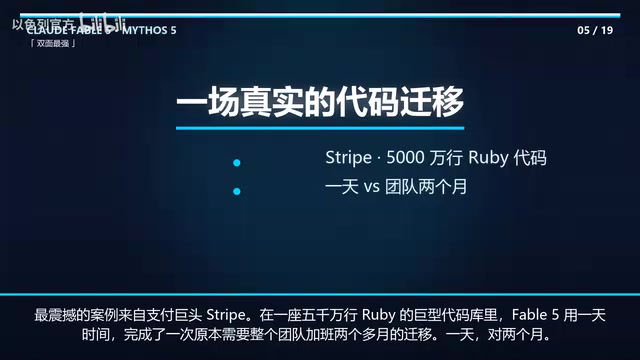
The most compelling case study comes from payment giant Stripe: in a massive codebase containing 50 million lines of Ruby code, Fable 5 completed in one day a migration task that would have taken an entire team more than two months of overtime. Stripe, as one of the world's largest online payment infrastructure companies, has its core systems heavily written in Ruby. A codebase of 50 million lines indicates an extremely large monorepo with incredibly complex interdependencies. Traditional code migration work (such as API version upgrades, framework migrations, dependency replacements) requires engineers to individually understand the contextual semantics of each call site to ensure modifications don't trigger cascading failures. Compressing two months of team effort into a single day fundamentally requires the model to "see" large volumes of interrelated code files simultaneously within an ultra-long context window while maintaining cross-file semantic consistency.
On Cognition's Frontier Code benchmark, Fable 5 scored first among all frontier models even with only medium reasoning intensity enabled — meaning its competitiveness isn't simply a matter of throwing more compute at the problem. Cognition is the company behind the AI software engineer Devin, and its Frontier Code benchmark targets high-difficulty programming tasks requiring multi-step reasoning, cross-file comprehension, and complex debugging. "Reasoning intensity" refers to the degree of internal Chain-of-Thought computation the model performs before generating an answer — high reasoning intensity means consuming more compute resources and tokens for "deliberation," while low intensity means giving quick answers. Fable 5 winning the top spot at medium reasoning intensity shows that its foundational capability layer already holds an advantage, without needing extensive additional reasoning computation to compensate for capability gaps — a finding with major implications for cost control in real-world deployment.
Vision and Multimodal: From Scientific Charts to Game Completion
Anthopic directly positioned Fable 5 as the "next-generation state-of-the-art model for visual tasks." Its specific capabilities include: precisely reading values from scientific charts and rebuilding web application source code from a single screenshot. An even more impressive demonstration was the model completing the game Pokémon: FireRed using visual input alone.
Reasoning Efficiency: Higher Performance with Fewer Tokens
On physics research tasks, Fable 5 consumed only one-third of the reasoning tokens and in 36 hours nearly solved problems that GPT-5.5 needed four days to reach.
Reasoning tokens refer to the number of tokens consumed during the model's internal "thinking" process before producing its final output. Since OpenAI's o1 model pioneered the "test-time compute" paradigm, the industry has broadly faced a dilemma: stronger reasoning ability often means exponentially growing token consumption and latency. Fable 5 achieving near GPT-5.5 results with only one-third the tokens suggests Anthropic may have achieved a breakthrough in reasoning architecture efficiency — either through more refined chains of thought or through better judgment of when the model can "stop thinking" and give an answer directly.

Efficiency and capability improving in tandem rather than trading off against each other — this is one of Fable 5's most noteworthy technical characteristics.
Long-Context Memory: The Multiplier Effect of Persistent File Memory
Fable 5 supports million-token-level context and can leverage self-generated notes to improve response quality. A million-token context window means the model can process approximately 750,000 English words in a single session — equivalent to about 10-15 books. But the context window alone only solves the "how far can it see" problem; it doesn't automatically solve "how long can it remember." Persistent file memory is a mechanism introduced by Anthropic: during long-term task execution, the model autonomously generates structured notes, writes key information to external files, and can retrieve and reference them at any time. This is similar to humans taking notes during extended work sessions, addressing the inherent limitation of attention decay over distance in Transformer architectures.
In testing with the strategy game Slay the Spire, persistent file memory delivered performance improvements three times greater than Opus 4.8. Slay the Spire is a deck-building card game that requires accumulating strategic experience across hundreds of turns, making it a task type where persistent file memory is particularly valuable. This data point means that as task duration increases, the compounding effect of the memory mechanism significantly widens the gap between models.
Mythos 5: Top-Tier Capabilities for Institutions Only
Cybersecurity: Officially Certified as the World's Strongest
Anthopic gave Mythos 5 a single official descriptor: the world's strongest cybersecurity capabilities. This version is deployed to government agencies, critical infrastructure, and cyber defense organizations through the "Glass-1" program, and is not available to regular users.
The core logic of the Glass-1 program is: the most powerful AI capabilities shouldn't be completely locked away (otherwise defensive organizations can't use them either), but they also shouldn't be released indiscriminately (otherwise attackers benefit equally). Therefore, top-tier capabilities are delivered to defensive institutions through rigorous organizational qualification reviews. This model bears similarities to the U.S. Department of Defense's tiered authorization system for selling military technology to allies (such as ITAR — International Traffic in Arms Regulations), reflecting how frontier AI capabilities are being incorporated into control frameworks similar to those for defense technology.
Biology and Drug Development: 10x Acceleration
Mythos 5 accelerated internal drug design workflows by approximately tenfold. In tests across 14 protein targets, 9 yielded strong candidate molecules, with some tasks matching or exceeding the level of professional researchers.
Traditional drug development from target discovery to candidate molecule confirmation typically takes 3-5 years and costs hundreds of millions of dollars. AI's value in this pipeline primarily manifests in three stages: target validation (determining whether a protein is worth developing drugs for), molecular design (generating compound structures that can bind to the target), and lead compound optimization (adjusting molecular structure to improve efficacy and safety). Mythos 5 producing strong candidate molecules for 9 out of 14 protein targets represents a success rate of approximately 64%, far exceeding the typical 10-20% hit rate of traditional computational chemistry methods.
More critically, Mythos 5 is the first model in the Claude series capable of consistently proposing novel scientific hypotheses. In blind tests, scientists preferred its molecular biology hypotheses approximately 80% of the time. One mechanism proposed by the model regarding an E. coli protein has been independently verified by a laboratory. This means the model can not only search within known chemical space but can also propose biological mechanisms that human researchers haven't yet considered — a critical watershed in the transition from "tool" to "research partner."
Genomics: One Week of Autonomous Work Outperforms Top-Journal Models
Mythos 5 worked autonomously for an entire week, assembling a single-cell dataset encompassing 138 samples and millions of cells.
Single-cell RNA sequencing (scRNA-seq) technology allows researchers to analyze gene expression at the individual cell level and is one of the most important tools in modern biology. However, processing datasets with millions of cells is extremely complex, involving data cleaning, batch effect correction, cell type annotation, dimensionality reduction visualization, and numerous other steps. Mythos 5 autonomously completed this entire pipeline, demonstrating bioinformatics comprehension far beyond traditional automated workflows.

A model trained on this dataset outperformed a model published in the top journal Science — despite being 100 times smaller in parameter count. This detail is particularly noteworthy: being 100 times smaller in parameters yet achieving superior performance suggests that Mythos 5's core advantage lies not in brute-force parameter scaling but in the intelligence of data curation and feature selection. Small parameters, high-quality data, and strong hypothesis generation — the combination of these three may be redefining the boundaries of what's possible in AI-assisted scientific research — not just accelerating existing workflows, but finding superior methodological paths.
The Engineering Implementation of Fable 5's Safety Guardrails
Fable 5's safety mechanism isn't simple keyword filtering but rather an automatic downgrade system. When requests involve offensive cybersecurity, biochemically sensitive content, or model distillation scenarios, the system automatically switches to Opus 4.8 for processing. Official data shows that on average, fewer than 5% of conversations trigger this mechanism.
This automatic downgrade mechanism is known in engineering as "tiered response." It works as follows: a front-end safety classifier evaluates the risk level of each request in real time, and when it detects that a request falls into predefined sensitive categories, it routes the request to the less capable but safer Opus 4.8 model. Compared to traditional "direct refusal" strategies (such as returning "I cannot answer this question"), user experience is significantly better — users still receive useful responses, just from a slightly less capable model. Notably, "model distillation" is listed as one of the sensitive scenarios, meaning Anthropic treats competitors' attempts to extract Fable 5's knowledge through API calls to train their own models as a security threat on par with cyberattacks.
This design strikes an engineering-level balance between user experience and safety: it avoids making regular users feel overly restricted while maintaining controllable boundaries in critical sensitive scenarios.
Business Strategy: Dual Signals from Pricing and Funding
Fable 5 is priced at $10 input / $50 output (per million tokens), less than half the price of the Mythos preview version.

On the funding front, Anthropic just completed a $65 billion fundraise at a valuation approaching $965 billion. A $965 billion valuation puts Anthropic on the doorstep of the trillion-dollar club, alongside tech giants like Apple and Microsoft. For reference, OpenAI's latest funding round valued it at approximately $300 billion, and Google DeepMind has no independent valuation as an Alphabet subsidiary. A single-round raise of $65 billion is virtually unprecedented in global tech history, reflecting capital markets' strong endorsement of the "safety-first AI company" narrative. The core uses of this funding are expected to include: large-scale GPU cluster procurement (for training next-generation models), talent acquisition (annual compensation for frontier AI researchers has reached millions of dollars), and building government relationship networks to facilitate distribution channels for Mythos-class products.
Capability tiering + price tiering + capital-driven momentum — together, these three elements form the business logic framework behind this release.
It's worth noting that just five days before the Fable 5 release, Anthropic published a call for a global pause on frontier AI development, then turned around and released its most powerful model ever, followed by the brief post-launch suspension and restoration — this sequence of events sparked widespread industry discussion about the tension between AI companies' safety rhetoric and commercial advancement. Supporters argue that Anthropic's position has always been "responsible advancement" rather than "complete halt" — the pause call targeted development lacking safety measures, while the tiered distribution of Fable 5/Mythos 5 is precisely a practical example of "responsible advancement." Critics counter that in a white-hot competitive market, calling for a pause may be more of a competitive tactic: if competitors actually pause, Anthropic has already released a stronger model. This tension is not unique to Anthropic but a shared predicament for all frontier AI companies caught in a prisoner's dilemma structure.
Tiered Distribution: Potentially Becoming an Industry Standard
The truly noteworthy signal from this release isn't just "strongest" — it's tiered. Splitting a single underlying model into two versions by safety level and distributing them to different audiences — this framework is highly replicable across technical, commercial, and regulatory dimensions.
For regular developers, Fable 5 is accessible directly via API; Pro/Max subscribers enjoyed a free trial window from June 9-22, transitioning to usage-based billing afterward. Mythos 5 remains unavailable to regular users and requires institutional application channels for access.
Against the backdrop of rapidly iterating AI capabilities, a distribution model based on "tiering by safety level, authorizing by institutional qualification" may be emerging as the standard approach for leading AI companies to manage the tension between frontier capabilities and public safety. The deeper significance of this model lies in transforming AI safety from a purely technical question (how to make models safer) into an institutional design question (who is qualified to use what level of capability), providing a reference point of commercial practice for potential future AI regulatory legislation.
Key Takeaways
Related articles
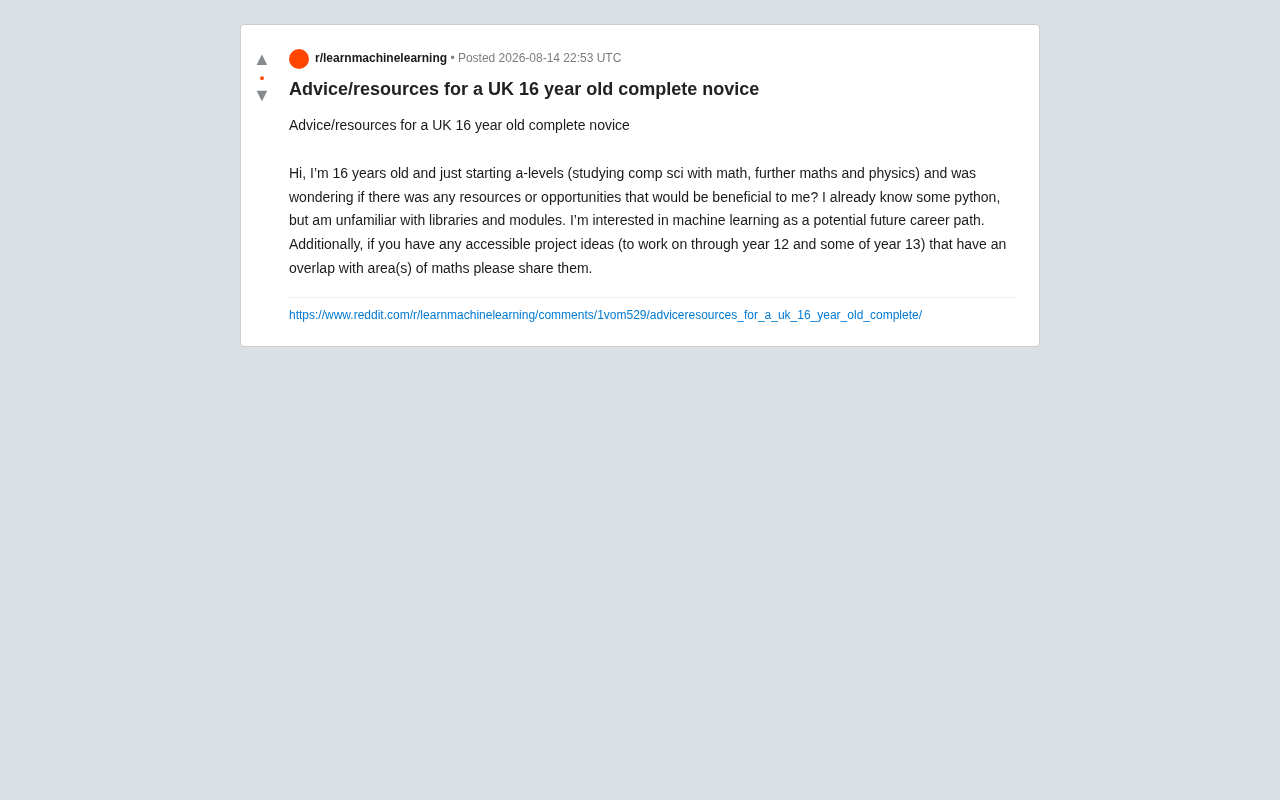
Getting Started with Machine Learning at 16: A Complete Learning Path from Zero to Hands-On Practice
How can a 16-year-old UK A-Level student get started with machine learning from scratch? A clear learning path covering Python basics, math connections, resources, and hands-on project ideas.
Building a GitHub Action Text Replacement Tool with JavaScript: From Principles to Practice
Learn how to build a GitHub Action for text replacement with JavaScript, covering implementation principles, use cases, and key technical details for CI/CD automation.

Coze Beginner's Guide: A Complete Cognitive Guide to Building AI Agents from Scratch
Learn what ByteDance's Coze platform is, key differences between domestic and international versions, how to use GPT-4 for free, and how to build AI Bots with zero coding experience.