Deep Dive into Cursor Origin: Why an AI Editor Is Building a Code Hosting Platform

Cursor launches Origin to control the full pipeline from Agent code generation to repository merge.
Cursor's new product Origin positions itself as a Git platform for the Agent era, aiming to own the end-to-end pipeline from task dispatch to code merge. This article analyzes why code hosting is the real bottleneck for AI Agents, how Origin eliminates network round-trips, its security and audit requirements, and provides a three-phase migration strategy for engineering teams.
Cursor Doesn't Want to Be Just an Editor Anymore
Cursor recently launched a new product called Origin, with an official positioning that hits the nail on the head — a Git platform built for the Agent era. It specifically emphasizes the ability to sync repositories from GitHub, with a focus on speed and deep integration. According to an in-depth breakdown by Chinese tech YouTuber "Why Called QQ," this move deserves more attention than releasing yet another coding model.
A model can only handle a piece of code, but a code hosting platform controls every commit, Code Review, test, and merge — it's the master valve of software delivery. Cursor clearly isn't satisfied with being just an IDE; its goal is to plug Agent-written code directly into a team's delivery pipeline. For programmers, the evaluation going forward won't just be about an editor, but an entirely new engineering control plane. After all, the repository is the Single Source of Truth that every Agent must pull from — no matter how many Agents work in parallel, they must ultimately defer to the latest state in the repository. This is a fundamental principle for ensuring consistency in distributed systems.
Public information is still scarce: Origin was briefly mentioned at the Compile conference in June, when it was still in the Waitlist stage; on August 17, the official announcement came, but the website still requires queuing up. This feels more like a gray-scale test than a full launch — feature lists, pricing, regional availability, and migration tools haven't been fully revealed yet.
The Real Moat of Code Hosting Isn't the Git Protocol Itself
Many people think code hosting is just setting up a Git server — that's thinking too small. Git itself is merely a distributed version control protocol, created by Linus Torvalds in 2005 to manage Linux kernel development. Its core design is decentralized — every developer's local repository contains the complete version history; just pull a clone, configure a few remotes, and you're done. What truly binds teams to a platform is the collaboration chain beyond Git.
Work retention relies on discussion records, merging relies on PRs and branch rules, and running CI/CD requires Status Checks — where the platform mandates that a series of automated checks all pass before allowing code to merge, including unit tests, integration tests, code style, and security scans. Extending outward, there are Webhooks (HTTP callback mechanisms where the platform pushes event notifications to external systems), Issues, and audit logs. Changing a Git remote address takes minutes, but seamlessly migrating the entire "organizational memory" — that's the system engineering headache. For Origin to enter production environments, this is an unavoidable hard problem — the remote is just the entry point; governance rules are the foundation of production order.
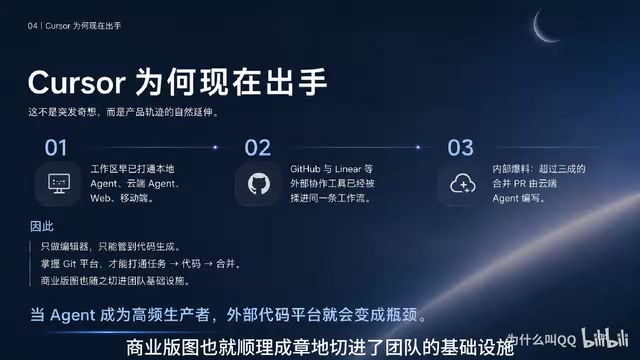
Looking at Cursor's product trajectory, there were already signs. They had previously combined local Agent, cloud Agent, Web, mobile, and even GitHub and Linear (a project management tool known for its lightning-fast response and keyboard-first design, chosen by many technical teams as a Jira alternative) into a single workspace. Internal sources have even revealed that over 30% of merged PRs were written by cloud Agents. Once this percentage continues to rise, external code platforms become a high-frequency bottleneck — branching, pushing code, checking CI, and handling permissions all require cross-platform operations. Only by controlling the Git platform can Cursor build an end-to-end pipeline from task dispatch to code merge.
The Rhythm Gap Between Agents and Humans Is Origin's Entry Point
Current code hosting workflows are entirely designed around human rhythms: pick up a requirement, create a branch, code for a few hours, push a batch, and reviewers take their time reading context. But Agents operate at a completely different tempo — a single task can spawn multiple parallel approaches, each creating workspaces, modifying code, and running unit tests. Humans haven't gotten faster, but candidate changes have multiplied exponentially. Repositories will quickly be flooded with short-lived branches, redundant batch runs, and conflicting PRs.
In traditional development, a code platform is just a code repository; but in Agent workflows, it's being forcefully pushed into the position of a control plane. The term "control plane" borrows from Kubernetes container orchestration architecture — in K8s, the control plane handles global scheduling decisions (deciding which node a Pod runs on) and event responses (detecting anomalies and auto-recovering), while the data plane executes actual workloads. Mapping this to code hosting: traditional repositories are equivalent to the data plane, only managing storage of code objects; what Origin aims to be is the control plane role, orchestrating Agents' change behaviors. When a task is dispatched, the platform must select execution environments, issue temporary tokens, and lock the baseline; when an Agent finishes, the platform must record which model it used and what tool permissions it had; with multiple Agents running concurrently, it must prevent them from modifying the same code segment (similar to optimistic or pessimistic locking strategies in databases). This workflow closely resembles container platform scheduling — the repository stores code objects, the control plane orchestrates change objects, and whoever controls this event chain determines how much work Agents can accomplish.
Eliminating Network Round-trips Is Origin's Core Technical Value
Currently, Agents chew through code in the IDE but still have to cross platforms to fetch PR comments and CI errors, often getting stale context. This problem is known in distributed systems as the "cache coherency" challenge — there's a time gap between the Agent's locally cached code state and the remote repository's actual state, and this gap is dramatically amplified in multi-Agent concurrent scenarios. A single CI red light might trigger re-fetching, fixing, refactoring, and committing, and once this cycle is interrupted, the cost is extremely high. To humans, it's just a few mouse clicks; behind the scenes, the system runs N rounds of authentication (OAuth token refresh, API Rate Limit checks) and context synchronization. The more fragmented the context, the lower the cache hit rate, and the harder error recovery becomes.

Origin's core value through deep integration with Cursor is likely eliminating these network round-trip costs: repository events reach Agent state directly (similar to the Event Sourcing pattern in event-driven architecture), and review comments are directly bound to specific commits. One dirty read wastes an entire reasoning cycle's compute — for Agents using Claude or GPT-4 level models, a single erroneous reasoning step could waste several dollars in API call costs.
Furthermore, once Agents join at scale, PRs must evolve from "written for humans to read" to "machine-readable protocols" — they need to declare task origins, permission boundaries, and execution evidence: which ones passed real tests, which were only flagged by static analysis, all must be crystal clear; abandoned trial approaches must also be preserved so the next Agent doesn't repeat mistakes. This thinking aligns closely with the SLSA framework (Supply-chain Levels for Software Artifacts) in software supply chain security, which similarly requires verifiable provenance proofs for every build artifact. The most reliable engineering practice is to make evidence into structured objects — execution commands, exit codes, and log summaries all independently verifiable, similar to the design principle in blockchain where each block can be independently verified.
Security, Identity, and Audit: New Thresholds for the Agent Era
The cost of having Agents write code has become dirt cheap, but safely merging code into the main branch remains expensive. GitHub can enforce checks and code scanning (like CodeQL static analysis, Dependabot dependency vulnerability scanning), and Agent platforms must at least match these gatekeeping capabilities while strictly enforcing the identity boundary between humans and machines — an Agent that can edit documentation absolutely should not be able to touch payment logic. This is a direct application of the "Principle of Least Privilege" in security engineering: every executing entity should only be granted the minimum set of permissions required to complete its specific task.
Normally everyone uses Git with fixed accounts, but Agents are everywhere, and the models behind them change constantly. If everything is attributed to a single bot account, tracing back after an incident becomes a disaster. A production-grade platform must be able to trace back to the specific triggering task, authorizing person, execution environment, and model version, with temporary Tokens strictly bound to specific repositories and branches. The temporary Token design here draws from short-lived credential practices in cloud computing — like AWS's STS (Security Token Service) which generates temporary credentials valid for 15 minutes to 12 hours, with strictly limited permission Scopes. GitHub App Installation Tokens are valid for only 1 hour; Origin needs to additionally bind Tokens to specific task IDs and model versions for even finer-grained access control. In the product, there are still corners to address: audit exports, Single Sign-On (SSO), and automated revocation across the board. The compliance threshold is always an order of magnitude higher than that of an editor.
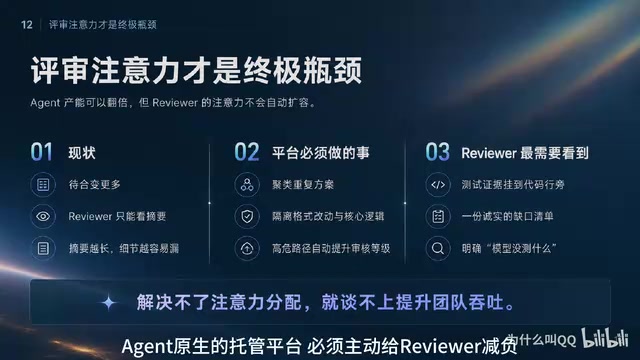
Additionally, reviewer attention is a scarce resource. An Agent-native platform must proactively reduce this burden: cluster duplicate solutions (similar to deduplication and similarity matching in machine learning, grouping similar solutions generated by multiple Agents and only displaying the best or most representative one), strictly isolate pure formatting changes from core logic, automatically escalate review levels for high-risk paths, and attach test evidence directly next to specific code lines. What reviewers most need to see is an honest "gap list" of what wasn't tested.
Migration Costs and Practical Advice for Engineers
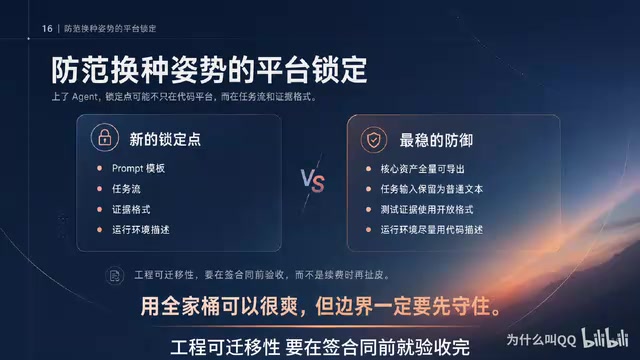
No repository is an island — peripherals often include Actions (GitHub's CI/CD automation engine that defines workflows through YAML files), self-hosted Runners (executors that run CI tasks on your own servers), artifact registries (like Docker image registries, npm package registries), and notification bots. Origin can pull Git commits, but these dependencies won't migrate themselves. Fortunately, Git's underlying distributed design leaves an escape route: a full clone carries history and naturally supports multiple remotes — a single local repository can configure multiple remote addresses simultaneously, for example origin pointing to GitHub and mirror pointing to Origin, achieving full synchronization via git push --mirror. Teams can absolutely continue using GitHub as the primary repo while using Origin as a mirror or experimental zone. But note that the Git protocol only transfers code objects (the four underlying object types: commit, tree, blob, tag) — PR comments, CI history, and secrets cannot be carried over.
If you get beta access, here are six dimensions to stress-test:
- Check Git protocol and large repo performance — Focus on shallow clone speed in monorepo scenarios, partial clone support, and LFS (Large File Storage) handling
- Examine collaboration objects and review workflows — Are PR templates, review assignment rules, and CODEOWNERS mechanisms complete?
- Monitor branch protection and status checks closely — Can Branch Protection Rules be granular down to the path level? Can required checks be dynamically adjusted?
- Test the identity system's SSO and temporary credentials — Is SAML/OIDC integration smooth? What about Token granularity and lifecycle management?
- Inventory Webhook and artifact registry integration — Event type coverage, delivery reliability (retry mechanisms), compatibility with existing DevOps toolchains
- Run full mirror backup and disaster recovery drills — Can RTO (Recovery Time Objective) and RPO (Recovery Point Objective) meet team SLA requirements?
When introducing a foundational tool like this, don't take steps too large. A three-phase approach is recommended:
- Phase 1: Read-only sync only — let Agents read code while observing permissions and latency;
- Phase 2: Allow writing to branches but not merging to main — merge actions stay on the old platform with humans as the safety net;
- Phase 3: Only after thorough stabilization, switch internal tools and documentation sites to Origin. Payment and core infrastructure should be deferred as long as possible.
This incremental migration strategy is essentially a "Strangler Fig Pattern" — the new system gradually wraps around the old system like a tropical banyan tree until the old system's functions are completely replaced before fully switching over, maintaining business continuity throughout.
Conclusion: The Battle Between Moats and Open Protocols
GitHub's moat remains incredibly deep — a massive open-source network (network effects from over 100 million developers and 330 million+ repositories), a comprehensive Actions ecosystem, and enterprise-grade permissions. But Cursor's entry point is also well-chosen: it firmly controls the interaction entry point between developers and Agents. The future competitive focus is the battle for "context of changes": GitHub is moving from repositories toward the Agent side (products like Copilot Workspace, GitHub Spark), while Cursor is moving from the Agent side toward repositories. This bidirectional competitive dynamic isn't uncommon in tech history — similar to how AWS expanded from infrastructure toward the application layer while application companies built their own clouds from the top down.
Cursor building Origin actually exposes a pain point: Agent coding speed has skyrocketed, but the delivery system is still stuck at human pace. The core of the next round of developer tool competition is who can safely and steadily handle massive machine-generated changes. Model quality certainly matters, but the underlying permissions, queuing, review, and rollback capabilities are the hard metrics that determine whether something can actually ship to production.
The scarcest engineering capability in the Agent era is making every automated change verifiable, accountable, and reversible. So here's the question: at this stage, would you dare hand your team's primary repository over to Cursor?
Related articles

Chain of Thought Isn't Just for AI: How Humans Can Use CoT to Improve Thinking Quality
Chain of Thought isn't just a prompt trick for large models. Starting from a Hacker News discussion, this article analyzes why CoT works for human thinking too, breaks down actionable ways to transfer it, and highlights the key differences between human CoT and machine CoT.
Cloudflare Teams Up with OpenAI: Closi…
Cloudflare Teams Up with OpenAI: Closing the Loop from Vulnerability Discovery to Defense with AI
Cloudflare uses OpenAI Daybreak to investigate security vulnerabilities and generate reviewable remediation plans, while developers use Codex to boost coding efficiency and quality.

Orca Multi-Agent Orchestration in Practice: A Guide to Parallel Collaboration with Claude and Codex
Orca is Stable AI's free open-source agent workbench supporting 34 agents like Claude Code and Codex in parallel. Learn its Git worktree isolation, multi-model orchestration, and mobile management.