Deep Dive into LLM Post-Training: NVIDIA Nemotron Experts Reveal the Full Post-Training Pipeline

NVIDIA Nemotron experts explain the full LLM post-training pipeline: data, distillation, and capability shaping.
Based on an NVIDIA Nemotron Labs expert livestream, this article systematically covers the essence and methodology of LLM post-training. It addresses five core topics: how well-formed structured data enables capability focus, how ablation studies and behavior profiling govern data bias, how multi-teacher on-policy distillation protects general capabilities while improving specialized ones, how to define benchmark goals from a model's "soul" and iterate with vibe testing, and dual strategies for preventing degenerate tool call loops. The team also notes that data blending is moving from experience-driven art toward automated science.
In today's increasingly competitive race for large model capabilities, pre-training tends to steal the spotlight — but the real determinant of whether a model is actually useful is post-training. In an expert livestream hosted by NVIDIA Nemotron Labs, Christian and Venkat from the Nemotron post-training team broke down the essence of post-training, its methodology, and the many practical trade-offs involved. This article distills the core logic of post-training from that conversation.
What Is Post-Training? From Task-Specific Training to General Capability Shaping
To understand post-training, we need to revisit where the word "pre-training" came from. Venkat explained that early neural networks used task-specific training — training separately for each concrete task like classification or sentiment analysis. Over time, researchers discovered that introducing a "pre-training" phase before task-specific training — using massive, diverse data to thoroughly regularize the model — significantly improved generalization and robustness during downstream fine-tuning. That's the linguistic origin of "pre-training."
In the modern AI context, pre-training specifically refers to Causal Language Modeling (CLM): scraping massive token counts from unstructured sources like GitHub and the internet, training the model to predict the next word. Post-training is its natural extension.
As the tasks models are expected to handle grew exponentially — approaching infinite tasks in Agentic scenarios — traditional task-specific training or even multi-task training became too limiting. Post-training evolved as a solution: starting from a well-regularized pretrained model, use structured data to train the model across a broad range of different tasks in a single pass.
The core spirit of post-training is: preserve the strong "foundation" the pretrained model built on unstructured data, then teach it — through structured data — general capabilities like chat templates, instruction following, and tool calls, so the model can adapt to a variety of real-world deployment scenarios.
Causal Language Modeling (CLM) is the core paradigm for modern LLM pre-training: given the first n tokens in a sequence, the model learns to predict the (n+1)-th token, with loss computed only at "future" positions, naturally forming a unidirectional attention mask (the origin of the Decoder-only architecture). The key advantage is that no human annotation is needed — massive internet text itself serves as a self-supervised signal. GPT series, LLaMA, Nemotron, and other mainstream models are all built on this paradigm. After pre-training, the model has internalized the statistical patterns of language, but its output modality is still "text continuation" — it doesn't naturally fit interactive scenarios like question answering or instruction following. That's precisely the core problem post-training needs to solve.
Focusing on Specific Capabilities: Structured Data Is Key
When an audience member asked whether post-training is like "layering in specific capabilities," Venkat gave a clear affirmative. He emphasized that the biggest shift from pre-training to post-training lies in the data structure becoming "well-formed."
During pre-training, the model sees mostly plain English sentences and simply predicts the next word. During post-training, although SFT (Supervised Fine-Tuning) still uses causal language modeling, the data format looks completely different: the model sees user tasks with chat templates applied, available tool sets, and tool response payloads from the environment. The model is trained to learn correct tool call structures — whether that's JSON-style Hermes format or XML-style formats.
More importantly, user prompts start becoming "tasks," such as "Please look up the weather in New York," and the model needs to learn to issue the corresponding tool call. This shift from "open-ended text continuation" to "prompt-completion format" is the core mechanism by which post-training narrows in on capabilities. Venkat also mentioned that this involves more granular phases like mid-training, which are worth exploring further.
Data Provenance and Capability Protection: Science and Art
When asked how to determine which data actually adds value among massive amounts of unstructured data, Christian introduced the practice of ablation studies: before merging a category of data into the post-training pipeline, test its impact in isolation to clarify its contribution to the overall data blend.

He noted two schools of thought in post-training: one advocates throwing all data in and letting the model learn to generalize; the other uses very specific data ratios for different capabilities (search, software engineering, terminal operations, etc.). In practice, it's usually a mixture of both.
How do you avoid damaging a model's general capabilities while improving specific ones (the "regression" problem)? Christian offered solutions at two levels. At the algorithmic level, the team uses on-policy distillation, even training multiple "teacher models" each specialized in different capabilities (search, SWE, Agentic), using multi-teacher distillation to achieve better cross-domain generalization — this works better than optimizing multiple objectives simultaneously in a single training run. This approach allows training highly "spiky" specialized models first, then smoothly merging them back into the main checkpoint.
At the data level, Venkat — who identifies as being in the "data camp" — emphasizes that understanding data bias is critical. The team builds "behavior profiles" of data, analyzing statistical characteristics like the length distribution of Agentic trajectories, tool call diversity, and correlations between tools and calls. He gave a vivid example: if all SFT data consists of very long trajectories, the model will score high on benchmarks, but in real usage it will "over-search" in response to simple queries and make large numbers of unnecessary tool calls. Similarly, if the data always uses a tool whenever one is provided, the model will learn the wrong association of "must use a tool whenever one is available."
"Who would have thought — you still have to look at your data," host Chris summarized. This also echoes Nemotron's open-source posture — the team has released datasets with tens of trillions of tokens on Hugging Face, welcoming the community to "add more eyes in the data mine."
On-policy distillation is fundamentally different from traditional offline knowledge distillation. Offline distillation has the student model directly imitate the teacher model's output distribution on a fixed dataset. In on-policy distillation, the student model first samples and generates its own trajectories, which the teacher model (or a reward model) then scores and uses to provide gradient signals. The advantage of this approach: the student model always trains on "its own distribution," avoiding distribution shift between offline data and the model's current capabilities, leading to more stable convergence and better performance on Agentic tasks requiring multi-step decisions like long-chain reasoning and tool calls. Multi-teacher distillation further fuses expert signals from different domains, resulting in fewer gradient conflicts compared to optimizing multiple objectives in a single training run.
After the Checkpoint: Evaluation, Vibe Testing, and Community Feedback
In response to the question "what do you do after settling on a satisfying checkpoint," Christian described a complete post-processing workflow: running large numbers of evaluations (benchmarks, internal assessments, real user use cases), actually experiencing the model as a coding assistant in different Agent harnesses or chat interfaces, and having the safety team review the checkpoint.
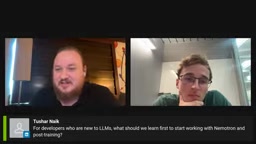
Chris particularly emphasized the value of "vibe testing": among several checkpoints with similar benchmark scores, if one "feels terrible" to use, its actual value is lower. The post-training team's work is precisely to synthesize benchmark data with real-world experience feedback, continuously iterating toward better models.
Starting from the "Soul": How Model Capability Goals Are Defined
On how capability goals are set for a model, Venkat introduced an insightful concept — every model starts from its "soul." Recent Nemotron models have had their souls focused on Agentic capabilities. After defining qualitative capability goals, the second step is quantification: finding public benchmarks that represent those capabilities. The third step is setting quantitative milestones — defining "what number counts as success."
He also acknowledged a danger here: you can't blindly optimize to inflate benchmark scores; you must balance with qualitative feedback from internal and external users. With a clear "soul," the team can prioritize and triage objectives, then allocate GPU resources, data curation effort, and personnel accordingly.
Data Blending: Moving from Art Toward Science
When asked whether the ratio of general to domain-specific data is automated or experience-driven, Venkat believes this is moving from art toward science. The team's goal is to ultimately achieve a "one-click" pipeline: given capability objectives and a data pool, automatically determine the optimal blend.
But the reality is that post-training doesn't start from a blank slate — it builds on a pretrained model, and decisions made during pre-training have real downstream effects. Different base models may therefore need different weightings for different capabilities, and the right balance often has to be "discovered" through iteration. The team currently has some initial starter blends (like Agentic-heavy configurations), but applying them to specific models still requires titrating based on results.
"Making good cookies is easy, but to make truly exceptional cookies, you still need a little craft and magic." This analogy perfectly captures the current state of post-training.
LoRA (Low-Rank Adaptation) is a parameter-efficient fine-tuning method: while keeping the pretrained weight matrix W frozen, it injects the product of two low-rank matrices A and B — ΔW = BA — as a residual update, training only A and B. Since rank r is much smaller than the original dimensionality (typically r=8~64), the number of trainable parameters can be reduced to 0.1%~1% of full fine-tuning, drastically reducing memory usage, making it runnable on ordinary consumer GPUs. The recommendation in this article for beginners to start with Nemotron 3.5 Lightning combined with LoRA is precisely because this combination brings the entry barrier down to what a single mid-to-low-end GPU can handle, while Nemotron's publicly released training recipes are also compatible with LoRA configurations, so developers don't need to design training pipelines from scratch.
Tool Call Loops and Advice for Beginners
On how to prevent models from falling into "degenerate tool loops," Christian said the team uses two approaches simultaneously: penalizing malformed tool calls in RL rewards, and using Nemo Data Designer to generate synthetic data demonstrating "recovery paths" and high-quality tool calls. Additionally, length penalties encourage more efficient responses, and as training progresses, improved efficiency even becomes an emergent property.
For developers looking to get into post-training, Christian's advice is straightforward: start with something you're personally interested in — if you like Minecraft, fine-tune a model that can play Minecraft. Build foundational understanding of SFT, RL types, and data blending along the way. He specifically mentioned that Nemotron has open-sourced its complete post-training recipes, which developers can directly reuse and customize from, dramatically lowering the barrier to entry. Developers with lower-end GPUs can start by experimenting with Nemotron 3.5 Lightning with LoRA.
On whether a single general model or multiple small specialized models is better, Christian believes there's no black-and-white answer: training expert models for a single capability is genuinely simpler, but cross-domain generalization phenomena exist (e.g., training math capabilities may improve Agentic capabilities). At the deployment level, you need to weigh GPU load, the cost of model-switching downtime, and other factors. When the "multi-expert + routing" strategy proves good enough, NVIDIA went ahead and baked it directly into training itself — that's the origin of the Mixture of Experts (MoE) model.
Mixture of Experts (MoE) is a sparse activation architecture: the model is composed of multiple "expert" sub-networks (typically FFN layers), and during each forward pass, a learnable router activates only a small subset of experts (e.g., Top-2) rather than all parameters. The benefits: total parameter count increases substantially (boosting model capacity), while the parameters actually participating in computation for each token remain constant (controlling inference cost). Models like Mixtral and DeepSeek-V3 adopt this architecture. The article's mention of "baking the multi-expert + routing strategy into training itself" refers to the fact that the MoE routing mechanism is jointly optimized with model parameters during the training phase, achieving lower deployment overhead and better expert collaboration than dynamically switching between independent models at inference time.
Conclusion
The core message from this expert conversation is: post-training is the critical link that shapes a large model's real-world usability, relying both on algorithmic innovation (multi-teacher on-policy distillation, reward design) and on deep understanding of data bias. In the Agentic era, training objectives have upgraded from narrow problems like "output well-formed JSON" to the open-ended challenge of "getting the model to complete real work" — and the answers are naturally no longer simple or straightforward. For developers, getting hands-on experience, building intuition, and actively participating in the open-source community may be the best entry point into this field.
Related articles
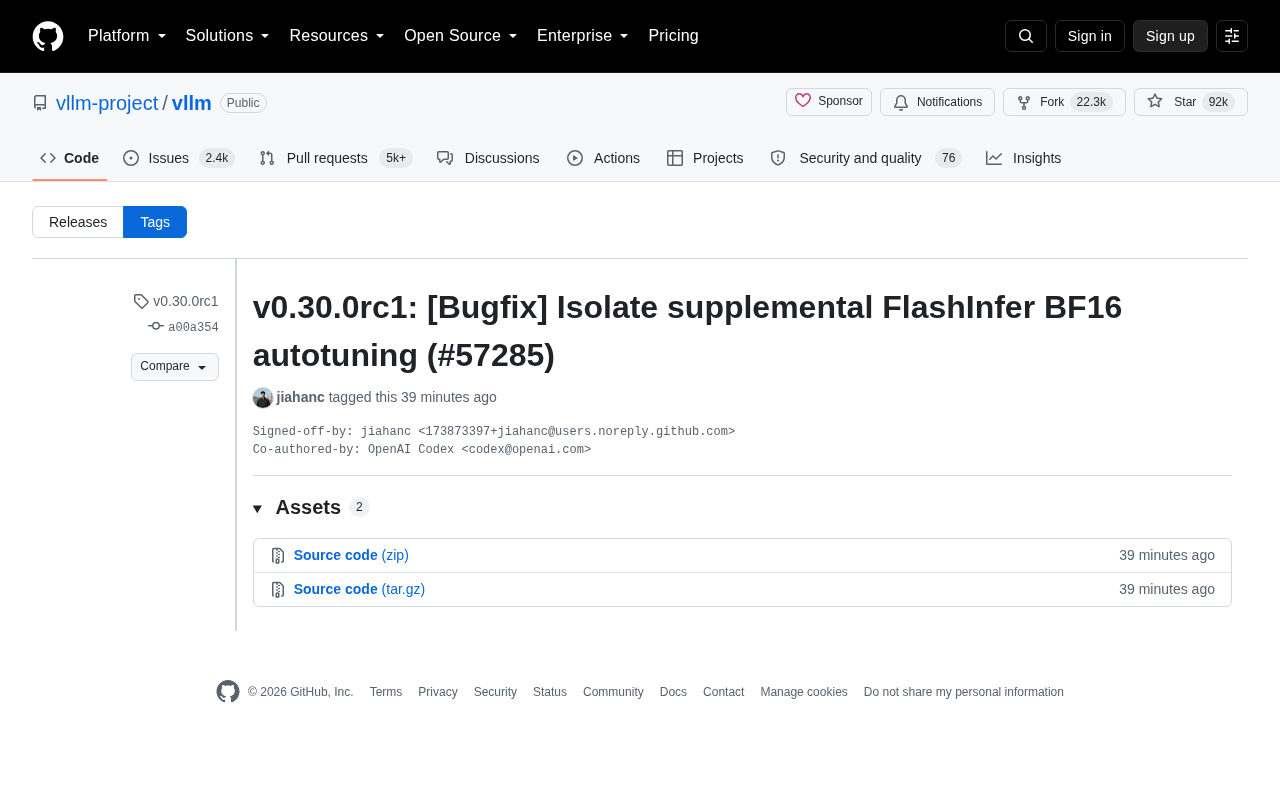
vLLM v0.30.0rc1 Released: Isolates FlashInfer BF16 Autotuning Logic
vLLM v0.30.0rc1 release candidate fixes FlashInfer BF16 autotuning isolation (PR #57285). Learn the technical background and its impact on inference deployment.
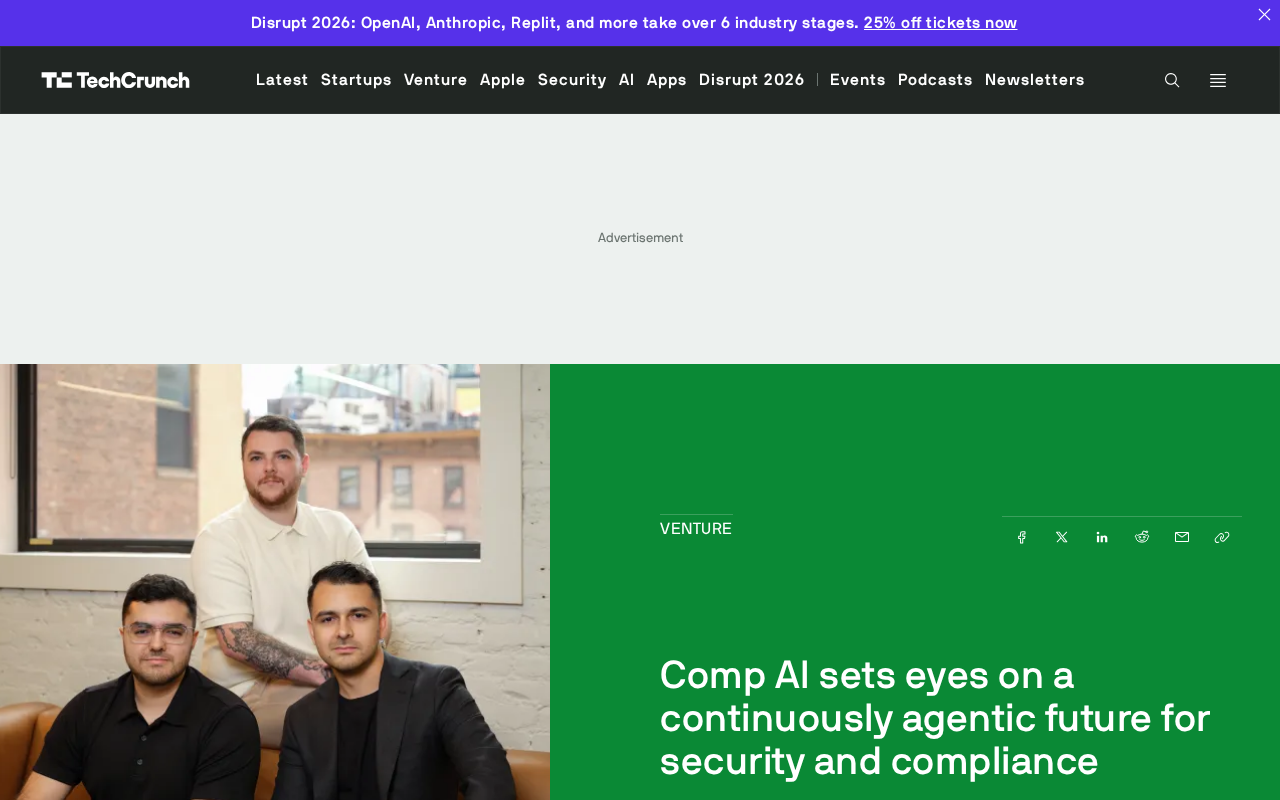
Comp AI Raises $34M Series A, Bets on Agentic Security Compliance
Comp AI raises $34M Series A led by Roo Capital and Grand Ventures, betting on "continuously agentic" AI to transform compliance from periodic audits into real-time monitoring.
MIT Technology Review's 35 Innovators Under 35: A Climate Tech Edition Explained
MIT Technology Review's latest 35 Innovators Under 35 list focuses on climate tech, spotlighting nine young global innovators. Here's what the list means and why it matters.