Deep Dive into Row-Bot's Multi-Agent Orchestration Architecture: Parent-Child Agent Collaboration and Concurrency Control

Row-Bot's parent-child Agent architecture solves multi-agent coordination with concurrency control and state persistence.
This article provides a deep dive into Row-Bot's open-source multi-agent orchestration architecture, examining how parent-child Agent delegation enables controlled collaboration. Key mechanisms include Git worktree-based workspace isolation for concurrent coding Agents, read-write lock patterns for file access, checkpoint-based state persistence for fault recovery, and task priority management distinguishing essential from background work.
Introduction: The Control Challenge of Multi-Agent Collaboration
As AI Agents powered by large language models continue to grow in capability, the bottlenecks of a single Agent handling complex tasks have become increasingly apparent. If research, coding, and review stages are executed sequentially, efficiency suffers; yet simply running multiple Agents in parallel can easily lead to loss of control over the overall task. The open-source project Row-Bot, which recently sparked extensive discussion on Reddit, offers an inspiring solution.
The developer mentioned in their post that the community raised numerous questions about how Row-Bot's "agent orchestration" works, prompting them to publicly share their architectural design. Agent orchestration refers to the systematic approach of coordinating execution order, communication methods, and resource allocation among multiple Agents in a multi-Agent system. This concept draws from Service Orchestration in microservices architecture—where an Orchestrator coordinates the invocation relationships between multiple services to ensure correct execution of business processes. When this pattern is applied to AI Agents, orchestration complexity increases significantly because Agent behavior is non-deterministic: the same input may produce different outputs, execution time is unpredictable, and unexpected side effects may occur. Current mainstream orchestration approaches include LangGraph's graph state machine pattern, CrewAI's role-based division pattern, and AutoGen's conversation-driven pattern. Row-Bot chose a parent-child delegation pattern that leans more toward engineering practice.
The core objective of Row-Bot's architectural design can be summarized in one sentence: Achieve multi-agent collaboration without losing control over the task.
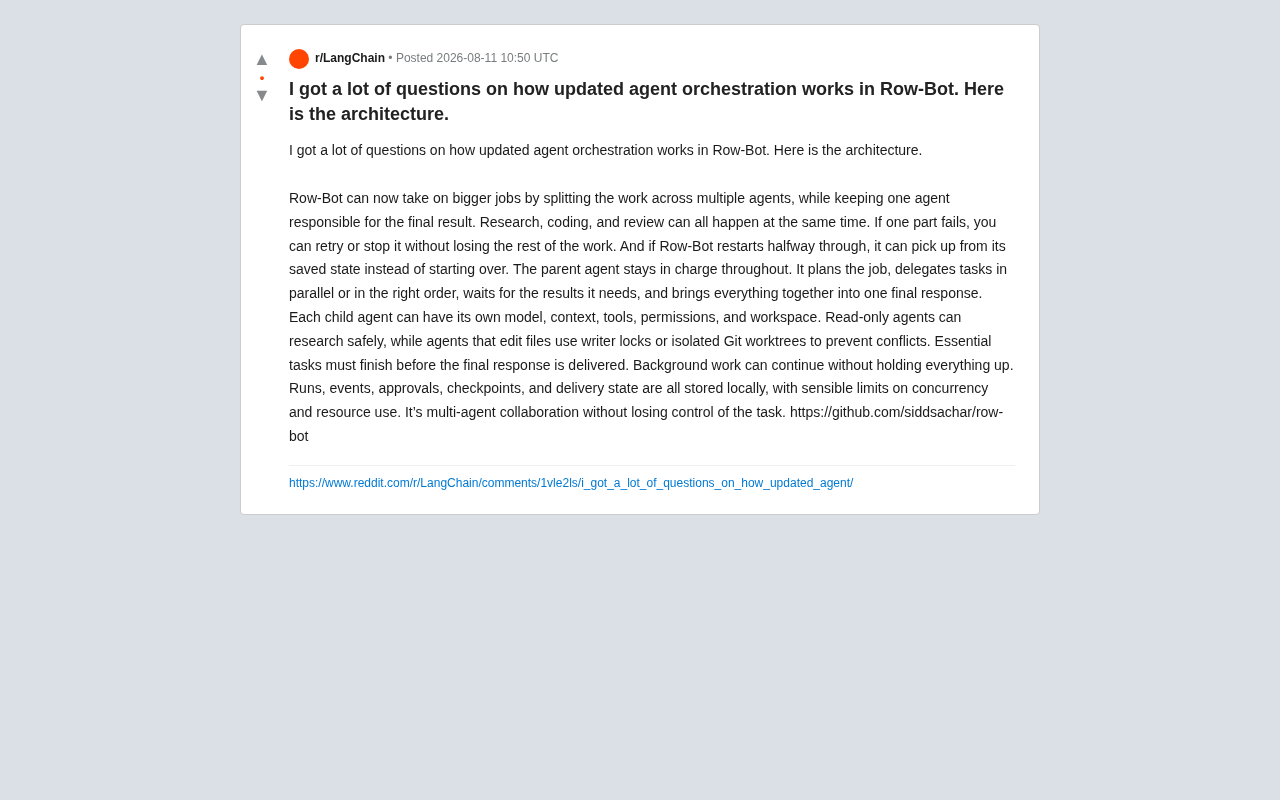
Core Architecture: The Parent-Child Agent Division of Labor
Parent Agent: The Coordinator Who Stays at the Helm
The most critical design decision in Row-Bot's architecture is the introduction of a parent agent that is always responsible for the final result. It doesn't personally complete all the specific work but instead takes on the role of a "project manager":
- Planning tasks: Breaking down a large task into executable subtasks;
- Dispatching and delegating: Deciding which tasks run in parallel and which need to be sequential, based on dependencies;
- Waiting and aggregating: Waiting for critical results to return, then integrating all parts into a unified final response.
The significance of this design is that even when tasks are distributed across multiple Agents, the responsible entity remains clear. Users still receive a coherent result rather than a pile of fragmented outputs that need manual assembly.
Child Agents: Independently Configurable Execution Units
Each child agent can have its own independent model, context, toolset, permissions, and workspace. This fine-grained configuration capability brings several direct benefits:
- Research tasks can be assigned to models that excel at information retrieval;
- Coding tasks can invoke models with code capabilities along with corresponding toolchains;
- Permission isolation ensures each Agent can only access resources within its scope of responsibility.
In other words, Row-Bot doesn't rely on a single "omnipotent Agent" to handle everything—it lets specialized Agents do specialized work. This design also enables cost optimization: simple information-gathering tasks can use cheaper models, while core code generation tasks call upon more capable but more expensive models.
Concurrency Safety Mechanisms: Preventing Agents from Stepping on Each Other
When multiple Agents run simultaneously, the thorniest problem is resource conflicts—especially when multiple Agents need to modify files at the same time. Row-Bot addresses this with an explicit concurrency control mechanism.
Read-Write Separation and Isolation Strategies
The architecture distinguishes between two types of Agent behavior boundaries:
- Read-only agents: Can safely perform research and information gathering without causing any side effects to the workspace;
- Write agents: When an Agent needs to edit files, it uses writer locks or isolated Git worktrees to avoid conflicts.
Writer Lock is a classic synchronization primitive in concurrent programming, part of the Read-Write Lock pattern. Its core rule is: multiple read operations can execute concurrently, but write operations must have exclusive access to the resource—when a writer holds the lock, all other read and write operations must wait. In the database world, this is known as Shared Locks and Exclusive Locks. Row-Bot applies this mechanism to Agent file system access control: multiple research Agents can simultaneously read project files to understand code structure, but when an Agent needs to modify a file, it must first acquire the write lock to ensure that two Agents don't simultaneously modify the same file, which could cause content overwrites or logical inconsistencies. This mechanism is more efficient than a simple Mutex because it allows maximum parallelism for read operations.
The use of Git worktree here is particularly clever. Git worktree is a feature introduced in Git 2.5 that allows users to check out multiple working directories simultaneously within the same Git repository, with each working directory corresponding to a different branch. In traditional Git workflows, switching branches requires stashing current changes or committing, but worktrees completely bypass this limitation. In multi-Agent coding scenarios, the value of this feature is clear: Agent A can modify frontend code in worktree-1 while Agent B modifies backend code in worktree-2—their file systems are completely independent with no write conflicts whatsoever. Once each completes its task, modifications can be integrated into the main branch through Git's merge mechanism. If logical conflicts arise (such as inconsistent interface definitions), the parent Agent steps in to coordinate. Compared to heavier solutions like Docker container isolation, Git worktree has virtually zero overhead and natively supports version rollback. This is a mature engineering practice that has been aptly introduced into the Agent orchestration scenario.
Task Priority: Distinguishing Critical Tasks from Background Work
Row-Bot also distinguishes between task urgency levels:
- Essential tasks must be completed before the final response is delivered;
- Background work can continue without blocking the overall process.
This design strikes a balance between response speed and completeness—users don't have to wait for non-critical finishing touches. For example, code generation and core logic validation are essential tasks, while documentation updates and code style optimization can be completed asynchronously as background tasks.
Fault Tolerance and Recovery: Checkpoint-Based Resume Design with State Persistence
For complex tasks that run over extended periods, stability is often more important than speed. Row-Bot's fault tolerance and recovery design deserves attention.
Local Failures Don't Affect the Whole
When a subtask fails, users can retry or stop that part without losing the rest of the completed work. This fine-grained error handling avoids the terrible experience of "one failure means starting everything over." This design philosophy is similar to task-level fault tolerance in distributed computing frameworks (like how a single Map task failure in MapReduce only requires rescheduling that task), rather than a system-level restart.
Checkpoint Resume and State Recovery
Going further, if Row-Bot restarts mid-task, it can recover from saved state rather than starting from scratch. This relies on a comprehensive state persistence mechanism:
Runs, events, approvals, checkpoints, and delivery state are all stored locally, with reasonable limits on concurrency and resource usage.
State Persistence is a core engineering concern in distributed systems and long-running tasks. The basic idea is: periodically save snapshots of the system's current state to persistent storage, so when the system crashes or is interrupted, it can recover from the most recent snapshot rather than starting from zero. In database systems, this manifests as WAL (Write-Ahead Logging); in stream processing systems like Apache Flink, it manifests as Checkpoints. In AI Agent scenarios, the state that checkpoints need to record is more complex, including: current task execution progress, output results from each child Agent, critical information in context windows, and tool invocation history. Row-Bot stores these states locally rather than in the cloud—a choice that has clear advantages for protecting code privacy (especially in enterprise development scenarios), but also means states cannot be recovered across machines, making it suitable for single-machine development scenarios.
All critical states are saved locally, ensuring both recoverability and a degree of data privacy and controllability. Meanwhile, limits on concurrency and resource usage prevent system overload when multiple Agents run simultaneously.
Architecture Value Analysis: Row-Bot's Positioning and Insights
Row-Bot's architecture doesn't introduce any revolutionary new concepts, but it systematically organizes a series of mature engineering practices—parent-child division of labor, permission isolation, Git worktree, state checkpoints, concurrency control—into an Agent orchestration framework. This is precisely what current multi-agent systems need most: not flashier capabilities, but more reliable control.
From an industry perspective, this type of design reflects a trend in AI Agent development: shifting from "making Agents smarter" to "making Agents more controllable, collaborative, and recoverable." AI Agent development is undergoing a paradigm shift from monolithic to distributed, highly similar to software engineering's evolution from monolithic applications to microservices. The single-Agent autonomous execution hype sparked by AutoGPT in 2023 has gradually faded, as the industry recognized that a single Agent—limited by context window length, single-inference capability, and tool-calling reliability—struggles to independently complete end-to-end complex tasks. Since 2024, projects like Devin, OpenHands, and SWE-Agent have begun exploring multi-Agent collaboration patterns, decomposing complex tasks into multiple specialized subtasks. But multi-Agent systems also introduce new challenges: communication overhead between Agents, result consistency guarantees, and failure propagation control. The industry has not yet formed a unified multi-Agent orchestration standard; Row-Bot, CrewAI, LangGraph, and other projects represent different design philosophies, collectively driving the engineering maturation of this field.
When Agents start taking on real development and research tasks, engineering reliability becomes the key factor determining whether they can be deployed in production.
For developers, Row-Bot as an open-source project provides a reference paradigm. Whether or not you use it directly, the approach of "parent Agent bears overall responsibility + child Agents specialize + isolation prevents conflicts + state is recoverable" offers valuable lessons for building your own multi-Agent systems.
Conclusion
Row-Bot answers the community's questions with a clear architecture: the difficulty of multi-agent collaboration has never been about "getting multiple Agents to work together," but about "how to make them collaborate without losing control." Through parent-child division of labor, concurrency safety mechanisms, and comprehensive state management, Row-Bot demonstrates a pragmatic technical path. For developers focused on bringing AI Agents into production, this project is well worth studying in depth.
Related articles

CSS Anchor Positioning: A New UI Positioning Approach Without JavaScript
A deep dive into CSS Anchor Positioning: from anchor-name and position-anchor to the anchor() function, position-area shorthand, position-try-fallbacks, anchor-size, and upcoming anchor queries.

New AI Chart Interaction: Continuous Follow-up Questions and Visualization in Conversation
Explore a new AI interaction method for continuously generating charts in conversation. Use the /visualize command to ask follow-up questions and visualize answers in the same chat window, improving data analysis efficiency.

Cursor Merges Into X Subscription: Paid Plans Share Unified Usage Pool, Grok Model Coding Usage Doubled
Cursor joins The X Subscription with a unified usage pool and doubled Grok coding quota. Third-party models shift to API pricing. Existing users can keep or migrate plans.