Deep Learning MLOps Tool Survey: The Real Pain Points of Maintaining Models in Production

A developer surveys the ML community to validate production model maintenance pain points before open-sourcing a custom MLOps tool.
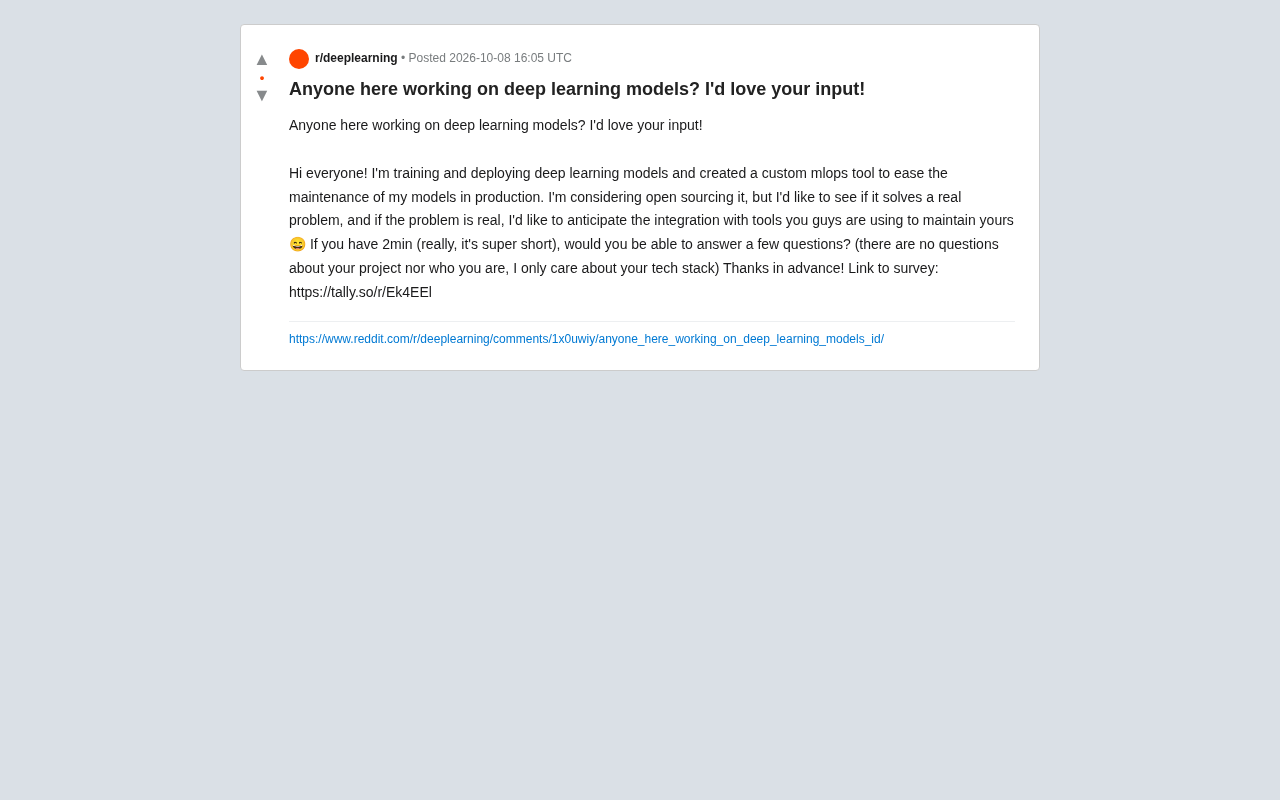
A developer posted on Reddit inviting deep learning practitioners to fill out a brief survey with two goals: validating whether difficulty maintaining models in production is a widespread industry problem, and understanding current tool stacks to plan integrations for a potential open-source MLOps tool. The article uses this as a lens to examine why MLOps teams keep reinventing the wheel, how fragmented tools like MLflow, Kubeflow, and W&B create integration challenges, and why lightweight pre-launch community validation is a smart strategy for any open-source project.
A Survey Invitation from the Developer Community
In a deep learning subreddit, a developer posted a brief survey thread looking to understand the tech stacks used by practitioners who train and deploy deep learning models. The developer mentioned having built a custom MLOps tool to simplify model maintenance in production environments, and is now considering open-sourcing it.
The post was notably restrained — the author explicitly stated that the survey would not ask for any personal or project-related information, focusing solely on the tools people actually use. This approach of validating real-world needs before rushing to promote a product stands out as refreshingly pragmatic in a developer community often saturated with marketing noise.
Why MLOps Tools Keep Reinventing the Wheel
This post reflects a persistent phenomenon in machine learning engineering: nearly every team that takes model deployment seriously eventually ends up building their own operations toolchain. The reason is straightforward — from model training and version management to deployment and live monitoring, every stage may require customization depending on the team's tech stack.
The author highlighted two core motivations worth examining individually:
Validating Whether the Problem Is Real
The developer first wanted to confirm whether "difficulty maintaining models in production" is a widespread industry problem, or just a quirk of their own project. This is a classic early-stage product validation approach — using a low-cost survey to gauge market demand before investing more effort into open-sourcing and maintaining the tool. For anyone considering building an open-source tool, this "validate first, invest later" rhythm is well worth adopting.
Anticipating Integration Requirements with Existing Tools
The second motivation is to understand upfront which tools community members are already using, so that integration can be factored into the design phase. This is especially critical. The MLOps landscape already has a large number of mature or semi-mature tools — MLflow, Kubeflow, Weights & Biases, BentoML, and others. A new tool that cannot integrate smoothly with these existing ecosystems will struggle to gain adoption. The author's awareness of this "integration-first" reality suggests meaningful engineering experience.
MLflow, led by Databricks, is an open-source platform that primarily provides experiment tracking, model registry, and multi-framework packaging — currently one of the most widely used foundational MLOps components. Kubeflow runs machine learning workflows natively on Kubernetes, making it suitable for teams that need large-scale distributed training and pipeline orchestration, though it comes with a steep learning curve. Weights & Biases (W&B) excels at visual experiment tracking and is popular among research communities and fast-iterating product teams. BentoML focuses on packaging and deploying model services, turning trained models into standardized REST API container images. These tools each cover different stages of the MLOps lifecycle, overlapping in functionality yet not fully interchangeable — which is precisely why most teams end up "stitching tools together." Any new tool that can't slot into this existing puzzle with minimal friction is almost certain to be abandoned.
MLOps (Machine Learning Operations) extends DevOps principles to machine learning systems, with the core goal of reliably moving models from the lab into production and sustaining them over time. Unlike traditional software, the "artifacts" of an ML system aren't just code — they also include data, feature processing logic, and model weights. Drift in any one of these can cause silent degradation of live performance. This multi-dimensional variability makes it difficult to simply reuse standard CI/CD toolchains: version control must track both code and data, deployments must account for GPU resource scheduling, and monitoring must cover statistical metrics rather than just service availability. This is precisely why, even with dozens of MLOps platforms on the market, "building your own" remains the norm for many small and mid-sized teams — general-purpose tools rarely fit perfectly against each team's unique model types, inference latency requirements, and infrastructure constraints.
Pre-Launch Validation Is Worth Learning From
This post offers a methodology that's valuable for independent developers and small teams alike: before open-sourcing a tool, spending two minutes conducting a lightweight community survey is far more efficient than spending six months building something no one ends up using.
The author chose a lightweight survey tool like Tally to lower the barrier to participation, and repeatedly emphasized that "it really only takes two minutes." This respect for respondents' time is itself a practical technique for improving survey completion rates. The post neither overstates the tool's capabilities nor includes any commercial links or promotional language, maintaining an overall community-friendly tone.
It's worth noting that due to the limited information in the original post, we cannot determine the specific features, technical implementation, or competitive differentiation of this MLOps tool. The post is fundamentally an early user interview invitation, not a product launch.
Takeaways for MLOps Practitioners
For engineers maintaining deep learning models in production, this type of survey post actually offers an opportunity to reflect on their own workflows: What are your current pain points in model maintenance? Is it difficulty rolling back versions, missing monitoring metrics, or a cumbersome deployment process? The answers to these questions are precisely the benchmarks for evaluating whether a new MLOps tool deserves attention.
If you happen to work in this space, participating in community surveys like this not only helps developers refine their products — it may also lead to the creation of an open-source tool that genuinely solves your problems. The vitality of the open-source ecosystem depends, to a large degree, on exactly this kind of early dialogue between builders and users.
Related articles

Amphibious Transforming Drone: Beyond 100x Power Savings, What Are the Real Needs?
Is the amphibious transforming drone just a gimmick? Starting from the 100x power difference of the M4 Morphobot, explore real application scenarios and thesis topic ideas, analyzing boundary conditions where pure drones and pure ground robots both fail.

Warhound Raises $200 Million: Genetically Engineered "War Dogs" Paired with Anduril Gear
Warhound raises $200M, backed by Ben Lamm and Palmer Luckey, to genetically engineer dogs for military and law enforcement use and equip them with Anduril gear. This article analyzes its technology direction, funding logic, and ethical controversy.

Claude API Comes to Google Cloud: IAM Integration and SDK Access Guide
Anthropic hosts the full Claude API on Google Cloud with IAM-controlled permissions and unified billing. This guide covers the Vertex AI and Anthropic-hosted entry points, IAM role configuration, and SDK access.