Deep Learning on PPI Networks Hits a Compute Bottleneck? A Systematic Evaluation of HPO Strategies

The paper systematically evaluates HPO strategies on PPI networks, offering practical reference for balancing accuracy and time under limited compute.
This article introduces a study published on IEEE Xplore that systematically evaluates different hyperparameter optimization (HPO) strategies on protein-protein interaction (PPI) network graph learning tasks. PPI networks have complex graph structures and high per-training costs, causing HPO overhead to often exceed model training itself. The paper compares the trade-off between training time and prediction accuracy across strategies, noting that the search budget itself should be treated as a hyperparameter and that search space design may affect efficiency more than algorithm choice. It offers practical insights for graph learning practitioners and AI for Science researchers on optimizing HPO pipelines under limited compute.
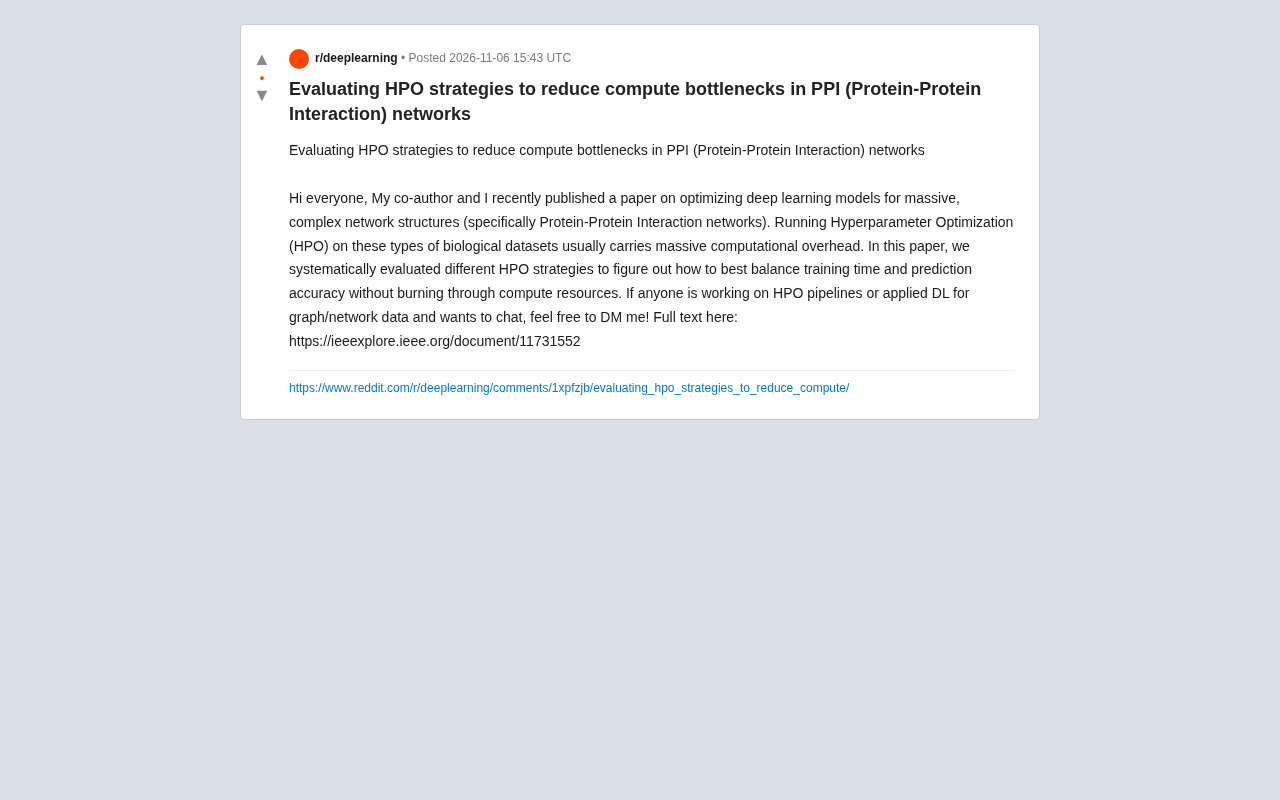
Protein-protein interaction (PPI) networks are a key data resource for understanding cellular mechanisms, disease mechanisms, and drug targets. But when we try to mine this kind of large-scale graph structure with deep learning models, a practical problem quickly emerges: the computational cost of hyperparameter optimization (HPO) is often even more startling than model training itself. Recently, a researcher shared on Reddit a paper published with collaborators that systematically evaluates the performance of different HPO strategies on PPI networks, attempting to answer a very practical question—how to balance training time and prediction accuracy under limited compute.
Why HPO on PPI Networks Is So Expensive
PPI networks are not ordinary tabular data. Nodes represent proteins, edges represent interactions, and the entire graph often contains thousands to tens of thousands of nodes along with complex topological structure. Training graph neural networks or other deep learning models on such data already carries a non-trivial cost for a single forward and backward pass. And HPO requires repeatedly sampling hyperparameter combinations, retraining models, and evaluating validation set performance—every trial is a complete training run.
What makes it worse is that the batching approach and memory access patterns for graph data differ from those for images and text, and GPU utilization is often suboptimal, further lengthening the actual time per trial. The researcher states plainly in the post that running HPO on biological datasets "is usually accompanied by enormous computational overhead," which is precisely the starting point for this systematic evaluation.
Hyperparameter optimization (HPO) refers to the process of searching for parameters that must be set manually before model training and cannot be learned automatically through the training process (such as learning rate, number of network layers, regularization coefficients, etc.). Common strategies include grid search, random search, Bayesian optimization, and successive halving based on early stopping (such as Hyperband). The goal of HPO is to find the hyperparameter combination that optimizes validation set performance within a given budget, but since each set of hyperparameters requires independently training a model, its computational cost is typically several times or even tens of times that of model training itself. In graph data tasks such as PPI networks, this cost is further amplified.
What the Paper Evaluates: A Systematic Comparison at the Strategy Level
According to the original post, this work does not propose a single new algorithm but rather systematically evaluates multiple HPO strategies, observing how they affect the trade-off between training time and prediction accuracy on the same type of PPI network task. This includes the convergence behavior of different search strategies under limited budgets, as well as the computational resources each consumes.
Since the original post does not elaborate on specific methodological details, no excessive inference is made here. But from the positioning of the research, the value of such work lies in providing practical reference: when researchers face a PPI graph learning task, which HPO strategy should they spend their limited compute on, rather than blindly doing grid search or random search. The paper is published on IEEE Xplore, and the complete methodology can be found in the original text.
Graph neural networks (GNNs) are a class of deep learning models specifically designed for graph-structured data, whose core mechanism is to aggregate neighbor node information through message passing to update node representations. In PPI networks, GNNs can capture local interaction patterns between proteins for predicting node attributes or edge relationships. Unlike image or text data, the irregular structure of graph data requires concatenating multiple small graphs or sampling subgraphs during batching, which increases memory access fragmentation and reduces GPU utilization—an important technical reason why HPO takes longer on PPI networks.
Practical Implications for Graph Learning Practitioners
From an engineering perspective, this evaluation conveys several noteworthy signals.
The HPO budget itself is a hyperparameter. On expensive tasks like PPI, the search budget (number of trials, number of training epochs per round, early stopping strategy) directly determines total computational cost. Rather than pursuing exhaustive search, it is better to treat budget allocation as part of the design decision.
Search space design affects efficiency more than the search algorithm. For graph neural networks, hyperparameters such as learning rate, number of layers, hidden dimensions, dropout, and aggregation method are intertwined, resulting in a high-dimensional space. Narrowing down to the few dimensions most sensitive to the task is often more effective than switching to a "smarter" searcher.
Accuracy and time are not linearly related. The goal emphasized in the original post is the "best balance," which means that on some tasks, the accuracy gain from spending several times more compute may be very limited. Finding that inflection point is key to practical deployment.
Search space refers to the set of all hyperparameters to be optimized and their value ranges. For graph neural networks, the search space typically includes learning rate (continuous values), hidden layer dimensions (discrete values), number of layers, dropout rate, aggregation function type (such as mean, sum, attention), etc. A high-dimensional search space exponentially increases search difficulty, and interaction effects between different hyperparameters further exacerbate optimization complexity. Therefore, in expensive tasks such as PPI networks, prioritizing the identification of the few hyperparameters with the greatest impact on performance (i.e., reducing the effective dimensionality) often saves more computational resources than adopting more complex search algorithms.
A Cross-Disciplinary Direction Worth Watching
This work sits at the intersection of bioinformatics and deep learning system optimization. For researchers doing AI for Science, compute bottlenecks are a daily reality; for researchers working on AutoML or HPO methods, PPI networks provide a real high-cost test scenario. At the end of the post, the researcher actively invites those working on HPO pipelines or deep learning on graph data to exchange ideas, indicating that there is still considerable room for such cross-disciplinary dialogue.
If you are working with large-scale graph-structured data and are troubled by the computational overhead of HPO, the evaluation framework in this paper may help you avoid some detours.
AI for Science refers to the research paradigm of applying artificial intelligence methods to the natural sciences (such as biology, chemistry, and physics). In bioinformatics, PPI network analysis is an important approach to understanding disease mechanisms and drug targets, but biological data is large in scale, annotation costs are high, and the computational overhead of model training and hyperparameter search is significant. The core challenge of this cross-disciplinary direction is: how to adapt AutoML/HPO methods to scientific data with complex topological structures under limited compute, while ensuring biological interpretability of results. As a real high-cost test scenario, PPI networks provide a valuable experimental platform for the research and deployment of HPO methods.
Key Points
- HPO on PPI networks is computationally enormous, with each trial being a complete training run
- The paper systematically evaluates the trade-off between training time and prediction accuracy for multiple HPO strategies
- The impact of search budget and search space design on practical efficiency may be greater than that of the search algorithm itself
- The complete paper is available on IEEE Xplore, and the authors welcome exchange with relevant practitioners
One-line Summary
The paper systematically evaluates HPO strategies on PPI networks, providing practical reference for balancing accuracy and time under limited compute.
Paragraph Summary
This article introduces a study published on IEEE Xplore that systematically evaluates the performance of different hyperparameter optimization (HPO) strategies on protein-protein interaction (PPI) network graph learning tasks. PPI networks have complex graph structures and high per-training costs, causing the computational overhead of HPO to often exceed model training itself. The paper compares the trade-off between training time and prediction accuracy for multiple search strategies, and points out that the search budget itself should be treated as a hyperparameter, and that search space design (such as focusing on sensitive dimensions) may affect efficiency more than the choice of search algorithm. The research provides practical insights for graph learning practitioners and AI for Science researchers on optimizing HPO pipelines under limited compute.
Related articles
 Tech Frontiers
Stylome Bot Slammed as Useless Junk: Why Do AI Detection Tools Keep Failing?
Reddit users test the Stylome AI detection bot: Gemini-rewritten text judged human-written, consistently low confidence. An analysis of AI text detection's technical dilemmas, privacy concerns, and credibility crisis in community governance.
 Tech Frontiers
When AI Becomes a Productivity Divide: Clarity or "AI Psychosis"?
A civil engineer's deep use of agentic AI boosted efficiency but bred contempt for peers who refuse to learn. Is this clarity or AI psychosis? An analysis of the cognitive and psychological challenges behind the AI productivity divide.
 Tech Frontiers
Opus 5.5 Benchmark Scores Climb, Community Says Its "Weights Are Blessed"
Reddit community discusses Opus 5.5's rising scores on the Benchmaxxing Bench, with users describing its performance as "weights are blessed." This article interprets the community reaction and cautions against conflating benchmark scores with real capability.