DeepMind Genie 4 World Model Agent Released: Three Years of Dramatic AI Video Change
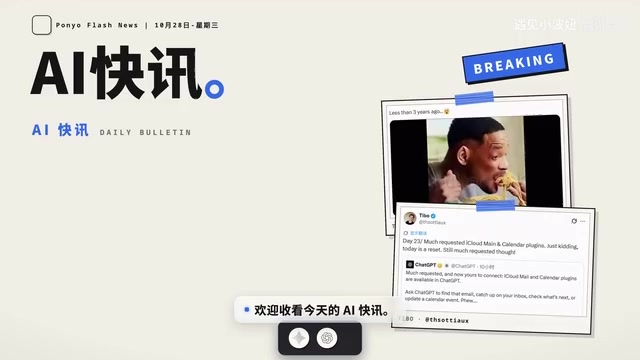
DeepMind embeds Gemini agent into Genie 4 for a closed-loop world model of planning, rendering, validation, and correction, plus robot execution.
According to Bilibili UP host Ponyo, DeepMind's Genie 4 introduces a built-in Gemini agent that forms a plan-render-validate-correct loop, enabling the model to spot and fix glitches on the spot and automating manual debugging. Apollo robot plays checkers without missing a step, showing transfer to embodied intelligence. Same day, ChatGPT resets iCloud email calendar integration, deepening conversational AI in productivity.
Three years ago, a "noodle-eating image" was considered the pinnacle of AI video generation; three years later, the same DeepMind team has changed the game—embedding Gemini into Genie 4, letting the world model plan, render, check, and validate on its own, forming a closed loop. According to Bilibili UP host Ponyo in "Ponyo News | Episode 8", this agent can already "play with robots", and ChatGPT also reset its iCloud email and calendar feature on the same day. From eating noodles to playing checkers, in less than three years, the boundaries of AI video and world model capabilities have been redefined.
Genie 4's Core Upgrade: From Generation to Self-Checking Closed Loop
The Genie series previously gave the impression of "generating interactive video clips", but Genie 4's biggest change is the introduction of a built-in Gemini agent. This agent is not only responsible for generation but also handles the entire process of "planning, rendering, and validation": first planning the scene and action sequence, then rendering the frames, then scoring and checking itself, and immediately correcting any glitches or logical breaks it finds.
This design of "generation as validation" automates the steps that previously required repeated manual debugging. Ponyo describes this process as "one-stop" in the video—from world generation to quality control, the model completes the loop itself. For world models, self-checking capability means that the consistency and physical plausibility of generated content can be systematically improved, rather than relying on random success like drawing cards.
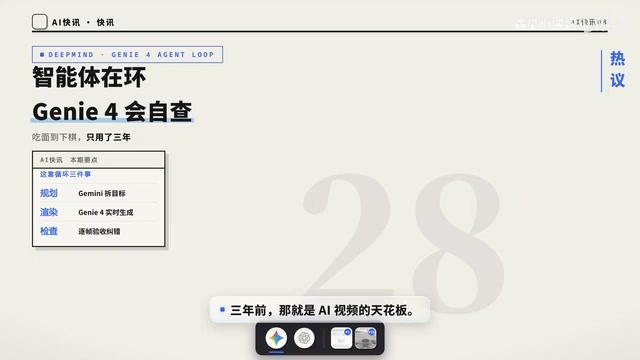
You may not have noticed that this capability is built on Gemini's multimodal understanding. The model needs to "see" the frames it generates, judge what is unreasonable, and then decide whether to re-render. This self-evaluation mechanism is the key difference between Genie 4 and earlier video generation models.
World Model is a core concept in the AI field, referring to a model that learns the dynamic laws of an environment and can internally simulate "if a certain action is taken, how the world will change". Unlike video models that merely generate realistic frames, world models emphasize modeling physical rules, causality, and the consequences of actions, and are therefore often regarded as infrastructure for embodied intelligence and autonomous driving. The Genie series is exactly DeepMind's exploration in the world model direction; early versions could already generate interactive 2D environments from a single image. After Genie 4 introduced the Gemini agent, the world model is no longer just passively rendering but has the ability to actively plan and self-evaluate, moving it from a "video generator" toward an "actionable internal simulator".
World Model Agent: A One-Stop Pipeline for Planning, Rendering, and Validation
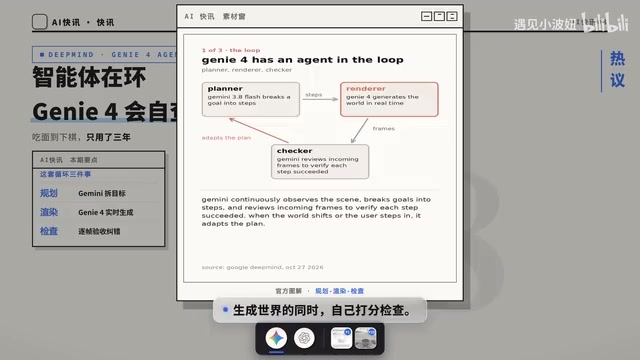
Breaking down Genie 4, its workflow is more like a complete production pipeline:
- Planning stage: the agent generates a scene script and action sequence based on the goal, deciding how the world evolves;
- Rendering stage: the world model outputs the corresponding video/interactive frames;
- Validation stage: Gemini scores the rendered results and detects defects, marking glitches, jumps, or unreasonable elements;
- Correction stage: after problems are found, regeneration is triggered until it passes self-check.
The value of this chain is that it also hands "quality judgment" to the model. In the past, quality evaluation of video generation relied heavily on human eyes, while Genie 4 attempts to use the model itself as a judge, which offers the possibility of large-scale, automated world model training. Ponyo's mention of "fixing glitches on the spot" describes exactly this real-time feedback mechanism.
Agent in the AI context usually refers to a system that can perceive the environment, make autonomous decisions, and take actions to achieve goals. Unlike a single large model call, an agent has capabilities such as task decomposition, tool use, memory, and reflection, and can execute complex processes in multiple steps. The Gemini agent in Genie 4 plays the role of "director + quality inspector": it first plans the scene and actions, then calls the world model to render, and then uses multimodal understanding to score and detect defects in the output, triggering regeneration when problems are found. This "plan-execute-evaluate-correct" loop is a typical paradigm of agent systems and a key technical path for current AI moving from "generating content" to "autonomously completing tasks".
Robot Execution Capability: Apollo Plays Checkers Without Missing a Step
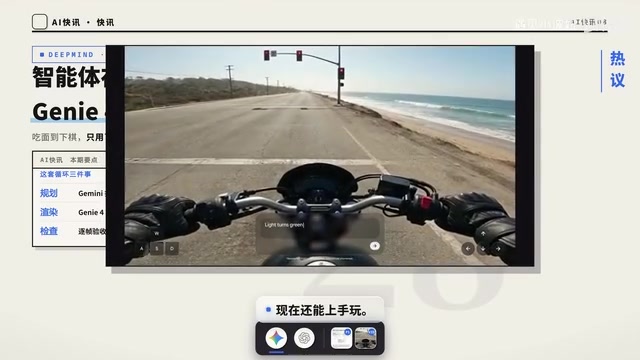
Another demonstration of Genie 4 is robot control. According to the video description, the Apollo robot is "arranged perfectly" and can play checkers and execute instructions without missing a step. This shows that Genie 4 is not just generating video frames; it can also transfer the generated world model capabilities to embodied intelligence scenarios, enabling robots to execute structured tasks in simulated or real environments.
Tasks like checkers may seem simple, but they actually require the model to understand rules, plan steps, and execute precisely. The robot's performance of "not missing a step" suggests that the world model has some reliability in action sequence modeling and long-horizon planning. For embodied intelligence, a world model can serve as the robot's "internal simulator", previewing results before execution, which is consistent with the idea of Genie 4's self-checking loop.
Embodied AI refers to agents that have a physical body and can perceive and interact with the real environment. Unlike pure software AI, embodied intelligence needs to handle challenges such as sensor noise, action errors, and real-time constraints. World models are often used in embodied intelligence as "internal simulators": before executing actions, the robot previews the consequences of different actions in the model, thereby choosing better strategies and reducing trial-and-error costs in the real environment. The demonstration of the Apollo robot playing checkers is essentially verifying whether the world model can transfer structured tasks (understanding rules, planning steps, precise execution) to physical entities. This path is in line with DeepMind's previous work such as RT-2 and PaLM-E, all aiming to let large models drive robots to complete long-horizon tasks.
Same-Day News: ChatGPT Resets iCloud Email and Calendar
Ponyo also mentioned that ChatGPT "rebuilt the iCloud email calendar" on the same day, and related features were launched shortly after. This means ChatGPT is further integrating email and calendar capabilities in personal productivity scenarios and linking with the iCloud ecosystem. Although the video does not elaborate, the word "rebuilt" suggests that this is not a brand-new feature but a redesign or reopening of an existing integration.
Looking at these two pieces of news together, on one side are breakthroughs in world models for generation and embodied intelligence, and on the other is the penetration of conversational AI into personal data management. AI products are moving from "can generate" to "can execute and can manage".
iCloud email and calendar integration refers to third-party AI assistants accessing a user's iCloud email and calendar data through interfaces or authorization mechanisms provided by Apple, thereby enabling functions such as schedule management, email summaries, and event creation. Such integrations usually rely on OAuth authorization or app-specific passwords and are constrained by Apple's privacy policies. ChatGPT "rebuilding" this feature may mean that an integration previously offline or restricted due to interface changes, privacy compliance, or user experience issues has been redesigned and launched. For conversational AI, the key to going deep into personal productivity scenarios is to connect high-frequency data sources such as email, calendars, and documents, so that AI can upgrade from "answering questions" to "performing operations on behalf of users", which is also an important direction of competition among major AI assistants.
Three Years of Change: From the Noodle-Eating Image to Self-Checking World Models
The "noodle-eating image" three years ago represented a milestone in visual realism for AI video generation; Genie 4 three years later represents systematic capability: planning, rendering, validation, and robot execution. Ponyo summarizes this leap as "from eating noodles to playing checkers", behind which is the evolution of models from single-point generation tools into agents with self-checking and execution capabilities.
This change has direct significance for content creation, game development, and robot training. World models are no longer just video generators that "look like" reality, but internal simulation environments that can self-correct and drive robots. Of course, the capabilities shown in the video are still far from a general world model, and the effectiveness of the self-checking mechanism also needs more independent verification. But the direction is clear: the next stop for AI video is world agents that can judge right and wrong on their own.
One-line Summary
DeepMind embeds a Gemini agent into Genie 4, enabling a generation loop of planning, rendering, validation, and correction for the world model, and demonstrates robot execution capabilities.
Paragraph Summary
According to Bilibili UP host Ponyo, the biggest upgrade in DeepMind's Genie 4 is the built-in Gemini agent, forming a "plan-render-validate-correct" loop that allows the model to find glitches and fix them on the spot, automating steps that previously relied on manual debugging. Another demonstration is that the Apollo robot can play checkers and execute instructions without missing a step, indicating that world model capabilities can transfer to embodied intelligence. On the same day, ChatGPT reset its iCloud email and calendar integration, further deepening conversational AI's presence in personal productivity scenarios. The article compares the "noodle-eating image" from three years ago with today's self-checking world model, arguing that AI video is evolving from a single-point generation tool into a world agent capable of self-correction and driving robots.
Related articles

From 0 to 1: Vibe Coding an AI Knowledge Base — A Practical Retrospective and Tech Stack Breakdown
A retrospective on building the AI knowledge base OilBook from scratch with Vibe Coding: Next.js+Neon stack, Oil Dev Skill workflow, Stripe paywall security, interview-style writing, AI-flavor control, and Vercel deployment.

GLM-5.4 Hands-On: Native Vision Meets a New Vibe Coding Workflow
Hands-on with Zhipu GLM-5.4: native vision tested across a 3D product demo, pure-code video generation, and remote-control Vibe Coding, compared with GPT-6.2 and Gemini Neon.

AI and Humans Claim to Prove the Riemann Hypothesis: Machine-Verified, Yet Nobody Can Understand It
Anthropic mathematician and AI Claude claim to prove the Riemann Hypothesis with 17 million lines of Lean code, machine-verified but unreadable by humans. This article analyzes the event, the zero proportion record from 41.6% to 67.2%, and the gap between machine verification and human understanding.