DeepMind Releases Genie 4: World Model Achieves Breakthroughs in Real-Time Interaction and Audio
DeepMind releases Genie 4 world model, adding audio and Gemini collaboration, moving toward interactive simulation.
Google DeepMind has released the Genie 4 world model, achieving breakthroughs over Genie 3 in audio generation, real-time Gemini collaboration, and photorealistic realism. Genie 4 predicts video and audio simultaneously from the same weights, covering ambient sound, music, and in-scene dialogue; it introduces Gemini as an intelligence layer to observe frames and infer user intent, enabling real-time text guidance and NPC reactions; and it significantly improves character dynamics and realism based on the Gemini Omni video foundation. The team summarizes its positioning as moving from "explorable" to "interactive simulation," with robot training and film/TV previsualization as key directions. The current frame rate is about 24-30 FPS, and long-term consistency, real-time safety filtering, and the evaluation system remain unsolved challenges; the product will be offered through Project Genie and will open an API for the first time.
Google DeepMind has officially released the Genie 4 world model. Compared with Genie 3 from earlier this year, this generation has achieved key leaps in audio generation, Gemini real-time collaborative control, and photorealistic realism—the world model is moving from "explorable" toward "interactive simulation."
What Is a World Model: From Language Understanding to Physical Interaction
In the release interview, the DeepMind team offered a clear definition: language models like Gemini are "thinking models" that process knowledge and language, while a world model understands a stateful environment—how the world will change when objects collide, move, or when the user takes an action.
This capability does not rely on a preset physics engine. Even in fantasy scenes never seen before, the model must infer "reasonable physical behavior." The Genie project initially aimed to generate rich game environments to train agents, and later evolved into using world models to continuously generate new simulations, providing environments for AGI training. Genie 1 was purely internal high-risk research, validating only basic interactions such as "move left and right, jump" on 2D platform games; Genie 2 expanded to 3D, but the visuals remained game-like and were not real-time; Genie 3 achieved photorealistic realism, real-time performance, and interactivity for the first time, which the team regards as a research inflection point.
A "stateful environment" means the system records and carries forward everything that has happened before: where the character has walked, whether the cup has been pushed to the edge of the table, which objects the flames have burned through. Unlike language models, which answer each question independently, a world model must infer the next frame at every step based on historical state, which makes "memory" and "consistency" core difficulties. This also explains why the team lists long-term consistency as a frontier problem—once state is lost, the house you see when you turn back may no longer look the same.
The Three Core Upgrades of Genie 4
Audio: The Key Piece That Completes Immersion
The most intuitive change in Genie 4 is the addition of an audio modality. Previously there was only visual output; now the model predicts video and audio simultaneously from the same set of weights. The team compares this to the leap of video generation models from silent to sound—you don't feel anything is missing until you've experienced it, and once you use it, it's hard to go back. Audio includes not only ambient sound and music but also dialogue from characters within the scene, the latter being the most complex and imaginative direction in current research.
Gemini in the Loop: Adding an Intelligence Layer to the World Model
Another structural change in Genie 4 is the introduction of Gemini as an "intelligence layer" working in concert with the diffusion model. Gemini observes what happened in the previous frame, infers the user's intent, and then decides what should happen next. The baseline used in the demo is 3.8 Flash, mainly for real-time considerations; the team has also tested stronger models in experiments to explore the upper limits for robotics and more complex tasks.
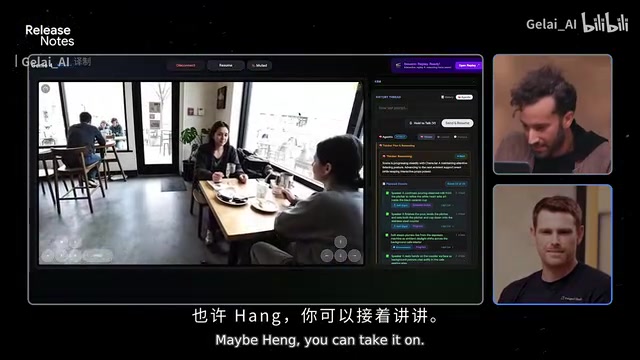
This architecture makes real-time text guidance possible: users can enter text commands while it runs to change the direction of the scene. The demo included interactions such as talking with a barista and picking up a coffee cup, with NPCs reacting to the character's actions in real time. The pause function currently mainly serves research scenarios—the real-time stream is running, and the user needs time to enter commands and hit the right frame—and whether to open it to users is still under evaluation.
A "diffusion model" is a type of generative model that generates images or video from random noise through progressive denoising. It excels at producing pixel-level visual detail but does not itself understand intent or causality. Gemini as an "intelligence layer" fills exactly this gap: it reads frames, understands context, plans what should happen next, and then hands the decision to the diffusion model to "paint" it out. This division of labor is like a director and a cinematographer—one decides the direction of the story, the other is responsible for the visual presentation—and only by combining the two can real-time text guidance and reasonable NPC reactions be supported.
Photorealistic Realism: Built on the Omni Foundation
Genie 4 is built on the Gemini Omni video foundation model, and the improvement in realism is obvious. A commonly reported issue in the Genie 3 era was that people in scenes were rather static and their behavior unnatural; Genie 4 has advanced in character motion, hand details, and the dynamics of multi-person interaction, although it is still some distance from perfection. Real-world data is naturally synchronized in audio and video, which provides ideal supervision signals for training.
The team focuses the interaction paradigm on two categories: first-person navigation (which can be controlled in real time with a keyboard or controller), and camera control. In the first-person demo, the character's coffee-making motions maintained surprising coherence, which is regarded as an important foundation toward robotics applications.

The "Gemini Omni video foundation model" is the base for Genie 4's visual capabilities and can be understood as a foundation model pretrained on large-scale video data with general video generation capabilities. Genie 4 is specially trained for interactivity on top of it, so the improvement in realism does not start from zero but inherits the foundation's priors about lighting, materials, and motion. Real-world video is naturally synchronized in audio and picture, which happens to provide aligned supervision signals for Genie 4 to predict video and audio simultaneously—this is also the technical prerequisite for the smooth addition of the audio modality.
From Exploration to Simulation: Robotics, Film & TV, and Education
The shift in Genie 4's positioning is summarized by the team as "from exploration to simulation"—in the past, users could only walk around in a generated world; now they can perform almost any action and see the world respond.
Robotics is a direction the team repeatedly emphasizes. Humans run a predictive world model in their heads, allowing us to smoothly judge when to contact an object and what will happen after an action. If robots also had such a model, they could approach biological levels of motion in dexterity and agility. In the short term, world models can generate massive amounts of training data at low cost; in the longer term, the model can predict the difference between picking up a heavy cup and a light cup, and the outcome after an object falls, becoming key to generalizing robot skills. In the demo, the team used a stronger model as the instruction layer and Genie 4 to generate pixel-level actions, completing a simulated task in which a robot places letter tiles.
Film, television, and creative production is another clear path. In the previsualization and storyboard stages, creators can quickly turn rough ideas into interactive, rich scenes—put in a dragon, spew flames, adjust the camera position—and the value of this kind of intermediate artifact has already been validated.
Speed, Consistency, and Safety: Unsolved Challenges
Real-time performance is the core engineering challenge of Genie 4. The team revealed that the current frame rate is roughly in the 24 to 30 FPS range. Choosing 24 is not because this is the threshold of human perception, but a compromise between input latency and the generation window—the system needs to interrupt generation at this frequency, incorporate user input, and then immediately generate enough of the next batch of frames to avoid stuttering. When asked "if all TPUs were given to one person, could it run at 60 FPS," team members admitted they had never tried and could not give an answer.
Long-term consistency also has boundaries. Generated scenes used to become blurry after running for a while; today they can maintain clear dynamic imagery for long periods, but memory of world state remains a frontier problem. One path the team envisions is to use code generation (3D structure or game logic) as a low-level state backend, combined with pixel generation—when you leave the hillside and come back, the house is still the same. But the team also stresses that they do not want to sacrifice the expressive power of the world model: a dragon flying over and the whole world turning into a watercolor painting—this degree of freedom is itself valuable.
On safety, all outputs are embedded with SynthID watermarks. A new problem brought by real-time generation is: once photorealistic realism is combined with real-time performance, how do you filter edge content without sacrificing latency? The team's approach includes progressive rollout, inviting trusted testers to give early feedback, and using Gemini's in-the-loop capability to proactively steer scenes in a safe direction rather than simply terminating the session. Different user identities also correspond to different strategies—ordinary users and directors or educators with clear creative purposes have different content boundaries.
The evaluation system is still immature. The team admits that the evaluation criteria for world models have been evolving along with model iterations, and new problem dimensions always emerge. One interesting solution comes from contemporaneous agent research: let agents that can automatically explore game worlds evaluate the worlds generated by Genie.

"SynthID" is a digital watermarking technology developed by Google DeepMind that can embed invisible identifiers directly into the pixels or audio waveforms of generated content. It is imperceptible to the eye and ear, but dedicated detectors can identify it. It solves the traceability problem of "whether this content was generated by AI." However, in a real-time world model, the watermark must be completed with low latency within the generation pipeline, while content safety filtering must also be layered on top; both compete with the frame-rate budget for compute, which is one reason the team emphasizes that real-time safety filtering remains an unsolved challenge.
Availability and Future Directions
Genie 4 will continue to be offered in Project Genie and will be opened through an API for the first time. The team said that important feedback after the previous generation's release was the desire to build applications in more diverse ways, so this generation focuses on opening the API channel. As for how code generation and pixel generation will merge, and what the final form of the open-ended interactive experience will be, the team regards these as open questions at the product level and looks forward to developers providing the answers.
One-line Summary
DeepMind releases the Genie 4 world model, adding audio and Gemini collaboration and moving toward interactive simulation.
Paragraph Summary
Google DeepMind has released the Genie 4 world model, which achieves breakthroughs compared with Genie 3 in three areas: audio generation, real-time Gemini collaboration, and photorealistic realism. Genie 4 predicts video and audio simultaneously from the same set of weights, covering ambient sound, music, and in-scene dialogue; it introduces Gemini as an intelligence layer that observes frame content and infers user intent, making real-time text guidance and real-time NPC reactions possible; and it significantly improves character dynamics and realism based on the Gemini Omni video foundation. The team summarizes its positioning as moving from "explorable" to "interactive simulation," with robot training and film/TV previsualization as key directions. The current frame rate is about 24-30 FPS, and long-term consistency, real-time safety filtering, and the evaluation system remain unsolved challenges. The product will be offered through Project Genie and will open an API for the first time.
Related articles

From 0 to 1: Vibe Coding an AI Knowledge Base — A Practical Retrospective and Tech Stack Breakdown
A retrospective on building the AI knowledge base OilBook from scratch with Vibe Coding: Next.js+Neon stack, Oil Dev Skill workflow, Stripe paywall security, interview-style writing, AI-flavor control, and Vercel deployment.

GLM-5.4 Hands-On: Native Vision Meets a New Vibe Coding Workflow
Hands-on with Zhipu GLM-5.4: native vision tested across a 3D product demo, pure-code video generation, and remote-control Vibe Coding, compared with GPT-6.2 and Gemini Neon.

AI and Humans Claim to Prove the Riemann Hypothesis: Machine-Verified, Yet Nobody Can Understand It
Anthropic mathematician and AI Claude claim to prove the Riemann Hypothesis with 17 million lines of Lean code, machine-verified but unreadable by humans. This article analyzes the event, the zero proportion record from 41.6% to 67.2%, and the gap between machine verification and human understanding.