DeepSeek & Agent 101: Understanding the Core Capabilities of AI Agents

A beginner's guide to AI Agents: four core capabilities and three evolutionary leaps explained.
This article distills a beginner-focused live session on DeepSeek and AI Agents. It explains why native large models fall short — lacking memory, real-time knowledge, internet access, and tool use — and how Agents address these gaps through four roles: Translator, Tool Expert, Memory Steward, and Task Steward. It also traces Agent technology through three evolutionary phases: tool calling, orchestration, and production engineering.
It Started with a Live Stream: Why Everyone Is Learning About Agents
A self-described developer with over a decade of experience — transitioning from Java and Android development — hosted a live stream aimed at complete beginners, covering DeepSeekAd and Agent (intelligent agent) technology. Setting aside the extensive audience engagement tactics and course promotions, the genuinely valuable part of the session was a plain-language breakdown of what Agents are, why they matter, and what problems they solve.
One of the instructor's core arguments is worth noting: the large model application space is in an early "high demand, low supply" phase, similar to the Java and Android booms a decade or so ago. It's an era that favors those who "grind on tech and projects" over those who compete on credentials. While this framing carries an obvious recruitment pitch, it does reflect the real supply-demand dynamics for AI engineering talent.
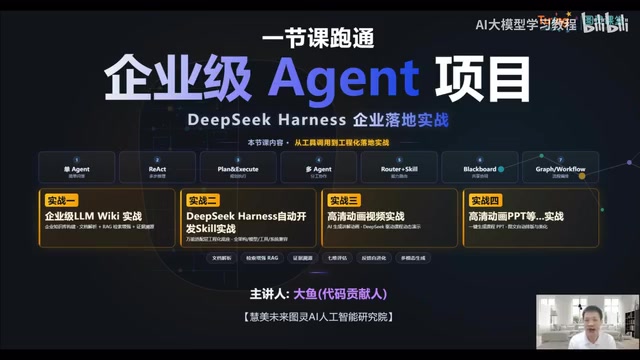
That said, it's worth flagging that phrases like "beats paid courses" and "complete tutorial" in the video title are largely clickbait. The real technical content is concentrated in the conceptual breakdown of Agents — the installation, configuration, and hands-on project sections were not fully covered in this particular session.
What Is an Agent: The "Proxy" of the Large Model Era
The instructor used a vivid analogy to explain Agents: they're like "an interpreter standing between a Chinese speaker and an English speaker," serving as a bridge.
When a user wants to interact with a native large model (like ChatGPT or DeepSeek), most people can't do so directly — you either need to write code or call an API. And even when that's set up, the native model itself has knowledge limitations. An Agent's role is to understand what the user needs, call the appropriate tools, integrate the results, and return a useful response.
In a single sentence: an Agent is the "proxy" of the large model era. It's not the model itself — it's a capability layer built around the model that transforms it from "only able to chat" into "actually able to get things done."
Four Key Limitations of Native Large Models
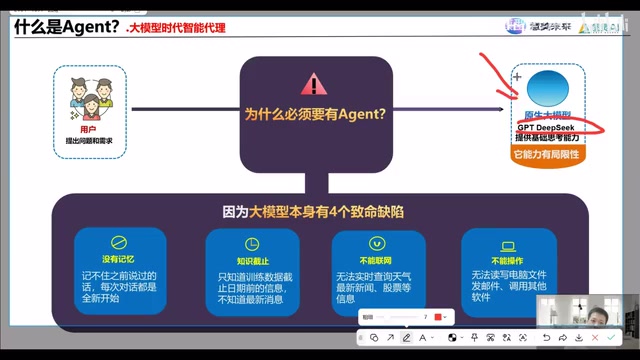
To appreciate what Agents bring to the table, you first need to understand what native large models lack. The instructor outlined several critical shortcomings:
No memory. Native models treat every conversation as independent. By the twelfth turn of a conversation, the model may have already "forgotten" what was said earlier, resulting in a lack of continuity.
Knowledge has a cutoff date. Models only learned from data up to the end of their training period. Ask about tomorrow's weather or the latest policy changes, and they'll often "confidently make things up."
No internet access. Native models don't have real-time retrieval capabilities and can't actively fetch external information.
Can't use local tools. They can't read files on your computer or interact with software applications.
These limitations explain why even native models trained at a cost of tens of millions — by companies like Huawei or iFLYTEK — still require an outer wrapper before they can be deployed in real business scenarios.
Understanding these limitations from a technical standpoint helps clarify the design logic behind Agents. At inference time, a large model is essentially a stateless function: it takes a token sequence as input and produces a token sequence as output, with no information retained between calls — this is the root of the "no memory" problem. The knowledge cutoff issue stems from the nature of pre-training: model parameters are fixed once training ends and cannot update automatically; models like GPT-4 and DeepSeek all have explicit training data cutoff dates. The inability to access the internet or use local tools comes down to the model running in a closed sandbox with no I/O channels for interacting with external systems. These structural constraints make "building an agent layer outside the model — one that can remember, connect to the web, and call tools" an engineering necessity, not an optional enhancement.
The Four Core Problems Agents Solve
In response to these limitations, the instructor organized Agent capabilities into four "steward" roles — the clearest and most logically structured part of the session:
The Translator
The Agent translates what a user expresses in natural language into instructions the large model can understand, then converts the model's output back into a form the user can use. This is the most foundational layer of capability.
The Tool Expert
The Agent enables the large model to call external tools and APIs, giving it the ability to search the web and query data. This transforms the model from "able to talk" to "able to act" — and is the key leap that distinguishes Agents from pure conversational models.
The Memory Steward
The Agent keeps track of context, user preferences, and multi-turn conversation history, allowing the model to remain coherent across extended interactions without "forgetting."
The Task Steward
For complex problems, the Agent can break a large task into smaller steps, plan an execution workflow, and proactively adjust when something goes wrong. This reflects the Agent's capacity for autonomous planning and execution.
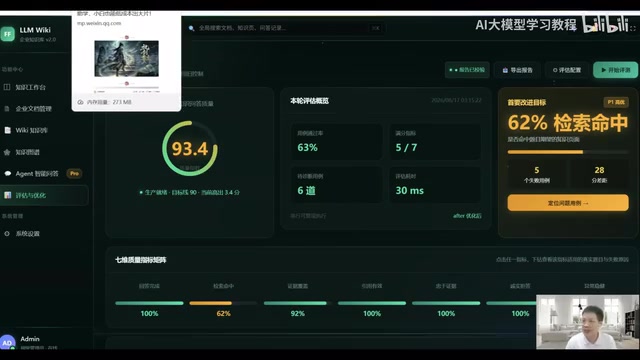
The instructor also pointed out that everyday apps like Doubao and the DeepSeek application are themselves Agents — when you submit a query, it doesn't go directly to the large model. Instead, it first reaches the app's Agent layer, which orchestrates the model through iterative processing before returning the result. Similarly, AI coding tools like Claude Code and Cursor — which can remember project structure, propose solutions, debug code, and verify outputs iteratively — rely on exactly these Agent capabilities: tool calling, memory, and task planning.
Three Evolutionary Leaps in Agent Technology
Toward the end of the session, the instructor introduced a useful framework: Agent technology has gone through three major leaps — from tool calling, to orchestration (programmatic coordination), to production-grade engineering.
This evolution describes the arc from "can work" to "works well" to "can be deployed at scale." Early Agents simply called one or two tools; then came the ability to orchestrate multiple tools and steps; and finally the engineering phase, focused on stability, maintainability, and enterprise deployment. This is the direction in which models like DeepSeek — paired with Agent frameworks — are generating real value in enterprise contexts.
The tool-calling phase refers to early Agents using Function Calling mechanisms, allowing large models to trigger predefined functions during conversation — such as checking the weather or searching the web. Capabilities were limited, but the foundation was laid. The orchestration phase saw the introduction of frameworks like LangChain and LlamaIndex, enabling developers to chain together multiple tools, prompt templates, and model calls into directed workflows, enabling Chain-of-Thought reasoning and multi-step automation. The ReAct (Reasoning + Acting) paradigm also matured during this period, giving Agents a "think → act → observe → re-think" loop. The production engineering phase centers on reliability: how to handle tool call failures, how to constrain "hallucination" behavior, how to deploy within enterprise security and compliance frameworks, and how to distribute complex tasks across specialized sub-agents through multi-agent collaboration architectures like AutoGen and CrewAI. These three phases are not strictly sequential — most mainstream Agent frameworks today incorporate features from the latter two simultaneously.
A Balanced Take: Separate the Signal from the Noise
While the technical content in this session offers real value for beginners, it's heavily mixed with course promotions, "like and follow" nudges, and "claim your free resources" hooks. For learners who genuinely want to get started, a few suggestions:
- Focus on absorbing the conceptual framework around Agents (the four steward roles, the three evolutionary leaps) — this is transferable foundational knowledge;
- Approach claims like "jobs everywhere, talent nowhere" and "historic opportunity" with healthy skepticism, and evaluate them against your own situation;
- Real engineering capability comes from hands-on practice — conceptual explanations are just the starting point.
Agents are the core form through which large models are being deployed in real-world applications today. Understanding their four capabilities — translating intent, calling tools, managing memory, and planning tasks — matters far more than memorizing the steps for any specific tool.
Related articles

Should U.S. College Fraternities Be Banned? A Researcher's Incisive Observations
Why not just ban U.S. college fraternities? A researcher finds the key resistance comes from decision-makers' own fraternity identities and schools' "willful ignorance."

Microsoft Discovery: Accelerating Scientific Discovery with AI Agents
Microsoft's Discovery platform runs specialized AI agents to help researchers screen and prioritize the most promising compounds and experimental paths, reducing experiments and accelerating scientific discovery.

Cambridge Heavy Industries Secretly Develops Desktop-Scale Nuclear Fusion Device
Cambridge Heavy Industries is secretly developing a desktop-scale laser-driven nuclear fusion device, targeting the equipment supply market for fusion power plants. This article analyzes its miniaturization technology path, commercialization logic, and unique positioning in the fusion startup wave.