DeepSeek and Zhipu Race to Build Custom AI Chips: China's Path to AI Compute Independence

DeepSeek and Zhipu AI pursue custom chips as China's AI leaders race toward compute self-sufficiency.
DeepSeek is seeking $7B to develop custom AI inference chips, while Zhipu AI explores ASIC development after a 27x usage surge — signaling a major industry pivot toward compute independence. Meanwhile, Meta, OpenAI, and xAI are rapidly iterating on multimodal generation, AI agents are expanding with new security risks emerging, and AI hardware shipments in China are poised to surpass non-AI products for the first time.
Chinese AI Giants Pivot to Custom Chip Development
One of the most significant signals in the AI industry recently is that leading Chinese large model companies are collectively launching an offensive at the foundational compute layer. According to publicly available information, DeepSeekAd is developing its own AI inference chips and seeking approximately $7 billion in funding. The project remains in early stages, with the core goal of reducing dependence on external compute and controlling inference costs over the long term.
Around the same time, Zhipu AI — after seeing GLM-5.2 usage surge 27x in a single week — began exploring custom ASIC chips for inference scenarios as well, with an estimated development timeline of at least two years. Together, these announcements reveal a clear industry trend: as model inference scales up and daily call volumes explode, compute costs have become an unavoidable pain point for Chinese AI companies.
The logic behind custom inference chips is straightforward. Unlike training chips, which demand extreme generality and peak compute throughput, inference chips can be deeply optimized for specific model architectures. ASICs (Application-Specific Integrated Circuits) deliver far superior energy efficiency and lower per-unit inference costs compared to general-purpose GPUs — for example, by designing dedicated compute units tailored to the attention mechanism and matrix multiplication in Transformer architectures. Google's TPU and Amazon's Inferentia are mature examples of this approach. When model usage grows exponentially, inference costs accumulate continuously at high frequency — at hundreds of millions of daily calls, GPU rental fees can easily consume all gross margin. Even shaving a few percentage points off per-inference cost compounds into massive savings at scale.
Microsoft Is Also Replacing External Dependencies with In-House Models
The drive to cut costs isn't unique to Chinese players. According to recent disclosures, Microsoft is gradually replacing some external models in Copilot with its in-house MAI models, with the stated goal of reducing inference costs and decreasing reliance on external vendors.
This reflects a broader industry consensus: whether at the chip level or the model level, leading players are all trying to control every critical link in the AI infrastructure stack. For years, the competition was about "whose model" and "whose chips" to use. Now the battleground is shifting toward deeper cost structures and supply chain autonomy. For Chinese companies like DeepSeek and Zhipu, building custom chips carries an additional strategic dimension — given uncertainties in external compute supply, owning self-controlled inference capacity is a strategic imperative for long-term competitiveness.
Notably, Synopsys has halted supply of its EES and FDC manufacturing monitoring software, affecting chip manufacturers including Samsung and SK Hynix, with some vendors still working through replacement validation. Ongoing chip supply chain tensions further underscore the case for the in-house development path.
Generative Models in Rapid Iteration: Meta, OpenAI, and xAI All Push Forward
At the application layer, the most active area of updates this cycle has been multimodal generation.
Meta Launches the MUSE Series
Meta released MUSE Image and MUSE Video in a single drop, significantly upgrading both image and video generation capabilities. MUSE Image improves prompt-following and precise editing; MUSE Video supports native audio generation — video and voiceover can be produced together, substantially reducing post-production alignment work.
OpenAI's Voice and Real-Time Capabilities
OpenAI launched GPT Real-Time 2.1 and its Mini variant, real-time voice models now accessible via API. A new caching mechanism reduces P95 latency by at least 25%. Meanwhile, ChatGPT's two-way voice mode was renamed from GPT-BD1 to GPT-Live1, a name that more explicitly signals real-time voice interaction — indicating that voice capabilities are being prepared for full productization.
xAI and Luma Video Upgrades
xAI's Grok Imagine received a video generation update supporting high-quality clips up to 15 seconds, available immediately after updating the Grok app. Luma launched Dream Machine 2.0 Mini, focusing on faster generation speeds and more consistent outputs suited for creative workflows.
Across these updates, a clear direction emerges: video generation is evolving from "can generate" toward "controllable, production-ready, and workflow-integrable," with native audio, prompt adherence, and generation speed becoming the new competitive differentiators.
Agents and Security: Opportunity Meets Risk

There are also multiple developments on the AI agent front. Google added four new capabilities to Gemini API-hosted agents for complex autonomous agent scenarios, covering background tasks, remote MCP, custom functions, and credential refresh. Remote MCP support is particularly significant — MCP (Model Context Protocol) is an open standard proposed by Anthropic that functions like a universal USB interface for AI agents, providing a unified protocol layer for accessing external resources such as databases, APIs, and file systems, eliminating the fragmentation of each application building its own integration. Developers can deploy custom MCP servers remotely and let cloud-hosted agents call private tools and data via a standardized protocol — a major capability for building enterprise-grade autonomous agents. Anthropic extended the free trial period for Claude Fable 5 to cover multiple paid user tiers, after which usage-based billing will apply uniformly.
Additionally, the open-source toolkit Office CLI opened up to AI agents, enabling direct read/write access to Word, Excel, and PowerPoint documents with support for rendering, inspection, and repair workflows, as well as integration with tools like Claude Code — providing a standardized interface for agents to operate on office documents.
But expanded agent capabilities also introduce new security risks. Security firm Sysdig disclosed the first AI agent-assisted ransomware attack, dubbed "Jade Puffer". Unlike traditional ransomware that relies on fixed attack scripts, AI agent-assisted attacks can dynamically generate attack paths based on the target environment, automating and adapting infiltration, lateral movement, and data encryption in ways that make rule-based defenses far less effective. It's worth noting that humans still select targets, build infrastructure, and provide initial credentials — AI plays the role of an "advanced automation layer" rather than an autonomous decision-maker. This signals that future cybersecurity confrontations will evolve from "rule vs. rule" to "agent vs. agent," and reminds us that the core risk of agent security lies in defining the boundaries of potential misuse.
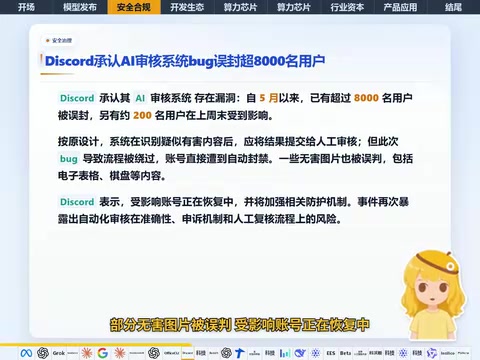
Elsewhere, Discord acknowledged a vulnerability in its AI moderation system that resulted in more than 8,000 users being wrongfully banned, with affected accounts being restored. Reddit is using AI to combat AI-generated spam, with its upgraded system intercepting approximately 23 million spam items per day. AI is simultaneously the source of content governance problems and the solution — a duality that is especially evident in this cycle of developments.
Chinese Companies Accelerate AI Deployment and Commercialization
Domestic AI application deployment has entered an intensive phase. Tencent's Hunyuan-3 is now available on OpenRouter, vLLM, and the Kilo platform. WeChat AI mini-programs plan to increase quotas to 1 billion tokens and 100,000 image generations. Alipay's AI open platform has launched, giving merchants access to capabilities that can reach approximately 1 billion users.
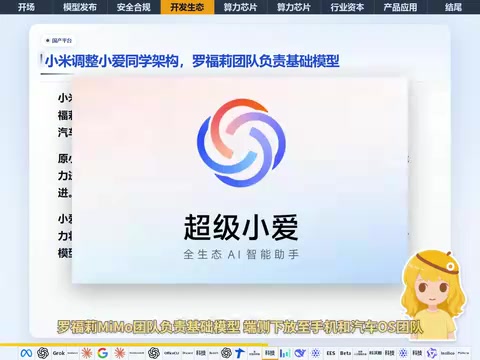
Xiaomi restructured Xiao Ai (小爱同学) by separating the cloud-based foundation model layer (managed by the MiMo team) from on-device capabilities, which have been delegated to the phone and automotive OS teams. This "cloud-based large model + lightweight on-device model" layered architecture is the dominant engineering paradigm for AI deployment today: cloud models (typically tens to hundreds of billions of parameters) handle computation-intensive tasks like complex semantic understanding; on-device small models (quantized to 1B–7B parameters via INT4/INT8) handle low-latency scenarios like local wake word detection and offline command responses, while avoiding compliance risks associated with uploading private data. This architecture maintains user experience while significantly reducing cloud inference costs — a necessary path for AI integration in IoT scenarios like smartphones, vehicles, and smart home devices.
On commercialization results, the "Lingxi Outfit Large Model" launched by Anta Group in partnership with Volcano Engine shows compelling early metrics: online conversion rates improved by over 10%, and return rates dropped by over 10%. These quantified outcomes demonstrate that AI can deliver tangible commercial value in vertical retail scenarios — far beyond proof-of-concept.
AI Hardware Boom: Shipments on Track to Surpass Non-AI Products for the First Time
Signals from the hardware side are equally worth watching. Data shows that combined shipments of AI smartphones and AI PCs in China have surpassed 100 million units, with AI terminal sales on track to exceed non-AI products for the first time — a landmark inflection point. AI terminals typically refer to smart devices with built-in NPUs (Neural Processing Units) that support local model inference and offer continuous learning or personalization capabilities. The significance of this milestone is comparable to 2007, when smartphone shipments overtook feature phones: as the distribution channel for AI capabilities shifts from cloud APIs to the hardware itself, the competitive dynamics among chip makers, OEMs, and software ecosystems will be fundamentally reshaped, and deep integration between large model vendors and device manufacturers will become the key path to reaching users and accumulating proprietary data.
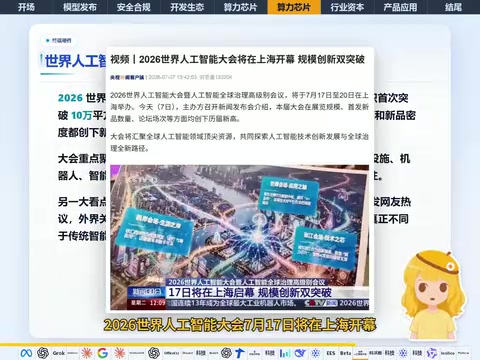
At the upcoming 2026 World Artificial Intelligence Conference (WAIC), the world's first AI agent phone will make its debut, alongside the Huawei Atlas 950. Ecovacs announced its first open-source robot, "G-Series," priced at ¥49,999 and targeting developers and research/education markets, with full-stack programmability.
From consumer AI smartphones to developer-oriented open-source robots, the AI hardware product spectrum is expanding rapidly. This aligns with data showing that AI and robotics companies now account for more than half of China's newly minted unicorns — the industry's center of gravity is accelerating its shift from software applications toward deep technology hardware.
Conclusion
Three main threads run through this cycle of developments. First, from DeepSeek and Zhipu to Microsoft, leading players are pushing down to the chip and model infrastructure layers to cut costs and build self-sufficiency. Second, multimodal generative models have entered an intensive iteration period, with video and voice becoming the primary battlegrounds. Third, AI is moving from software to hardware and from tools to agents — bringing with it rising challenges in security and governance. These three threads interweave to paint a clear picture of an AI industry deepening from "competing on models" to "competing on infrastructure, deployment, and cost efficiency."
Key Takeaways
Related articles

Meta vs. Publishers: The AI Data Battle Over Terms of Service Changes and the Future of the Internet
Meta changed its business account terms to allow AI training on linked website data, sparking backlash from publishers and creators. Industry groups demanded negotiations, forcing Meta to remove 'training' wording and delay the effective date. The dispute reveals the deeper battle over data authorization and the future of the internet in the AI era.

When Outside Xbox Meets Blood on the Clocktower: A Legion Match in Minecraft
Outside Xbox guests Ellen and Mike play Minecraft Blood on the Clocktower in a Legion game. How can three good players fight an evil majority amid information noise? This article breaks down Legion mechanics, information-role mind games, and the endgame reversal.

Kimi K3.1 Hands-On Test: Open-Source Model Nears Opus, Video Generation Steals the Show
Kimi K3.1 completed motion graphics, 3D rendering, mini-games, and video generation in a live test. Analysis of its 2.8T MoE architecture, gap vs Opus/GPT, and hidden video generation.