DeepSeek API Price Hike of 3x: Can It Still Undercut Every Coding Plan?

DeepSeek API prices rise ~3x with new peak/off-peak billing, eroding its cost advantage over competitors.
DeepSeek has announced a shift to peak and off-peak API pricing starting August 17, effectively tripling costs during business hours. The move erodes its legendary cost advantage — at the new price point, many Coding Plans offering Claude and GPT-4 access become cheaper. V4 Pro's benchmark improvements appear modest, and the price hike likely reflects a strategic decision to reallocate GPU compute from inference to training next-gen models.
DeepSeek's Price Adjustment: From Cost-Performance King to Competitive Pressure
August 14 was a bittersweet day for DeepSeekAd: on one hand, the official release of DeepSeek V4 Pro was completed; on the other, the company announced that starting August 17, its API would shift to a "peak and off-peak" pricing model. According to preliminary estimates by Bilibili creator 鱼天 (Yutian), this billing change is expected to raise overall DeepSeek API pricing by roughly 3x.
For developers and entrepreneurs who have long relied on DeepSeek's low-cost API, this is undoubtedly a heavy blow. DeepSeek had previously leveraged its extreme cost-performance ratio to essentially "slay" every mainstream large model on the market. Now, that advantage is being significantly eroded.
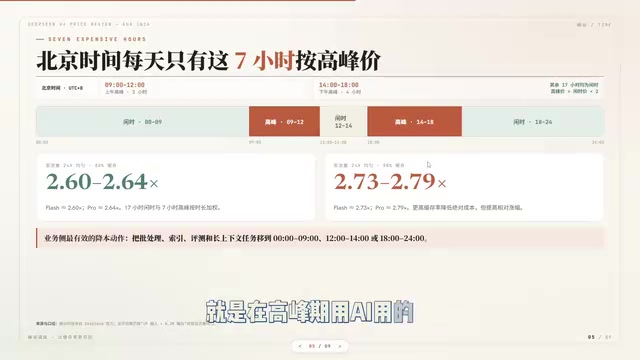
Peak and Off-Peak Billing Rules Explained: Up to 4x During Peak Hours
According to DeepSeek's official pricing reference, the new billing model will distinguish between "peak" and "off-peak" periods. The specific rules are roughly as follows:
- Peak periods: Beijing time 9 AM to 12 PM and 2 PM to 6 PM — API calls during these work-hour windows will cost approximately 4x the original price;
- Standard periods: Billing will be roughly 2x the old price;
- 24-hour continuous usage: If you call the API around the clock without distinguishing time slots, the overall price lands at approximately 2.6x to 2.8x.
Time-of-Use Pricing is not an AI industry invention — it originated as a classic pricing strategy from the electricity industry. Grid operators have long used peak and off-peak electricity rates to balance supply and demand — raising prices during peak hours to suppress demand and lowering them during off-peak hours to encourage consumption. In cloud computing, AWS, Google Cloud, and others have long offered similar mechanisms like Spot Instances and Reserved Instances. DeepSeek's introduction of this model to large model API pricing fundamentally reflects the fact that GPU inference resources, much like electricity, exhibit pronounced supply-demand fluctuations: request volumes surge during working hours, pushing GPU utilization near capacity, while late-night hours see significant idle capacity. Theoretically, using price signals to guide users toward off-peak usage can improve overall resource utilization. However, for ToC (consumer-facing) application developers who must respond to user requests during business hours, the off-peak discount is essentially inaccessible.
Since most developers concentrate their AI usage precisely during peak hours, the effective overall multiplier they experience will fall between 3x and 3.2x. This means that for real-world business scenarios, "3x price increase" is far from alarmist — it's quite close to the actual experience.
DeepSeek API Price Comparison: Cost-Performance Ranking Drops Significantly
A before-and-after comparison tells the story most clearly. Below is a horizontal comparison of DeepSeek under both old and new billing models against other Coding Plans.
In the billing system for large model APIs, a Token is the most fundamental unit of measurement. One token corresponds to roughly 1-2 Chinese characters or about 4 English characters. When a large model processes a user request, it must calculate both input tokens (the user's prompt) and output tokens (the model's generated response). These are typically priced differently, with output tokens often costing 2-4x more than input tokens because the generation process requires sequential token-by-token decoding, making it computationally more expensive. "Per million tokens" has become the industry-standard billing unit, similar to how the telecom industry charges per MB/GB. Taking ¥0.15 per million tokens as an example, generating a 2,000-character article consumes roughly 3,000-4,000 tokens, costing less than ¥0.001 — seemingly negligible, but for enterprise applications with millions of daily API calls, costs accumulate rapidly to substantial amounts.
Under the old model, DeepSeek's price of approximately ¥0.05 per million tokens essentially crushed every other large model on the market — virtually unbeatable. After the peak/off-peak adjustment, this price has risen to approximately ¥0.15 per million tokens.
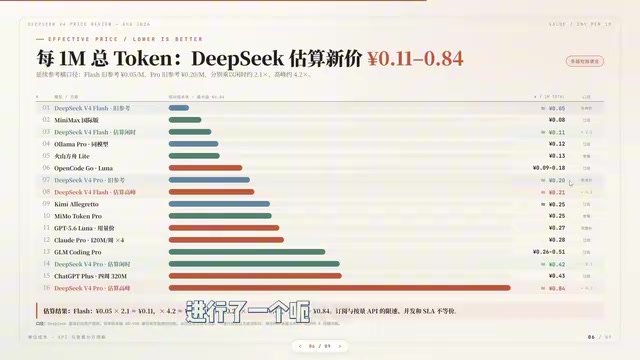
At the new ¥0.15 per million tokens price point, things shift subtly — this price range already buys access to some quite capable third-party models, and can even reach Claude's higher-tier models. Coding Plans are a subscription service model for AI programming assistants that has emerged in recent years. AI coding tools like Cursor, Windsurf, and GitHub Copilot typically offer monthly subscription packages where users pay a fixed fee to make heavy use of underlying large models for code generation, completion, debugging, and more within their quota. These Coding Plans are essentially "middlemen" between users and large model APIs — platforms secure volume discounts on API quotas and resell them to end users in subscription bundles. Due to intense competition, the effective per-unit price of many Coding Plans has been driven extremely low. After DeepSeek's API price increase, its per-unit cost may actually exceed the cost of indirectly calling Claude, GPT-4, and other models through Coding Plans. In other words, DeepSeek's once-proud absolute price advantage is being chipped away by competitors.
DeepSeek V4 Pro Official Pricing: The ¥0.6 Range Raises Concerns
Even more noteworthy is the pricing for the official DeepSeek V4 Pro release. If its original price of roughly ¥0.2 triples to the ¥0.6 range, that would be a staggering figure. Analysis suggests that at the ~¥0.6 multiplier, virtually every Coding Plan on the market would offer cheaper API call pricing than DeepSeek V4 Pro's new billing.
For reference, subscribing to ChatGPT Plus and using Claude's higher-tier models costs approximately ¥0.43 per million tokens. Claude is a large language model series developed by Anthropic, renowned for its safety, long-context processing capabilities, and code generation quality. Claude's product line is tiered by capability into Haiku (lightweight and fast), Sonnet (balanced), and Opus (flagship), with Claude Opus 4.x representing Anthropic's most premium model version — performing at the industry's cutting edge in complex reasoning, code writing, and long-document comprehension. Anthropic was founded by former OpenAI Research VP Dario Amodei and has received massive investments from giants like Amazon and Google, with cumulative funding exceeding $10 billion. By comparison, paying 1.5x the price for a model that arguably "doesn't match" the competition naturally puts a dent in DeepSeek's competitiveness.
DeepSeek V4 Pro Capability Assessment: Does the Progress Meet Expectations?
Beyond pricing, V4 Pro's actual capabilities are also a market focal point. In official materials, DeepSeek V4 Pro is positioned as being "roughly on par" with Claude Opus 4.x.
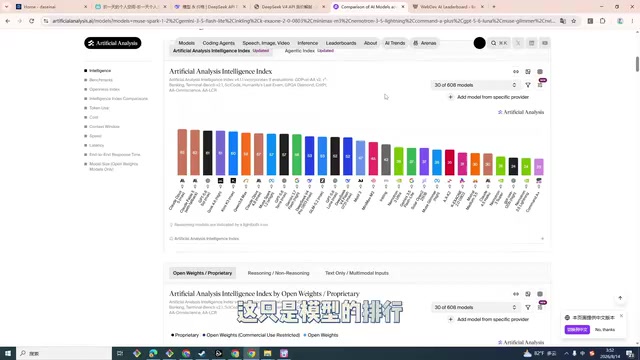
However, according to leaderboard data from third-party evaluation organization Artificial Analysis, V4 Pro's improvement margin wasn't that dramatic — scores only rose from 52 to 53, a mere 1-point difference. Artificial Analysis is an independent third-party AI model evaluation platform dedicated to providing objective, standardized benchmark testing for large models. Its scoring system comprehensively considers model performance across multiple dimensions, including but not limited to: general knowledge Q&A (MMLU), mathematical reasoning (MATH/GSM8K), code generation (HumanEval/MBPP), instruction-following ability, and inference speed. While a 1-point gap at the top of the leaderboard might signify meaningful improvements on specific tasks, it could also simply be statistical noise. No single evaluation system can fully capture a model's performance in real-world business scenarios, which is why the article emphasizes the need to observe real-world effectiveness when paired with the Harness toolchain.
That said, this data deserves a rational perspective. Leaderboards only reflect a model's raw capabilities, and whether actual usage combined with DeepSeek's new Harness (agent framework/toolchain) can yield further capability improvements remains unclear. In the large model ecosystem, Harness typically refers to the agent framework and tool-calling chain built around a foundation model. A bare large model can only perform text generation, but through a Harness, the model can be endowed with the ability to call external tools — such as executing code, searching the internet, reading and writing files, operating databases, and more. This "scaffolding" layer can often dramatically amplify a model's practical utility. In programming scenarios, for example, a model equipped with a well-built Harness can automatically run code, detect errors, and iteratively fix them — its final output quality may far exceed what bare-model benchmark scores can reflect. OpenAI's Function Calling, Anthropic's Tool Use, and open-source community projects like LangChain and AutoGen all fall under the broad Harness umbrella. If DeepSeek can release a high-quality native Harness, it could partially bridge the gap in raw benchmark scores. This is also something many users are eager to see validated.
The Logic Behind the Price Hike: Shifting Compute Toward Training
Why did DeepSeek choose this moment to raise prices? A reasonable interpretation is that DeepSeek's compute priorities are likely still focused on training the next generation of models. If massive numbers of users aggressively call the API, it consumes precious inference compute resources, which in turn squeezes training resources.
One of the core resource bottlenecks facing large model companies is the zero-sum game between training compute and inference compute. Training refers to the process of optimizing model parameters using massive data and computational resources, typically requiring thousands of high-end GPUs (such as NVIDIA H100/H200) running continuously for weeks or even months, costing hundreds of millions of dollars. Inference is the process where, after training is complete, the model responds to real-time user requests. While the computational load per individual request is far less than training, when concurrent request volumes reach the millions, the total GPU demand is equally staggering. For a company like DeepSeek that simultaneously handles R&D and service delivery, every single GPU faces the choice of "should it be used to train the next-generation stronger model, or to serve current users." This dilemma is even more pronounced against the backdrop of global GPU supply constraints — particularly U.S. export controls on chip sales to China.
From this perspective, the price increase is both a commercial adjustment and a strategic compute allocation decision — using the price lever to suppress excessive inference demand and free up capacity for new model development. This logic holds universal relevance for any AI company that simultaneously handles both training and inference workloads.
Conclusion: Is DeepSeek Still Worth Using After the Price Hike?
Overall, this price adjustment doesn't mean DeepSeek is "completely unusable" — rather, its cost-performance advantage relative to competitors has been noticeably weakened. For price-sensitive developers, the range of viable alternatives is expanding.
It's worth noting: if API prices do go up, might DeepSeek launch its own Coding Plan subscription package? Additionally, by subscribing to third-party packages like OpenCode, users can still get decent price reductions after the increase, so fears of "no more affordable DeepSeek" are largely unwarranted.
Ultimately, whether DeepSeek can maintain its market reputation and whether V4 Pro's real-world capabilities can deliver on official promises still requires time and more real-world scenario testing. For the broader user base, maintaining rational expectations is perhaps the best attitude for now.
Related articles

Automate Job Search with AI Agents and Residential Proxies for Precise Matching
Build an AI Agent with MCP and residential proxies to bypass recruitment site anti-scraping and geo-restrictions, scrape thousands of DevOps jobs, then have Claude score and rank each against your resume. Includes proxy comparison experiments, project structure, and cost analysis—filtering only, no auto-submission.

The AI Task Assistant That Knows When to Back Off: A Cure for Activation Struggles
One Small Step is an AI assistant for task initiation struggles, using agentic decisions for guilt-free reminders, timely retreat, and cross-platform task management. The developer shares real test results on 13 tasks and architectural trade-offs.

FastAPI: A High-Performance Python Framework and a Production-Ready API Development Powerhouse
FastAPI is a high-performance web framework based on Python type hints, supporting async and automatic OpenAPI docs. With over 100k GitHub stars, this article analyzes its core strengths, production readiness, and selection advice.