DeepSeek Coder Deep Dive: How This Open-Source Code LLM Outperforms GPT-4

DeepSeek Coder is the first open-source code LLM to surpass GPT-4 Turbo, powered by MoE architecture and 128K context.
DeepSeek Coder is a fully open-source, Apache 2.0 licensed code LLM from DeepSeek AI. Its V2 release introduces a 236B MoE architecture that activates only 21B parameters per inference, a 128K context window, support for 338 programming languages, and a 90.2% HumanEval pass rate — making it the first open-source model to outperform GPT-4 Turbo on code benchmarks.
What Is DeepSeek Coder
DeepSeek Coder is a fully open-source, code-specialized large language model built by the DeepSeek AI team, designed specifically for software development workflows. Unlike conventional code completion tools, it functions more like an intelligent development partner that understands developer intent — covering everything from requirements analysis and code generation to unit testing and deployment.
Several key design decisions are worth noting. First, its training data composition: 87% code corpus + 13% mixed Chinese/English natural language. This ratio isn't arbitrary — it reflects years of accumulated best practices in code LLM research. Early pure-code models (like the original Codex) often struggled to accurately interpret natural language requirements, while too much natural language diluted the model's understanding of code syntax, runtime semantics, and engineering dependencies. The 13% natural language ratio strikes the right balance between instruction comprehension and code specialization, enabling the model to interpret vague requests like "write me a distributed lock" while generating production-quality implementation code. Second, the model weights are fully open-source under the Apache 2.0 license — one of the most permissive open-source licenses available, allowing free use, modification, and distribution, including in commercial products, with no requirement to open-source derivative works. Unlike GPL's "copyleft" requirements, Apache 2.0 only requires retaining original copyright notices and license text. For enterprise users, this means DeepSeek Coder can be integrated into proprietary products or SaaS services without IP concerns, with no restrictions on commercial use.

Notably, DeepSeek Coder is built on DeepSeek Math as its foundation — a base LLM trained specifically for mathematical reasoning, achieving strong results on benchmarks like MATH and GSM8K. Its core training strategies include large-scale math corpus pretraining, reinforcement learning fine-tuning with a Process Reward Model (PRM), and targeted reinforcement of chain-of-thought (CoT) reasoning.
Understanding the Process Reward Model helps explain the source of DeepSeek Coder's reasoning capabilities: traditional RL typically rewards only the final answer (outcome reward model), while a PRM scores each intermediate reasoning step, guiding the model to learn "step-by-step correct derivation" rather than "accidentally arriving at the right answer." This training approach is especially effective for tasks requiring multi-step rigorous reasoning — such as mathematical proofs and algorithm design — and is the fundamental reason DeepSeek Coder demonstrates stronger logical rigor when implementing complex algorithms involving numerical optimization, probability calculations, and matrix operations. Chain-of-thought training further reinforces the model's habit of "analyzing before concluding," making it more robust in code debugging and edge case analysis.
Version Evolution: Architectural Leap from V1 to V2
V1: Three Model Sizes Covering the Full Compute Spectrum
DeepSeek Coder V1 offers three parameter sizes — 1.3B, 6.7B, and 33B — covering everything from edge devices to cloud servers. This tiered design ensures both resource-constrained individual developers and performance-demanding enterprise teams can find a suitable version.
On performance, the 33B Instruct variant achieves a 79.3% pass rate on HumanEval Python code generation benchmarks, surpassing GPT-3.5 Turbo. HumanEval, released by OpenAI, contains 164 Python programming problems evaluated using the "pass@k" metric — pass@1 means the model passes on the first attempt, while pass@10 allows up to 10 attempts. It has become the industry standard for comparing code LLMs. This version was trained on 2 trillion tokens of high-quality code, supports over 80 programming languages, and features a 16K context window — sufficient for large files or entire small projects. For individual developers, the 1.3B and 6.7B versions can run on a single consumer GPU with minimal setup.
V2: A Cost Revolution Through MoE Architecture
The headline feature of V2 is the introduction of Mixture of Experts (MoE) architecture. MoE is a sparsely activated neural network architecture — unlike traditional dense models that activate all parameters on every inference pass, MoE uses a learnable "Gating Network" to dynamically select a small subset of "Expert Layers" for each input token, while the remaining experts stay inactive and consume no compute. Google's Switch Transformer and Mistral's Mixtral use similar approaches. DeepSeek Coder V2 has 236B total parameters, but only 21B are activated during inference, achieving true sparse computation.
Designing the gating network is one of MoE's core challenges. Early MoE implementations often suffered from "expert collapse" — the gating network tended to repeatedly select the same few experts, leaving most expert layers undertrained and wasting parameters. DeepSeek V2 addresses this with an Auxiliary Loss mechanism that constrains expert load balancing, forcing the gating network to distribute activation frequencies evenly across experts during training. This ensures each group of expert layers within the 236B total develops specialized knowledge for specific input types (Python syntax, SQL queries, mathematical expressions) rather than redundant overlaps. This fine-grained specialization is the deep reason why MoE models can match dense large models on code generation tasks with far fewer activated parameters.
Understanding this from an engineering perspective: large model deployment costs split into training (one-time) and inference (ongoing). Every user request consumes GPU compute. For a dense 236B model, each inference requires matrix operations across dozens of high-end GPUs — extremely costly. MoE's gating mechanism compresses this to the equivalent of a 21B model, multiplying the number of concurrent users serviceable within a given hardware budget. This is a core technical reason why DeepSeek can offer API services at extremely low prices.

Beyond the architectural upgrade, V2 brings several other important improvements:
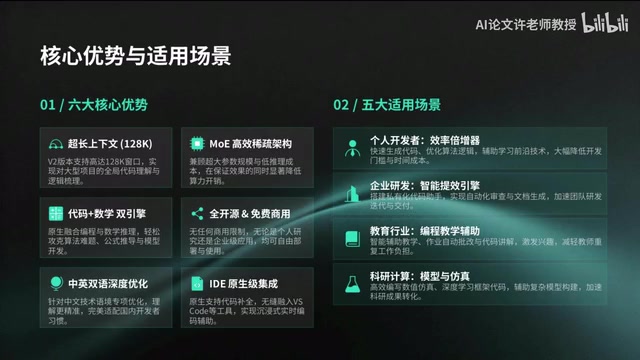
- Context window extended to 128K: 128K tokens is roughly 100,000 English words, accommodating thousands of lines of code or an entire mid-sized codebase. In practice, this means developers performing global refactors, cross-file dependency analysis, or large-scale code reviews no longer need to manually split files before sending them to the model, significantly reducing comprehension errors caused by lost context. This capability relies on RoPE positional encoding extension and Flash Attention. RoPE (Rotary Position Embedding) encodes relative position relationships via rotation matrices, offering better length generalization than absolute position encoding. Flash Attention reduces attention mechanism memory usage from O(n²) to near-linear through block computation and IO optimization, making ultra-long sequence processing feasible within limited VRAM;
- Support for 338 programming languages, dramatically expanding scenario coverage;
- HumanEval pass rate reaches 90.2%, with leading results on MBPP (Mostly Basic Python Problems, introduced by Google Research, covering ~500 entry-level Python programming problems to evaluate basic programming task comprehension and generation) — the first open-source code model to surpass GPT-4 Turbo, setting a new performance ceiling for open-source code LLMs.
Core Capabilities: Dual Engines for Code and Math
Code Generation and Engineering Assistance
DeepSeek Coder's intelligent generation and completion capabilities span everything from single lines and functions to full project-level code output. It can generate code directly from natural language descriptions or comments. Its Fill-in-the-Middle (FIM) capability is particularly well-suited for real-time IDE completion. The FIM training paradigm works by randomly splitting code snippets into prefix, middle, and suffix segments during pretraining, enabling the model to predict missing middle code based on surrounding context — a much better fit for real development scenarios than simple autoregressive continuation.
The implementation of FIM goes deeper than simply reordering training samples. Researchers found that if the model is trained naively with "prefix + suffix → middle," it tends to ignore the suffix and degrade to ordinary autoregressive continuation. DeepSeek Coder uses both SPM (Suffix-Prefix-Middle) and PSM (Prefix-Suffix-Middle) interleaved formats during training, with special tokens (e.g., <|fim▁begin|>, <|fim▁hole|>, <|fim▁end|>) to explicitly mark prefix, suffix, and fill positions — forcing the model to genuinely "read bidirectionally" during generation. This training detail enables DeepSeek Coder to more accurately perceive function signatures, variable scopes, and calling conventions in IDE completion scenarios, rather than naively continuing from whatever precedes the cursor. This is a key reason its completion quality outperforms same-parameter autoregressive models.
For debugging and repair, it can automatically identify syntax errors, logic bugs, and memory leaks, suggest fixes, and perform batch security vulnerability scanning and patching. Additional capabilities include unit test generation, API documentation writing, README output, code refactoring, performance optimization, and cross-language translation — significantly reducing repetitive engineering work.
Deep Integration of Algorithms and Mathematics
Thanks to its native connection with DeepSeek Math, DeepSeek Coder demonstrates rigorous logic when handling complex mathematical derivations, numerical simulations, and machine learning algorithms, providing reliable support for research and engineering computation.
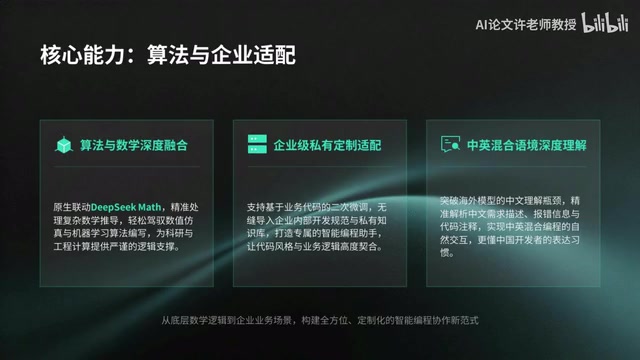
For enterprise users, DeepSeek Coder supports fine-tuning with proprietary business code, development standards, and knowledge bases. It also has deep optimization for Chinese requirements, Chinese error messages, and Chinese comments, with excellent support for mixed Chinese-English programming — perfectly aligned with the habits of Chinese-speaking developers.
Two Deployment Options: Cloud API vs. Local Private Deployment
Cloud API: Zero-Ops Quick Integration
With cloud API access, developers can use the model's inference capabilities without managing GPU infrastructure. The API is fully compatible with OpenAI standards — just an API key and a few lines of Python are all you need to get started. This compatibility means existing GPT-4 integrations can switch to DeepSeek Coder by changing just the base_url and model parameters, with near-zero migration cost. Multiple model versions are supported for flexible switching based on precision and compute requirements.
Local Deployment: Free and Data-Sovereign
Local open-source deployment offers three practical advantages:
- Completely free — no API usage fees, highly cost-effective for long-term use;
- Data privacy guaranteed — the model and data run entirely within your own environment, code never leaves the internal network, making it ideal for finance, healthcare, defense, and other industries with strict data compliance requirements;
- Low hardware barrier — the 6.7B version runs smoothly on consumer GPUs like the RTX 3090 or 4090, no expensive server clusters needed. For further VRAM reduction, 4-bit quantization via GGUF format with llama.cpp compresses the 6.7B model's VRAM footprint to around 5GB, enabling it to run on a standard workstation with 16GB VRAM.
A brief note on quantization: 4-bit quantization compresses model weights from 32-bit or 16-bit floating point to 4-bit integer representation, theoretically reducing model size and VRAM usage by 4× to 8×. The trade-off is precision loss — quantized models must dequantize 4-bit integers back to floating point during inference, introducing rounding errors. For code generation tasks, 4-bit quantization typically causes a 1–3% drop in HumanEval pass rate, which is negligible for most everyday development assistance scenarios. The GGUF format (defined by the llama.cpp project) further supports mixed-precision quantization — retaining higher bit-width for precision-sensitive layers (such as Query/Key matrices in attention layers) while applying more aggressive compression to less sensitive layers, achieving a better balance between VRAM efficiency and output quality.
With Hugging Face Transformers, just a few lines of code are needed to get up and running — an ideal choice combining efficiency and control.
Comparisons and Use Cases
Among open-source models, DeepSeek Coder outperforms CodeLlama and WizardCoder on both HumanEval and MBPP core code generation benchmarks, generating more accurate code with stronger logical rigor.
Compared to closed-source solutions, the V2 236B version is the first open-source code LLM to surpass GPT-4 Turbo on authoritative code benchmarks — particularly excelling in complex code generation and mathematical reasoning scenarios. This marks a turning point where open-source code LLMs can compete head-to-head with top closed-source solutions, offering the global developer community a more efficient and economical intelligent programming option.
In terms of use cases, DeepSeek Coder covers the full spectrum from learning to enterprise development to research: individual developers can use it for rapid code generation and algorithm optimization; enterprise teams can build private code assistants or automate code review; educational institutions can use it for automated grading and teaching assistance; and research scenarios can leverage it for numerical simulation and deep learning modeling.
Summary
DeepSeek Coder's value goes beyond its benchmark scores over GPT-4 Turbo — more importantly, it delivers this capability to the entire developer community in an open-source, free, commercially usable form. The MoE architecture compresses the inference cost of 236B parameters to the equivalent of 21B through the gating network's sparse activation and expert load-balancing training, fundamentally addressing the cost problem of large model inference. The 128K ultra-long context window, enabled by RoPE positional encoding extension and Flash Attention, makes it capable of handling real-world project-scale tasks. The SPM/PSM dual-mode FIM training paradigm gives it genuine bidirectional context awareness for completion rather than simple continuation. And the process reward model-enhanced mathematical reasoning engine makes it more reliable in algorithm-intensive scenarios. For teams that prioritize data security, cost control, and deep reliance on Chinese-language development environments, DeepSeek Coder is a highly competitive choice.
Related articles
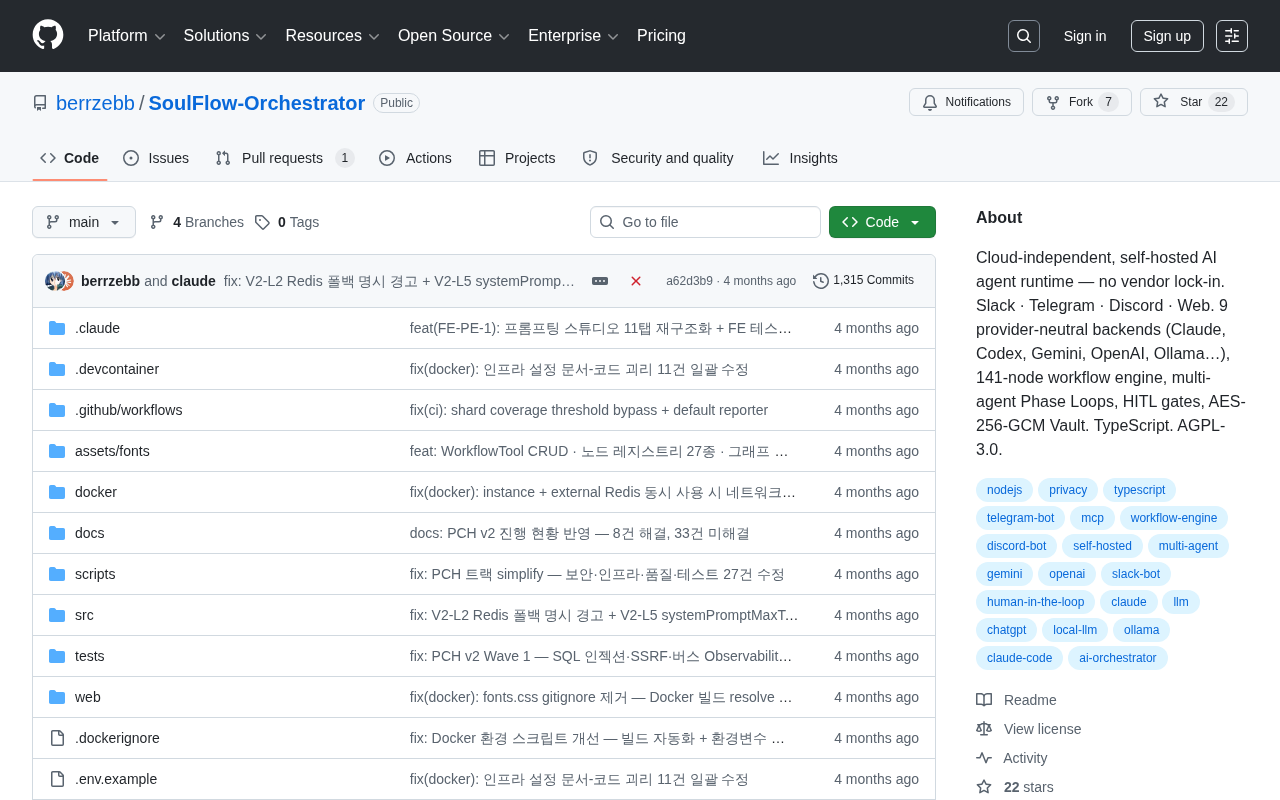
SoulFlow-Orchestrator: A Self-Hosted, Vendor-Lock-In-Free AI Agent Runtime
SoulFlow-Orchestrator is an open-source, self-hosted AI agent runtime with no vendor lock-in. Supports 9 neutral backends (Claude, OpenAI, Ollama), 141-node workflow engine, multi-agent loops, and HITL gates.
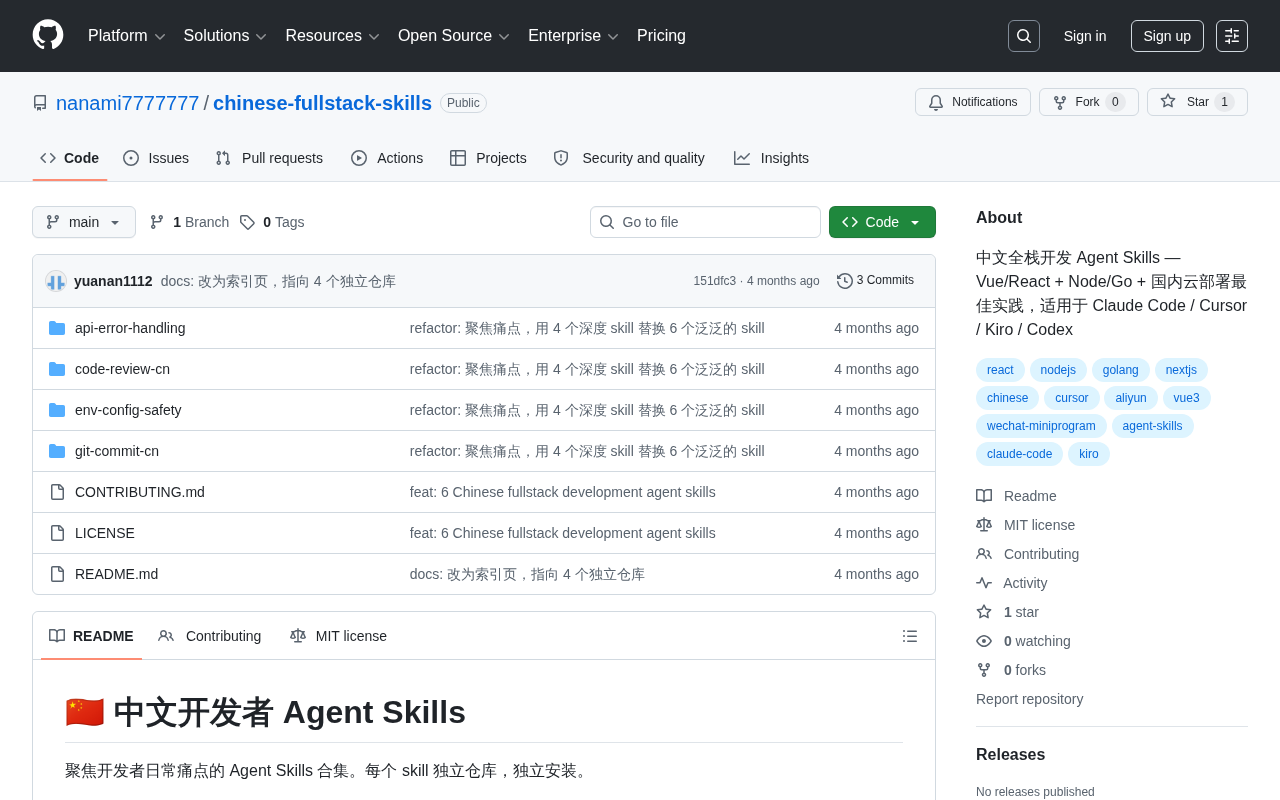
Chinese Full-Stack Agent Skills: A Skill Library Tailored for Domestic AI-Assisted Development
chinese-fullstack-skills is an Agent Skills library for Chinese full-stack development, covering Vue/React, Node/Go, and domestic cloud deployment best practices. Compatible with Claude Code, Cursor, Kiro, and Codex.
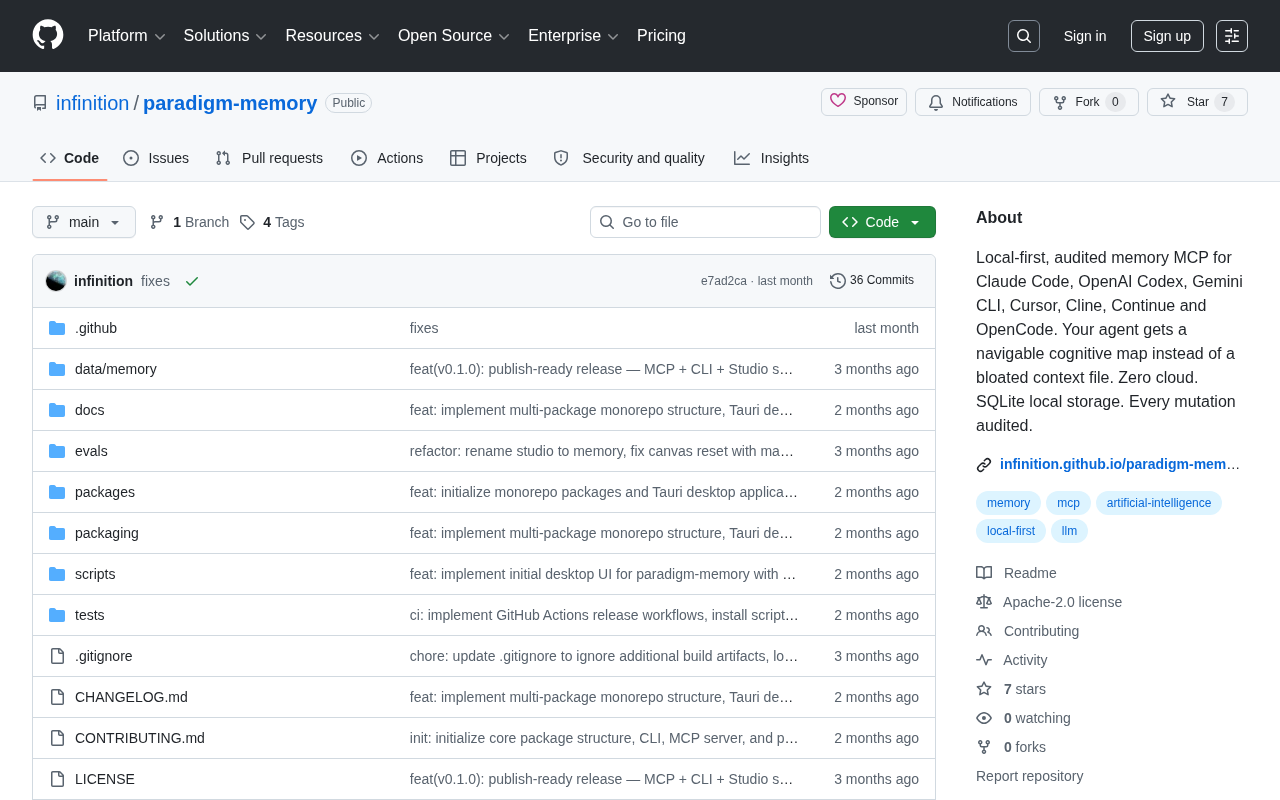
Paradigm Memory: A Local-First Memory System for AI Coding Assistants
paradigm-memory is a local MCP memory tool for Claude Code, Cursor, and Cline. It uses SQLite local storage, zero cloud, full audit trails, and a navigable cognitive map instead of bloated context files.